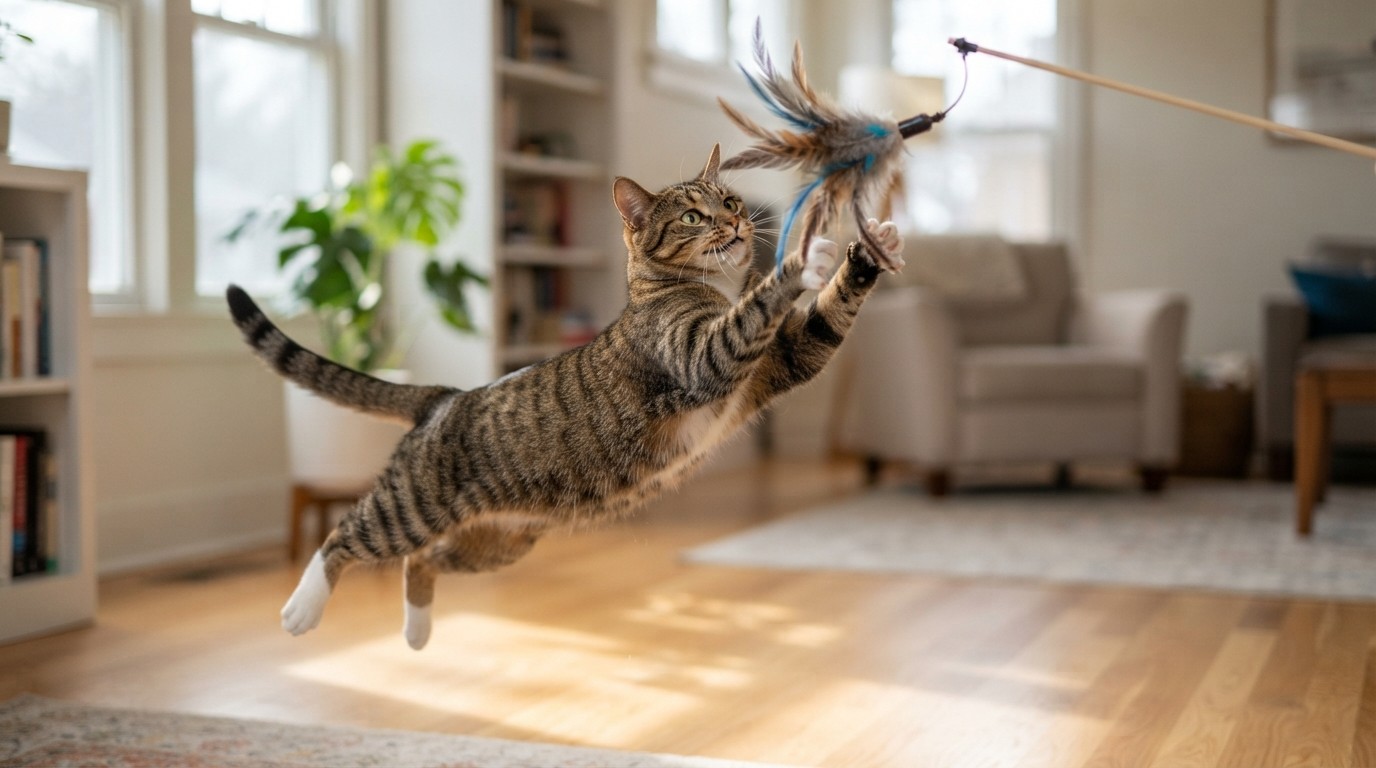
Most healthy adult indoor cats do well with about 30 to 45 minutes of interactive play per day, split into two or three short sessions of 10 to 15 minutes. Kittens and young cats often need more — up to an hour in several bursts — while seniors usually prefer shorter, gentler games. The total matters less than the pattern: short hunts that end with a small meal, spread across the day, match how cats are built to live.
If your cat zooms around at 3 a.m., attacks ankles from under the coffee table, or is slowly gaining weight despite eating the same food, playtime is one of the first things to fix. It’s also one of the easiest fixes. You need a wand toy, a few minutes with your phone put down, and a little know-how about thinking like prey.
Here’s how much play your cat needs at each age, how to run a satisfying session, and the mistakes that leave cats bored in homes full of toys.
Key Takeaways
- Most adult indoor cats thrive on 30 to 45 minutes of interactive play a day, split into two or three sessions of 10 to 15 minutes.
- Play should copy a hunt: stalk, chase, catch, then eat. Always let your cat win sometimes, and end with a small meal or snack.
- You moving the toy is the point. A pile of toys on the floor is not a substitute for interactive play with you.
- A 10 to 15 minute session before bed, followed by food, is the best fix most families have for the 3 a.m. zoomies.
Playtime by Age
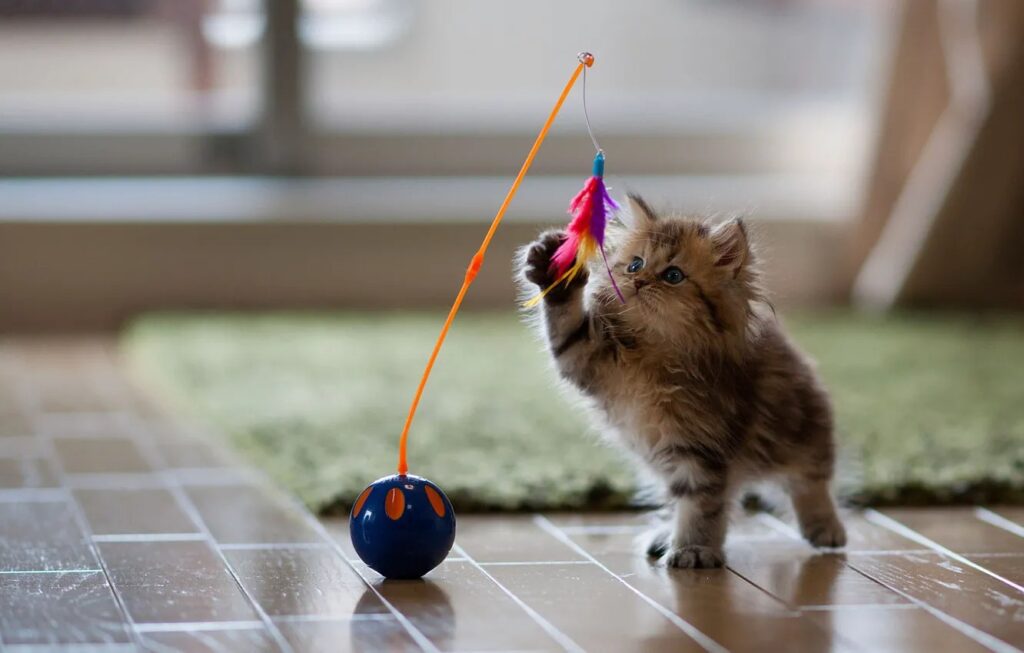
- Kittens (under 6 months): Lots of short bursts throughout the day, often totaling 60 minutes or more. Play is how kittens learn coordination, bite control, and how to be a cat, and they burn off enormous energy doing it. Let the kitten set the pace and rest when she wants.
- Young adults (6 months to 3 years): Usually the most demanding group. Aim for 30 to 45 minutes daily, and expect some cats — looking at you, Bengals and Abyssinians — to happily take more in the evening.
- Adults (3 to 10 years): About 30 minutes a day in two or three sessions keeps most cats fit, calm, and out of trouble.
- Seniors (10+ years): Shorter, slower sessions — even five gentle minutes twice a day is valuable. Play supports muscle, joints, and mood, but watch for stiffness or tiring quickly, and keep the toy low so there’s less jumping.
These are starting points, not rules carved in stone. A cat who walks away mid-session has had enough, even if you’re only six minutes in. A cat who brings you a toy, sits by the closet where the wand lives, or suddenly gets very interested in your shoelaces at 9 p.m. is asking for more. Learn your own cat’s signals and you’ll rarely need to watch the clock.
PetMD gives a similar baseline in its guide on how long you should play with your cat every day: two or three sessions of 10 to 15 minutes, adjusted for age and energy. The ASPCA lands in the same place for cats who play rough, recommending at least two daily play sessions of 10 to 15 minutes, ideally before meals, ending with a final catch and a few treats. When vets and behavior folks agree that closely, you can treat it as a solid target rather than a guess.
Why Indoor Cats Need You to Play With Them
Outdoor cats spend their days hunting, exploring, and patrolling. Indoor cats are safer — they live longer, avoid cars and coyotes, and never get into a midnight fight over a fence line — but their instincts didn’t get the memo. Without an outlet, that hunting energy comes out as ankle ambushes, nighttime sprints down the hallway, chewing on cords and houseplants, door-dashing attempts, and frustration aimed at other pets.
Interactive play — you moving a toy — is different from leaving toys on the floor. Solo toys are fine for batting around at 2 p.m. when you’re on a work call, but only a moving, unpredictable toy that behaves like prey truly satisfies the hunting sequence. A crinkle ball sitting still is furniture. That same ball skittering away from your cat, pausing, and darting behind a chair leg is a mouse with a story to tell.
Regular play also helps with weight control, confidence in shy cats, and the bond between you and your cat. A nervous rescue who won’t accept petting yet will often play at the end of a long wand — and that’s a real relationship starting, on terms she controls. For multi-cat homes, individual play sessions can lower tension, because each cat gets an outlet without competing with a bolder housemate for the toy.
Play and Weight: The Indoor Cat Problem
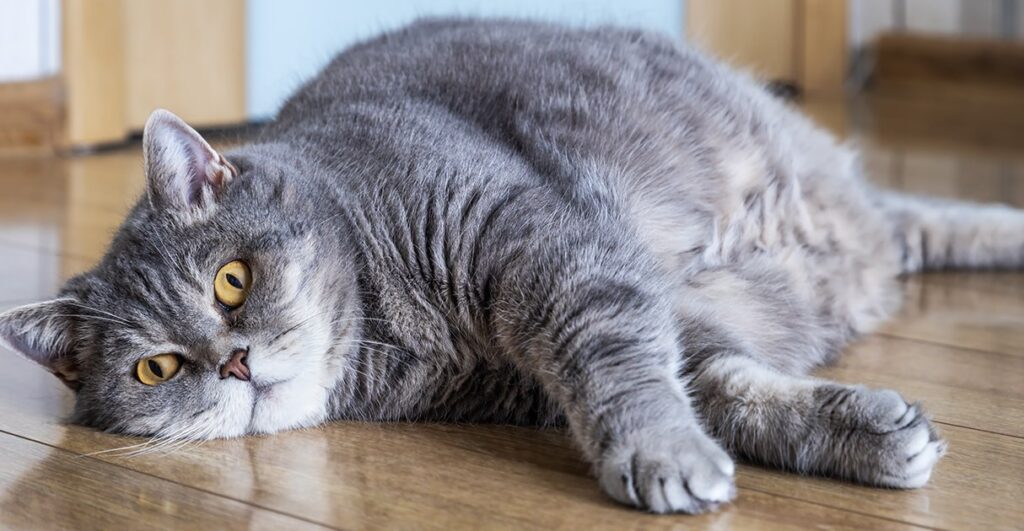
Let’s talk about the spare tire. Indoor cats move far less than their outdoor ancestors did, while food shows up whether they worked for it or not. PetMD notes that overweight cats face higher risks of diabetes, arthritis, and fatty liver disease, and that scheduled daily play helps turn that around — even building up to 10 minutes a day helps a very overweight cat get started. More in PetMD’s guide to helping a cat slim down.
Play alone won’t fix obesity — portions and a chat with your vet matter, and cats should never lose weight fast. But play does three things a diet can’t. It burns calories, it builds muscle that burns more calories at rest, and it gives your cat something to look forward to besides the food bowl. A cat whose day is hunt, eat, groom, sleep is a lot less likely to spend the evening begging at the kitchen counter out of sheer boredom.
Pro tip: If your cat is on a vet-supervised weight plan, use part of her regular meal as the post-play reward instead of adding treats on top. She gets the satisfying “I caught dinner” ending, and you don’t blow the calorie budget you just worked off.
How to Play: The Hunt, Catch, Kill, Eat Cycle
The best play sessions copy a hunt. Use a wand toy with a feather, fabric mouse, or crinkle attachment, and follow this pattern:
1. Make the Toy Act Like Prey
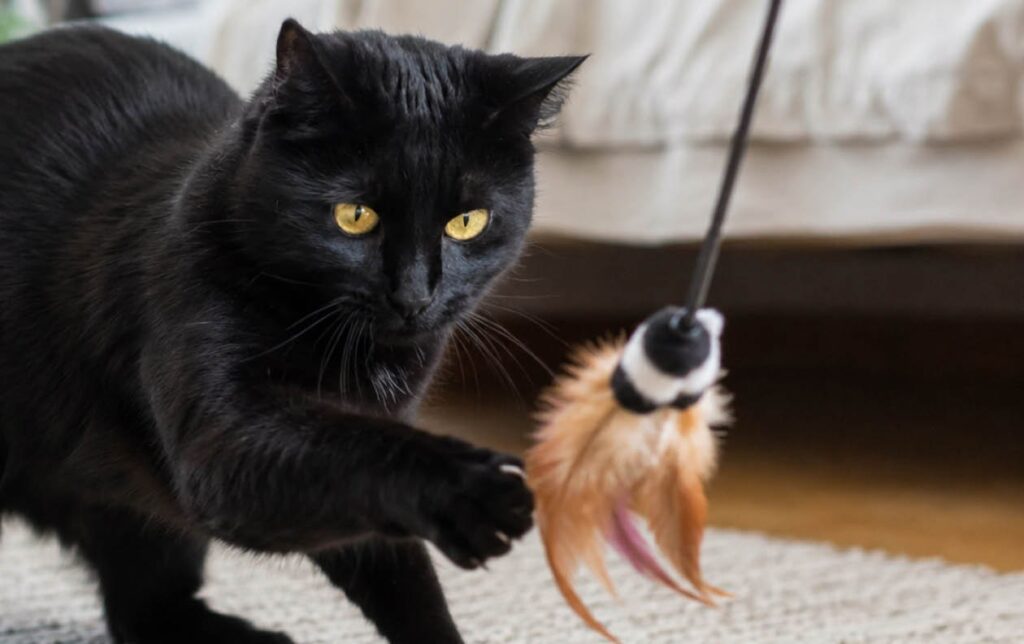
Move the toy away from your cat, not toward her face. Drag it around corners, pause, let it tremble, then dart again. Real prey hides, freezes, and flees. A toy waved frantically in the air teaches your cat the game is impossible, so mix in slow, catchable moments. Think like a mouse who doesn’t know a cat is watching: skitter, stop, look around, skitter again. That pause, by the way, is when the magic happens — the crouch, the wiggle, the pounce.
2. Let Your Cat Win
Stalking and pouncing are the workout; catching is the reward. Let your cat grab the toy several times during a session and bunny-kick it proudly. A game your cat never wins becomes frustrating, and frustrated cats quit playing — or redirect onto your hands. Try a rhythm cat behaviorists often call “boil and simmer”: a burst of chasing, a breather while she watches and plans, then another burst. Cats are sprinters, not marathon runners, and those little rests are part of the hunt, not a sign she’s done.
3. End With a Small Meal or Treat
After the final catch, wind the game down with slower movements, then feed a small meal or a few treats. This completes the natural cycle — hunt, catch, eat, groom, sleep — and it’s the reason an evening session so often leads to a quieter night. Never encourage playing with hands or feet, either. It seems cute with a kitten; it’s a lot less cute with a ten-pound adult who learned that ankles are fair game.
A Simple Daily Schedule That Works
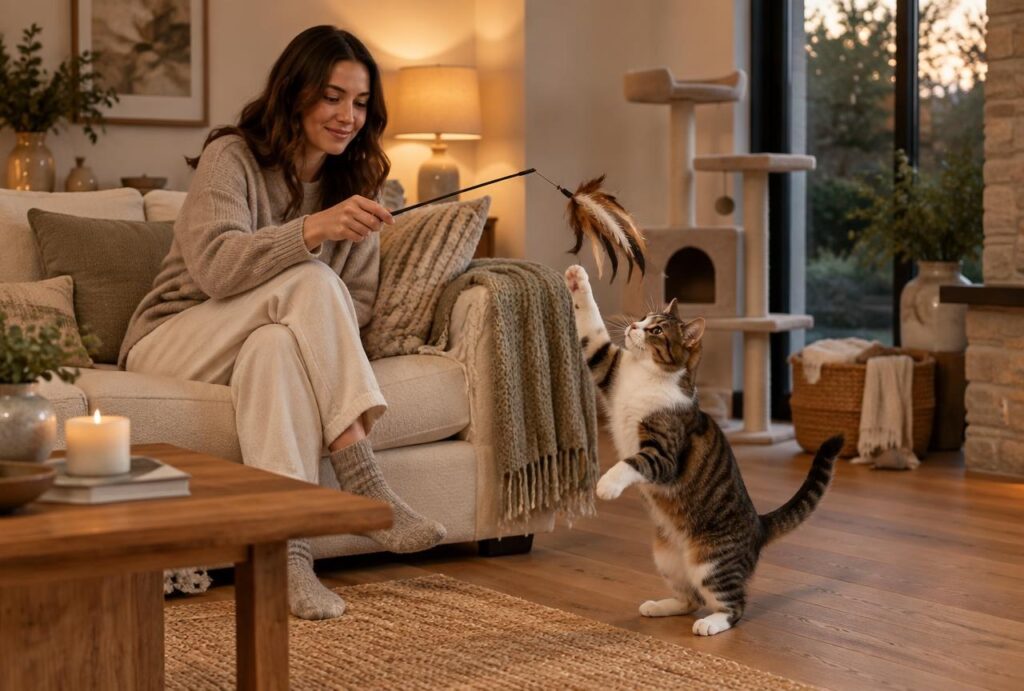
- Morning: 10 minutes of play before breakfast, while your coffee brews.
- Evening: 15 minutes when you get home or after dinner — the natural energy peak for most cats.
- Before bed: 10 to 15 minutes, ending with a small snack, to burn off the nighttime energy surge.
Anchor sessions to things you already do — meals, getting home from work, your own bedtime — and they’ll become habits instead of chores. Your cat will help: cats are spectacular at learning routines, and within a week or two she may start showing up at the toy closet at the appointed hour, looking at you like you’re late. On busy days, two solid sessions beat skipping entirely, and one good session beats zero. Consistency across the week matters more than one marathon game on Sunday.
Working from home? A midday session is a gift for both of you — five to ten minutes between meetings gets you out of your chair, too. Families can share the job, as long as kids learn the rules: toy away from the cat, let her catch it, never pick her up mid-game.
Best Toys for Interactive Play
- Wand toys: The essential tool. Keep a couple of attachments — a feather for the bird hunters, a fuzzy worm or mouse for the ground hunters — and rotate when interest fades.
- Laser pointers: Fine for a chase, but always end by landing the dot on a physical toy or treat your cat can catch, so the hunt has a satisfying ending. Never shine a laser in any eyes, yours or hers.
- Crinkle balls, springs, and toy mice: Good for solo batting between sessions, especially scattered overnight for the cat who patrols at dawn.
- Puzzle feeders: Not a replacement for play, but they stretch a meal into mental work, which tires cats in a different, useful way. Start easy — a frustrated cat and a too-hard puzzle is a bad combo.
- Catnip or silver vine toys: Great for reviving interest in older toys. Not every cat responds to catnip; silver vine works for many who don’t. Rotate toys every few days so they feel new again.
More ideas are in our Cat Toys category. After the hunt, a cozy crash pad helps too — see our guide to getting a cat to use a cat bed.
Inspect toys regularly and throw away anything with loose string, feathers coming apart, or small pieces your cat could swallow. Put wand toys away between sessions — a string toy left out is a chewing and tangling hazard, and a stored toy stays exciting. That closet door opening should feel like an event.
Common Mistakes to Avoid
- Waving the toy in your cat’s face. Prey doesn’t volunteer. Move it away, across her line of sight, and let it hide — that’s what flips the hunting switch.
- Playing while scrolling your phone. Cats can tell when you’re not really there. Half-hearted play gets a half-hearted cat. Ten focused minutes beat twenty distracted ones.
- Never letting your cat catch the toy. Endless chasing with no catch builds frustration, especially with laser pointers. Wins are the whole point.
- Using your hands as toys. It teaches biting and scratching people is part of the game — a hard habit to undo later.
- One long marathon instead of short sessions. Most cats are done, mentally and physically, after 10 to 15 good minutes. More isn’t better if she’s walked off.
- Leaving every toy out all the time. A toy that’s always there becomes invisible. Rotate a few at a time and store the rest.
- Skipping play because your cat “seems lazy.” Some cats need a slower warm-up, a different toy, or a better time of day before they engage. Try dawn or dusk before you decide she’s not a player.
Signs Your Cat Needs More — or Less — Play
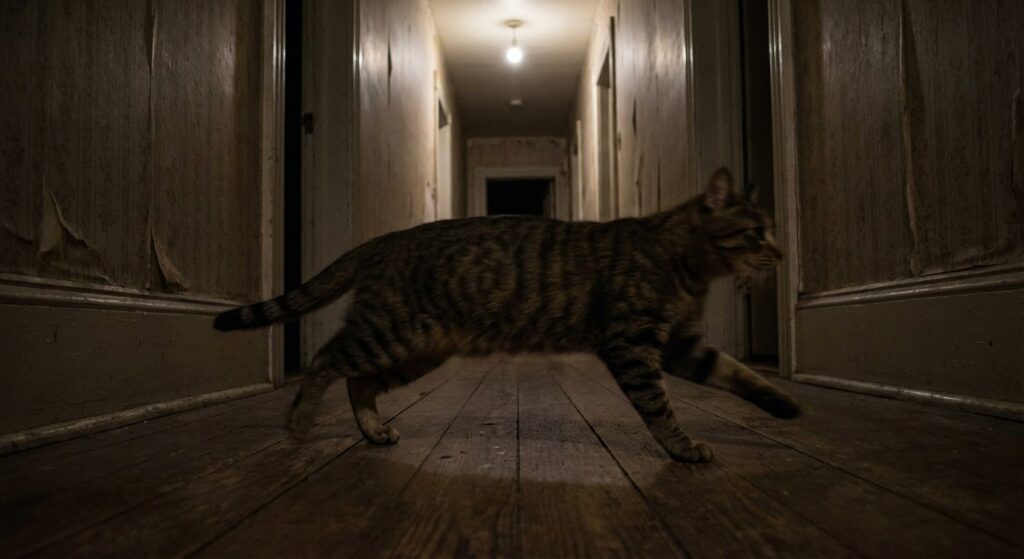
Consider adding a session if your cat is waking you at night, ambushing feet, playing roughly with other pets, gaining weight, or seems restless and vocal in the evening. A bored cat rarely looks bored — she looks busy, just busy with your curtains, your plants, and your sleeping schedule. Consider easing off if your cat pants, lies down and disengages, walks away, or seems sore afterward. Open-mouth breathing during play means stop and let her recover; if it happens often, mention it to your vet.
Cats hide discomfort well, so a senior cat who suddenly refuses a favorite game deserves a mention at the next vet visit — arthritis is common and treatable, and a cat who feels better often plays again.
The Bottom Line
Start with two or three sessions totaling about 30 minutes a day, play like prey, let your cat win, and finish with food. Adjust up for young, energetic cats and down for seniors. Within a couple of weeks, most owners notice the payoff where it matters: a calmer evening, a better night’s sleep for everybody, and a cat who greets the toy drawer like it’s the best part of the day — because for an indoor cat, it often is.
And here’s the part nobody warns you about: you’ll probably start looking forward to it, too. A cat in full hunting mode — the wiggle, the chatter, the triumphant bunny-kick — is genuinely delightful, and ten minutes of that beats most of what’s on your phone.
Frequently Asked Questions
Is 10 minutes of play a day enough for a cat?
For a calm senior, two gentle sessions totaling around 10 to 20 minutes may be plenty. For a young or energetic adult, 10 minutes total usually isn’t enough, and the leftover energy tends to appear at night. Aim for 30 minutes or more, split into short sessions, and adjust based on your cat’s behavior.
Why does my cat lose interest in playing after a few minutes?
The toy may be moving too predictably, your cat may be a stalk-and-wait hunter who plays in short bursts, or the session may be at the wrong time of day. Try dawn or evening sessions, slower prey-like movement with pauses, and a different toy or attachment. Short attention is normal if your cat returns for more later — that’s the boil-and-simmer pattern, not boredom.
Should I play with my cat before bed?
Yes — it’s one of the most effective sessions of the day. A 10 to 15 minute hunt ending with a small snack follows your cat’s natural cycle into grooming and sleep, and often reduces the 3 a.m. energy burst that wakes the household.
Can playtime really help my cat lose weight?
It helps, as part of a bigger plan. Daily play burns calories and builds muscle, but portion control and veterinary guidance do the heavy lifting for weight loss, and cats should lose weight slowly. Talk to your vet before starting a slimming plan, use part of a regular meal as the post-play reward, and build session length gradually for a very overweight cat.
What if my cat won’t play at all?
Try a different time of day, a different toy type — ground prey versus bird-style — and a slower start, with the toy barely twitching across the room. Some cats prefer playing behind a partially closed door or under a blanket’s edge, where they feel hidden. If a cat who used to play suddenly stops, or also eats less or hides more, book a vet check. Pain and illness often show up as “laziness” first.