

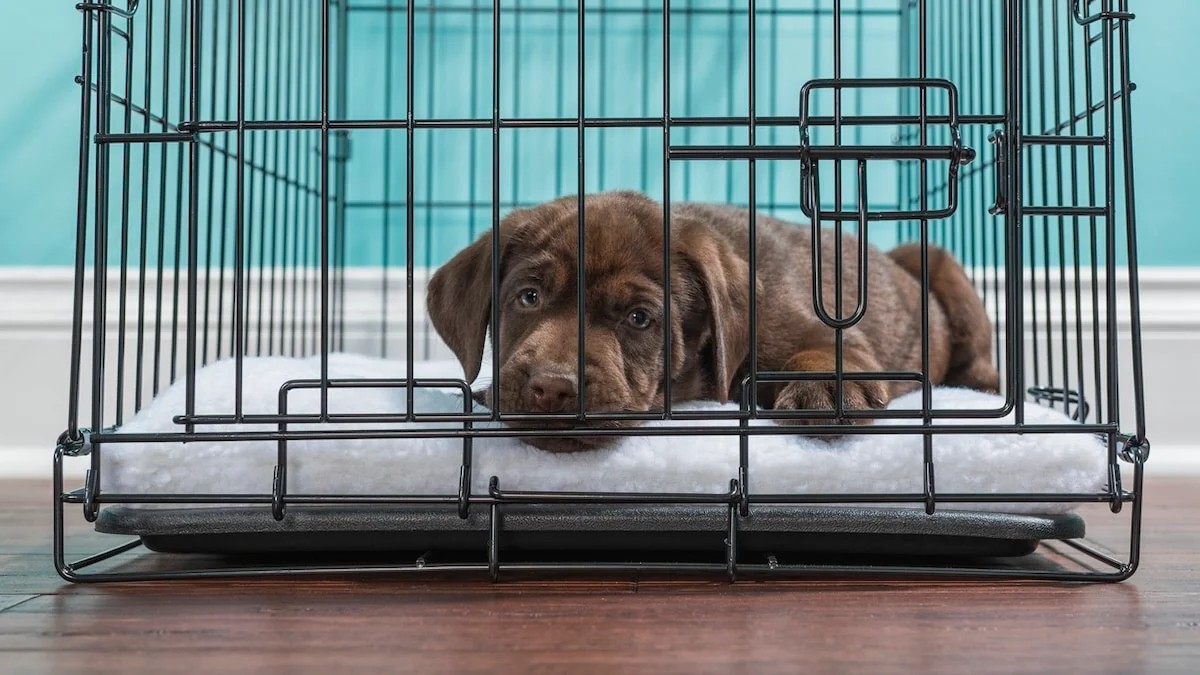
Picture this: it’s 2 a.m., you’re barefoot in a dark hallway, and your brand-new puppy is crying in the crate like the world just ended. You’re tired, you feel guilty, and you’re wondering if you bought the wrong crate, the wrong puppy, or both. Take a breath. That rough first night doesn’t mean crate training is failing. It usually just means your puppy is a baby who, until very recently, slept in a warm pile of brothers and sisters — and now everything smells different.
Here’s the good news. You can teach most puppies to accept, and honestly even like, a crate within about a week if you go slowly, feed the good stuff in there, and never use it as punishment. Seven days is a realistic target for the basics: walking in willingly, settling with the door closed, and resting while you leave the room for a bit. It’s not a promise that every puppy will sleep through the night alone by day seven, and trying to force that pace is exactly what creates crate anxiety in the first place.
This plan breaks the week into small, boring wins. If your puppy needs an extra day on any step, take it. Going back a step isn’t failure — it’s information, and it’s faster than repairing a puppy’s fear of the crate later. For more puppy basics, browse our dog training guides.
Key Takeaways
- Make the crate pay: feed meals, treats, and safe chews in there so your puppy decides it’s a great place before the door ever closes.
- Build time in seconds, then minutes — door closed, you nearby, then you out of the room — and always quit while you’re ahead.
- Never use the crate as punishment, and never leave a young puppy in it longer than they can comfortably hold their bladder.
- Mild fussing is normal; panic, drooling, or frantic escape attempts are not. Slow down or get help if you see them.
Why a Crate Helps — When You Do It Right
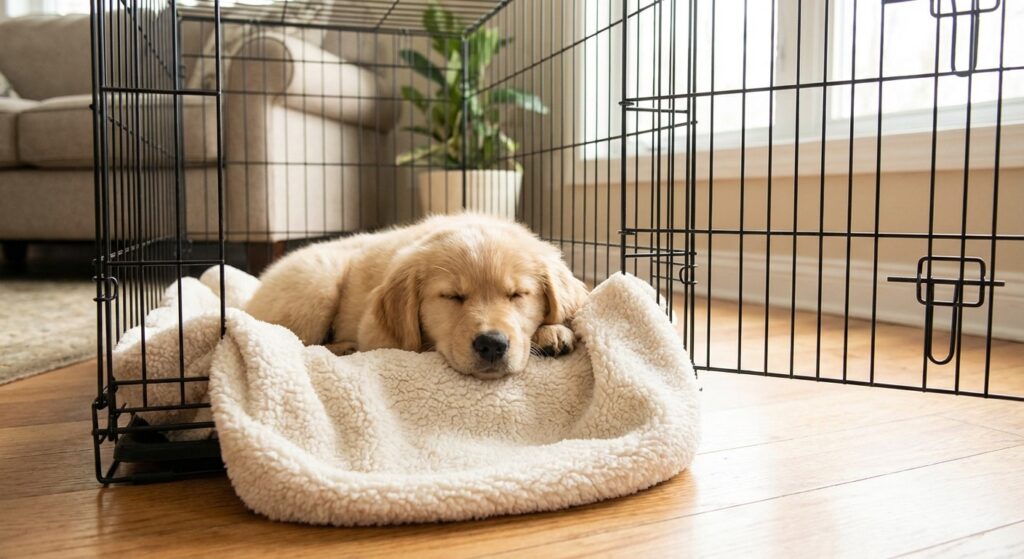
A crate isn’t a cage for a “bad dog.” Think of it more like a crib or a playpen: a safe, small space where a puppy can’t chew a power cord, swallow a sock, or practice peeing behind the couch the second you turn around. Dogs also tend to avoid soiling where they sleep, which is why a properly sized crate can quietly support house training instead of fighting it.
There’s a longer payoff, too. Sooner or later, almost every dog ends up in a crate somewhere — at the vet, the groomer, a boarding kennel, or in the car. As the American Kennel Club’s guide to crate training your dog points out, a dog who’s already learned a crate is safe will handle those moments with far less stress. You’re not just training for this week. You’re training for every vet visit for the next decade.
Before Day 1: Set Up for Success
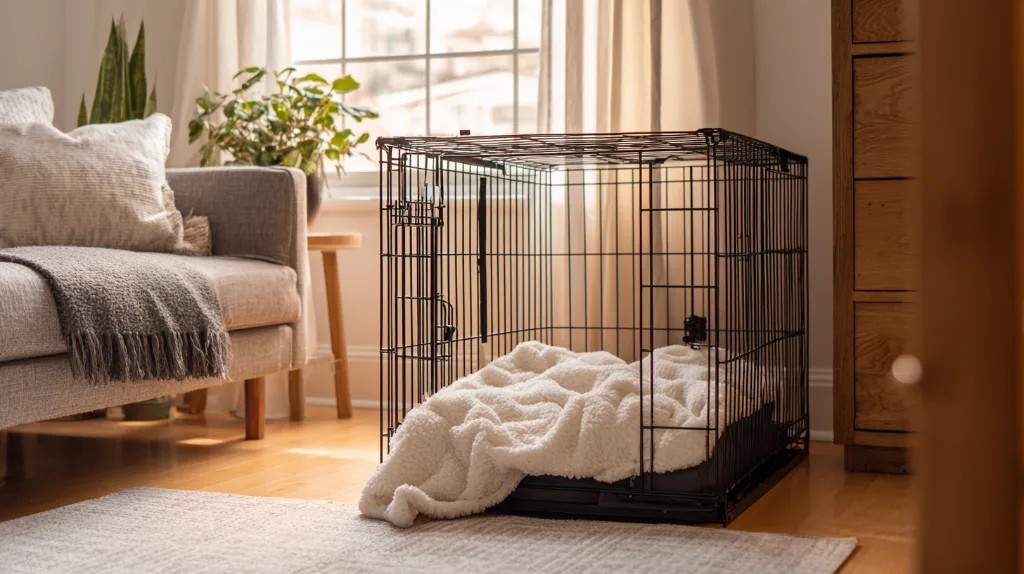
Choose the right crate size
Your puppy should be able to stand up, turn around, and stretch out on their side. That’s it. Bigger isn’t better here. Give a puppy a crate the size of a studio apartment and they’ll do what makes sense to them: sleep at one end and use the other end as a bathroom. For a fast-growing puppy, buy the adult-size crate and use the divider panel it comes with, moving it back as they grow. No divider? Plan on sizing up once or twice. It’s annoying, but it’s cheaper than re-teaching house training.
Make it comfortable — and safe
Put the crate where life actually happens: the living room, the corner of the kitchen, somewhere your puppy can see you puttering around. Not the garage. Not a spare room down the hall. Isolation makes everything harder.
Add washable bedding if your puppy leaves it alone. If they shred it — and plenty do — skip the bedding for now and use a bare, easy-clean base. Swallowed fabric is a real emergency-vet risk, and a puppy doesn’t need a Pinterest-perfect crate. They need a safe one. Take collars and harnesses off inside the crate if there’s any chance of them catching on the bars, and only leave chew items you’ve already watched your puppy with while supervised.
Pro tip: Ask the breeder or rescue for a small blanket that smells like mom and the littermates for the first few nights. That familiar smell can take the edge off in a way no new toy can.
Gather your tools
You don’t need much: small, high-value treats (pea-sized bits of chicken or cheese, not giant biscuits), part of your puppy’s regular meals, a stuffable food toy you can freeze, and one consistent cue word like “crate” or “bed.” Time sessions smart — a puppy who’s had play and a potty break and is getting that heavy-eyed look is ready to learn the crate is for resting.
The 7-Day Plan
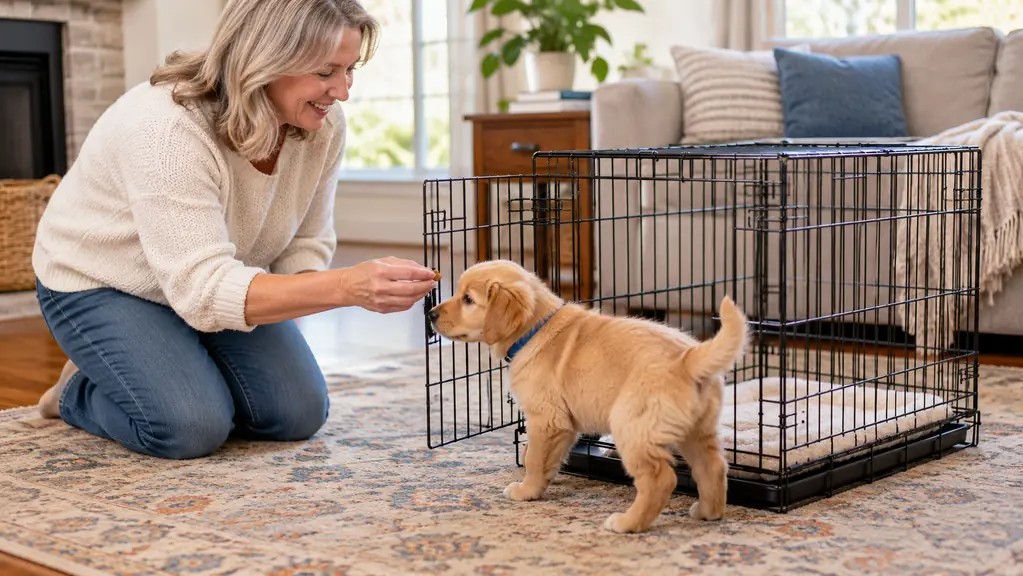
Day 1: The crate is a great place to find food
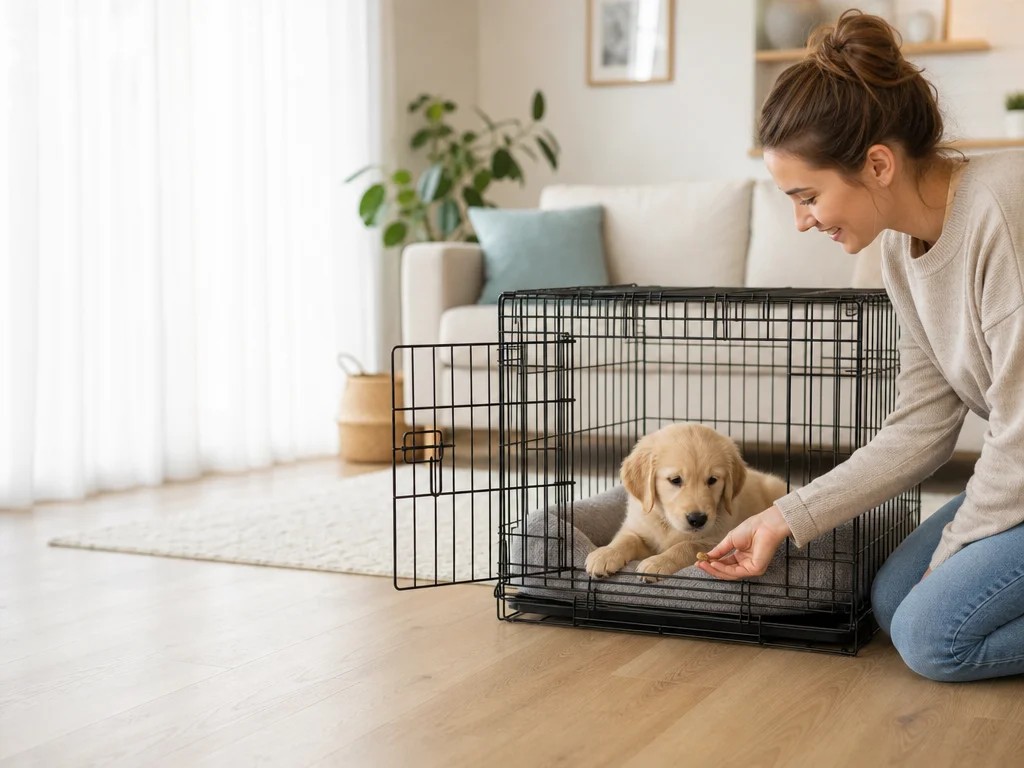
Tie or prop the door open so it can’t swing shut and startle your puppy. Then just scatter treats in and around the crate all day. Feed meals in there, bowl near the front at first. Let your puppy wander in and out like it’s no big deal — because right now, it isn’t. If they wander in and flop down for a nap, wonderful. Don’t close the door today, no matter how tempting it is. The only lesson on Day 1 is: good things happen in that box.
The ASPCA’s step-by-step guide to introducing your dog to a crate uses this same slow build — treats tossed deeper each time, then a cue word, then a brief door close.
Day 2: Short rests with the door moving
Keep feeding meals in the crate. While your puppy is happily working on a stuffed toy inside, gently swing the door almost closed, then open it right back up and praise them calmly. Repeat a few times, like it’s the most ordinary thing in the world. Later, close the door fully for just a few seconds while you stay right there, then open it before your puppy even thinks about worrying.
Keep your voice boring here. If you throw a party every time the door opens, you’re teaching your puppy that getting out is the exciting part. Calm in, calm out.
Day 3: Door closed for a few minutes
Now build to one to five minutes with the door closed while you sit nearby. Give your puppy a safe chew so they’ve got a job to do. If they whine a little, wait for a short pause in the noise before you open the door — you don’t want whining to become the key that unlocks it.
But here’s the line you need to know: mild protest is one thing, panic is another. If your puppy is drooling, panting hard, biting the bars, or hurting themselves trying to escape, let them out and go back to Day 2. That’s not a puppy “being stubborn.” That’s a puppy who’s genuinely scared, and pushing through it backfires.
Day 4: You leave the room, briefly
Once your puppy settles with the door closed and you in the room, stand up. Step out of sight for a few seconds. Come back before they worry. That’s the whole rep. Build to a few minutes, and mix it up — sometimes ten seconds, sometimes two minutes — so your puppy can’t learn that every absence gets longer and start bracing for it. Practice normal life sounds too: a door closing, water running, you going upstairs and coming right back down.
Day 5: A real short absence
Work up to about 20 to 30 minutes out of the room. If that’s going well, try a truly short trip out of the house — take out the trash, walk to the mailbox. Set your puppy up to succeed: potty break first, a little play, then crate time when they’re ready to crash anyway. A cheap camera helps, too — seeing that your puppy whined for ninety seconds and then slept will save your sanity.
Day 6: Practice the daily routine
Start using the crate at the times you’ll actually need it: while you shower, cook dinner, take a work call, or answer the door. Keep total time modest — young puppies need frequent potty breaks, play, and time just hanging out with you. A crate is a management tool, not a storage unit for a full workday. If you’ll be gone longer than your puppy can handle, that’s a dog walker or a puppy-proofed pen — not a longer crate stretch.
Day 7: Put it together and review
By now, most puppies will trot in for a treat or a meal, settle with the door closed, and rest while you’re out of the room for a reasonable stretch. Test one slightly longer, realistic absence and see how it goes. If it goes well, congrats — you’ve got the foundation. If it doesn’t, repeat Days 4 and 5 for a few more days and test again. The calendar doesn’t get a vote; your puppy does.
Want to see the “go in your crate” step taught live, treat by treat? Watch this clear, force-free demonstration:
Nighttime Crating Without the Drama
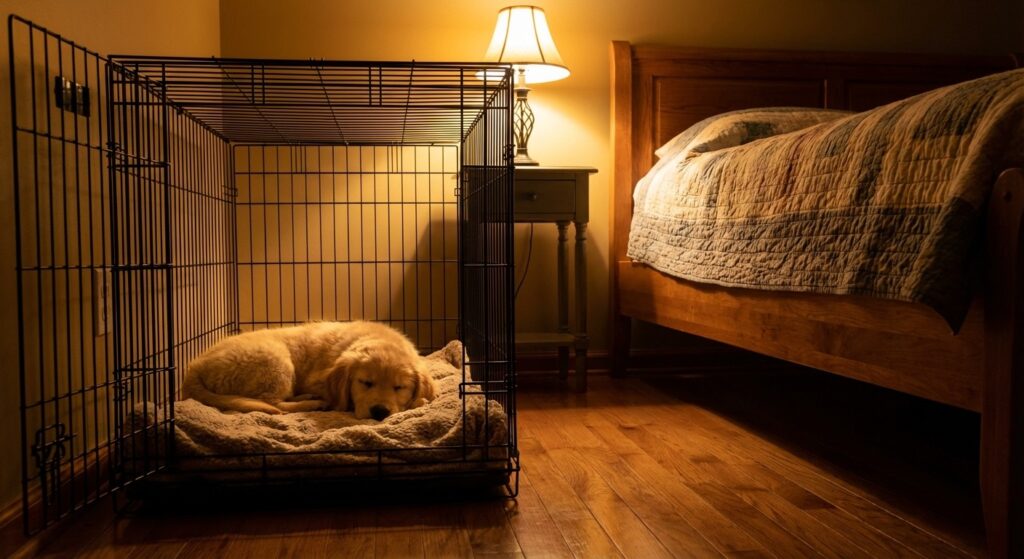
For the first nights, most puppies settle way better if the crate sits right next to your bed, where they can hear you breathe and smell that you’re near. Take your puppy out for a potty break last thing before bed, keep the room dark and quiet, and expect to get up at least once — probably twice — in those early weeks. Their bladders are tiny. That’s biology, not bad behavior.
When your puppy fusses at a plausible potty time, don’t debate it. Leash on, carry them out if they’re small, stand there being boring while they go, praise quietly, and head straight back to the crate. No play session, no kitchen tour. Boring teaches them that 3 a.m. wake-ups are for business only.
Later, once nights are solid, you can move the crate to another room if you want to — but move it gradually, a few feet at a time over several nights. Yanking it down the hall in one go is a classic reason a puppy who was doing great suddenly cries all night again.
Troubleshooting: When It’s Not Going to Plan
“My puppy screams the second the door closes”
You moved too fast — and hey, almost everyone does at some point. Drop back to feeding meals with the door open, then door-touching games, and rebuild in smaller steps. Also check the basics before you blame training: does your puppy need to pee, are they overtired and wired, did they get any exercise today? A puppy who’s bouncing off the walls won’t settle in a crate no matter how good your technique is.
“There was an accident in the crate”
Clean it up with an enzymatic cleaner, no scolding, and ask two questions. Was the stretch too long for a bladder that age? And is the crate too big, so your puppy could potty in one corner and sleep in the other? Fix whichever fits. If accidents keep happening on short, well-timed stretches, mention it to your vet — sometimes a medical reason, like a urinary tract infection, hides under a “training problem.”
“My puppy was fine, then suddenly hates the crate”
Think about what changed. One scary moment — a door slamming, something falling on the crate, fireworks while crated — can undo a lot of good feelings, and so can a growth spurt that makes the crate cramped. Go back to Day 1 games for a few days, check the fit, and rebuild.
Common Mistakes That Slow Everything Down
- Using the crate as punishment. Never send a puppy to the crate angry, and never shove them in after an accident. The crate has to stay emotionally neutral at worst, and ideally the best snack bar in the house.
- Moving too fast. Closing the door and leaving for an hour on day one doesn’t teach independence. It teaches fear.
- Too much total crate time. Puppies crated too long may start toileting inside, lose house-training ground, and miss out on the socialization that shapes who they’ll be as adults.
- Only crating when you leave. If the crate only ever predicts you disappearing, your puppy will dread it. Practice while you’re home, puttering around, very obviously not leaving.
- Letting a panicked puppy “fight it out.” A little protest whining is normal. Panic, self-injury, heavy drooling, or repeated accidents despite good timing means stop, back up, and get help from a qualified trainer or your veterinarian.
The Bottom Line
Crate training works when your puppy decides the crate is safe, predictable, and full of good things. Feed in there. Close the door in seconds before minutes. Leave the room in steps. Keep nights close and boring. Do that for a week and you’ll have a skill your dog can lean on for years — for visitors, vet stays, quiet rest, and travel. Once your puppy loves their crate at home, our guide on how to keep a dog safe in the car gets much easier, since a secured crate is one of the safest ways to ride.
FAQ
How long can a puppy stay in a crate?
Only for short stretches, and the younger the puppy, the shorter the stretch. Young puppies need potty breaks every one to two hours while they’re awake, plus plenty of play and training time out of the crate. Overnight, they can usually manage longer as they grow, but expect potty trips in the early weeks — that’s normal, not a setback.
My puppy cries in the crate. Should I let them cry it out?
Don’t ignore real distress. First check the obvious stuff: do they need the toilet, are they too hot or cold, are they actually panicking? For mild protest, wait for a brief quiet moment before opening the door so crying doesn’t become the release button. If the crying is intense or goes on and on, the step you’re on is too big. Shrink it and build back up more slowly.
Should I cover the crate with a blanket?
A lot of puppies do settle better with a light cover that makes the crate feel den-like and cuts down on visual stimulation — as long as airflow stays good and your puppy can’t pull the fabric through the bars and chew it. If your puppy grabs at covers, skip it and just darken the room instead.
What if my puppy will only settle in the crate if I’m in the room?
That’s incredibly common in the first week or two, and it’s not a dead end. It just means your “leaving the room” steps need to be smaller and more frequent: step out, step back in, treat calm behavior like it’s no big deal. Borrow a trick from Day 4 — randomize the lengths so your puppy stops trying to predict you. Most puppies get there; they just get there on puppy time.
Can I crate train an older puppy or adult dog the same way?
Yes — same steps, though an older dog may need more days at each one. Food in the crate, door in seconds before minutes, no punishment, no marathon stretches.



Pingback: Puzzle Toys for Dogs: Benefits, Risks & How to Start
Pingback: Dog Car Safety: Harnesses, Crates & What Never to Do