This guide contains affiliate links. As an Amazon Associate, PawChirp earns from qualifying purchases — at no extra cost to you. Read our full disclosure.
A bored dog is rarely a quiet dog. Boredom turns into chewed baseboards, excavated couch cushions, and barking at absolutely nothing — usually twenty minutes after you leave for work. The good news: most of that energy has a simple outlet. Interactive dog toys make your dog paw, nose, slide, sniff, or chase for his food instead of just handing it over, and that problem-solving burns mental energy in a way a plain chew just can’t.
This guide goes beyond the basic puzzle feeders we covered in our look at whether puzzle toys are good for dogs. Here we’re comparing five kinds of boredom-busters — a rolling treat dispenser, a board puzzle, a snuffle mat, an adjustable rolling feeder, and a self-moving electronic ball — because different dogs get bored in different ways. One honest note up front: “when you’re away” toys still need a supervised trial run first. Watch how your dog attacks a toy before leaving it with them alone, and check the supervision note under each pick — some are genuinely home-alone-friendly for the right dog, and some are not. For general guidance on keeping dogs healthy and enriched, see the AVMA’s pet care resources.
Key Takeaways
- Best all-around boredom-buster: The KONG Wobbler turns a meal into a long, active batting game for medium and large dogs.
- Best for problem solvers: The Nina Ottosson Dog Brick packs three puzzle mechanics into one board, so the challenge lasts for weeks, not days.
- Best for calm dogs and sniffers: The PAW5 Wooly Snuffle Mat turns dinner into 10–15 minutes of soothing nose work.
- Best for small dogs: The PetSafe Kibble Nibble’s trim-to-fit prongs let you dial the difficulty for dogs under 20 pounds.
- No toy is indestructible: Every pick here is a supervised-play product. Trial-run each one, size it to your dog, and discard anything that cracks or starts shedding pieces.
Quick Picks: The Best Interactive Dog Toys at a Glance
| Product | Best For | How It Works | Dog Size |
|---|---|---|---|
| KONG Wobbler, Large | Active treat-chasers | Weighted wobble toy that dispenses kibble as it rolls | Medium/large dogs |
| Outward Hound Nina Ottosson Dog Brick, Level 2 | Beginner-to-intermediate problem solvers | Board puzzle with flip lids, sliders, and removable bones | All sizes |
| PAW5 Wooly Snuffle Mat | Calm foraging and nose work | Kibble hidden in dense fabric strands | All sizes |
| PetSafe Busy Buddy Kibble Nibble, Small | Small dogs that eat too fast | Rolling feeder with adjustable treat openings | Under 20 lbs |
| Cheerble Wicked Ball PE, Purple | Chase-driven dogs | Self-moving electronic ball with 3 modes | 35 lbs and up |
How We Chose
We researched the interactive toys owners actually buy for home-alone boredom, comparing manufacturer specifications, mechanisms, size guidance, and long-term owner feedback — with special attention to whether parts can be pried off, how each toy holds up to chewing, and how much supervision it honestly needs. We don’t claim hands-on lab testing we haven’t done; this guide is research-based, and you can read exactly how we work on our How We Choose Products page.
1. KONG Wobbler, Large — Best Rolling Treat Dispenser for Medium and Large Dogs
Who it’s for: Medium and large dogs who eat too fast and enjoy batting things around the kitchen. If your dog treats mealtime as a two-minute event, this stretches it into a game.
The KONG Wobbler is a weighted, snowman-shaped dispenser that rights itself every time your dog paws or noses it over. Each wobble shakes a few pieces of kibble or small treats out of the hole, so the reward keeps coming only as long as the dog keeps playing. The top unscrews for filling and cleaning, and because it works with regular dry food, it doubles as a slow feeder — a useful way to hand over part of the day’s meals while you’re out instead of adding extra treats on top. This is the Large; a smaller version exists under a different listing.
Pros:
- Self-righting weighted base keeps the game going without help from you
- Works with regular kibble, so boredom-busting doesn’t mean extra calories
- Unscrews for easy filling and washing; no small removable parts
Cons:
- Hard and noisy on wood or tile floors
- Clever dogs learn the technique quickly and empty it faster over time
- Only works with dry food small enough to fall out of the hole
Supervision note: This is a food puzzle, not a chew toy. Most dogs can be left with it after a few watched sessions, but take it away from any dog that tries to chew through the shell to reach the food.
2. Outward Hound Nina Ottosson Dog Brick, Level 2 — Best Board Puzzle for Problem Solvers
Who it’s for: Smart, food-motivated dogs who have mastered simple treat toys and need a real challenge. It’s rated Level 2 (intermediate) — the right step up from beginner puzzles.
The Nina Ottosson Dog Brick hides treats three ways on one board: under flip-up lids, beneath sliding panels, and inside compartments covered by removable white bone pieces. That variety is the point — your dog learns three separate skills, introduced one at a time, so the puzzle stays interesting far longer than a single-trick toy. The board measures about 12.75 × 8.75 inches, holds roughly 3/4 cup of kibble or treats, and is made from food-safe plastic that’s BPA-, PVC-, and phthalate-free. Owners rate it around 4.4 out of 5 stars, per roundup data.
Pros:
- Three puzzle mechanics in one board, with difficulty you can raise in stages
- Generous capacity — works as a full slow-feeding meal, not just a snack game
- Food-safe, BPA/PVC/phthalate-free plastic, sized for all breeds
Cons:
- The removable bone pieces are tempting chew targets and can be pried off by determined dogs
- Lots of compartments and moving parts means real effort to wash properly
- A determined chewer will damage the board itself — it isn’t built for jaws
Supervision note: Supervised enrichment only — not a chew toy and not an all-day unattended toy. If your dog mouths or carries the loose bone pieces, remove and store them; small parts are a choking hazard.
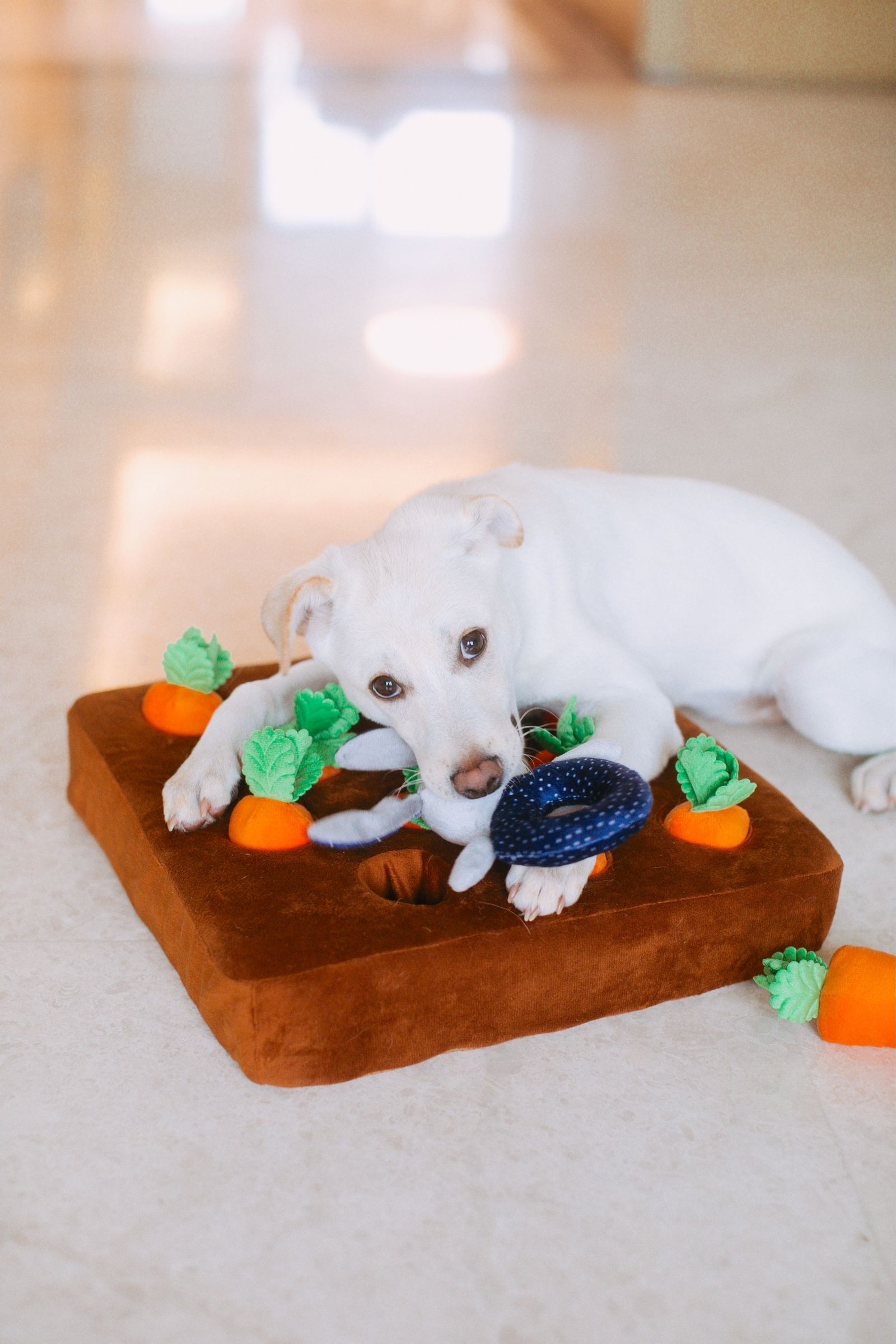
3. PAW5 Wooly Snuffle Mat — Best Nose-Work Mat for Calm Foraging
Who it’s for: Dogs who live through their noses — scent hounds, anxious dogs who need a calming activity, seniors, and fast eaters.
The PAW5 Wooly Snuffle Mat works on a different instinct from the other picks here. Instead of pawing or problem-solving, your dog sniffs: you bury dry kibble or treats deep in the mat’s dense fabric “grass” strands, and your dog forages for them one piece at a time. Sniffing is naturally self-soothing, and scattering part of a meal in the Wooly typically buys 10–15 minutes of calm, focused nose work. The mat measures about 12 × 17 inches, is made from cotton (the tag lists a cotton blend), and is machine washable — which you’ll appreciate, because it needs regular washing. Chewy owners rate it around 4.4 out of 5 stars across roughly 2,900 reviews.
Pros:
- Calming, sniff-led play — a good fit for anxious, senior, or low-energy dogs
- Slows down fast eaters when you serve part of a meal in it
- Machine washable, made from non-toxic materials per the maker, and completely silent
Cons:
- No anti-slip bottom, so it can bunch up and travel across smooth floors
- The dense pile dries slowly and traps kibble dust and odor if you skip washes
- Dry food only — wet food coats the fibres
Supervision note: Watch shredders and diggers — the fabric strands are not chew-proof, and a dog that tears the mat can swallow fabric.
4. PetSafe Busy Buddy Kibble Nibble, Small — Best Adjustable Rolling Feeder for Small Dogs
Who it’s for: Small dogs under 20 pounds — the terriers, toy breeds, and little mixes most “interactive toy” guides forget. Also smart if your small dog inhales meals.
Most rolling dispensers come in one difficulty: whatever the hole size happens to be. The PetSafe Kibble Nibble is different. This egg-shaped feeder has two patented Treat Meter openings with flexible prongs that randomly release dry food as the ball rolls — and you can trim the prongs to make the game easier, or leave them long to make your dog work harder. It unscrews in the middle for filling and cleaning, holds a full small-dog meal, and has rubber bumpers that soften noise and spare your baseboards. An independent dog-training review site rated the Kibble Nibble line 4 out of 5 stars. This listing is the Small; the Medium/Large is a separate product, so double-check before ordering.
Pros:
- Trim-to-fit prongs let you tune the difficulty — rare in rolling feeders
- Random dispensing keeps dogs guessing instead of learning one trick
- Rubber bumpers reduce noise and floor marks
- Properly sized for dogs under 20 lbs
Cons:
- Trimming is permanent — cut the prongs too short and you can’t make the game harder again
- Hard plastic is still loud on hard floors, and the two halves can be fiddly to screw back together
Supervision note: Supervise play, and start with the prongs untrimmed, adjusting gradually so your dog doesn’t get frustrated. Remove it if pieces begin to break off, and skip it entirely for determined chewers, who can tooth-mark the hard plastic.
5. Cheerble Wicked Ball PE, Purple — Best Self-Moving Electronic Ball for Medium and Large Dogs
Who it’s for: Chase-driven medium and large dogs (35 pounds and up) who ignore stationary toys. If your dog only cares about things that move, this is the one pick here that moves by itself.
The Cheerble Wicked Ball PE is a 3.08-inch self-moving ball made from natural rubber and TPU. It rolls, shakes, or bounces on its own and changes direction when it bumps into furniture, with three modes — Gentle, Normal, and Passive — plus LED lights. It’s rechargeable by DC cable and runs on a sensible cycle: 10 minutes of active play, then 30 minutes of rest, waking again with a touch. That rhythm matters — a home-alone dog gets a chase game that restarts itself through the day instead of one frantic burst followed by nothing. Note this purple listing is the PE version; Cheerble’s newer versions sit under different listings.
Pros:
- Moves unpredictably on its own — no throwing, no apps, no remotes
- Three modes let you match the energy to your dog’s confidence
- Auto play/rest cycle spreads stimulation across the day; rechargeable, with LED lights
Cons:
- A chase toy, not a chew toy — not suitable for heavy chewers
- Works best on hard floors; shag and high-pile carpet are not recommended
- Play sessions are short by design (10 minutes on, 30 minutes rest)
Supervision note: Supervise, especially at first. A dog that catches and chews this ball can crack the shell and reach the motor and battery inside — take it away immediately if the shell is damaged. If your dog is frightened by or fixates on moving toys, this isn’t the right pick.
Buying Guide: How to Pick the Right Interactive Toy
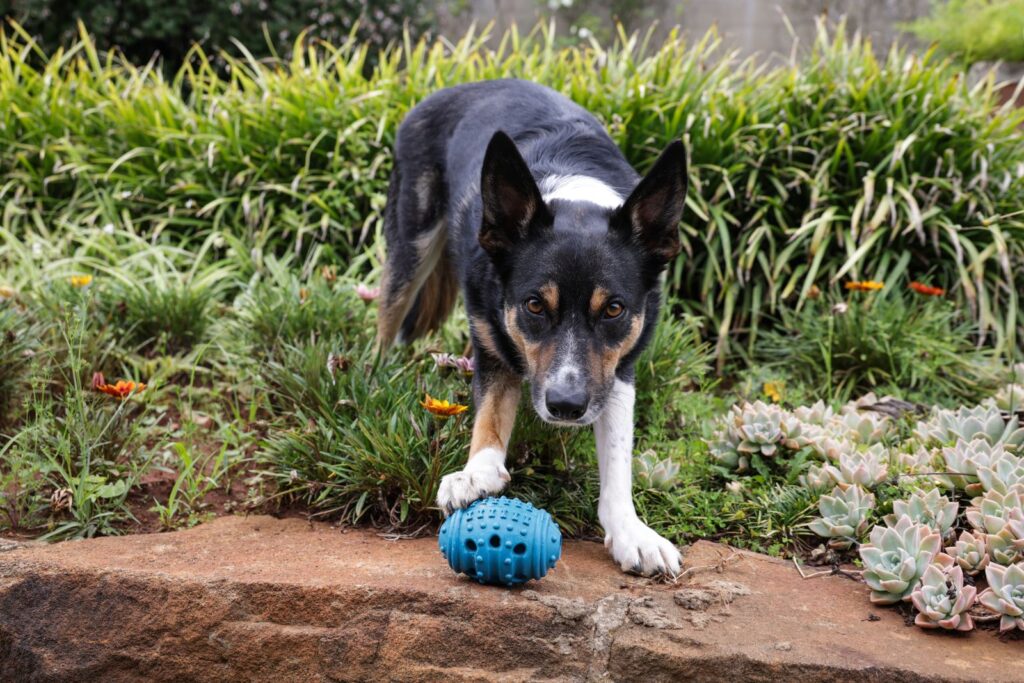
Match the toy to the instinct. Sniffers light up for the snuffle mat, problem-solvers get the most from the Dog Brick, and batting-and-chasing dogs do best with the Wobbler, Kibble Nibble, or Wicked Ball.
Be honest about supervision. No toy is truly indestructible, and no interactive toy earns blind trust on day one. Run every new toy through several supervised sessions first. Pawing and nosing is what you want; pinning it down and gnawing at seams, lids, or shells is a warning. Board puzzles with removable parts and electronic toys stay supervised toys, full stop. Dispensers and snuffle mats graduate to alone-time use only for dogs you’ve watched play gently with them.
Size it correctly. A toy that can fit entirely in your dog’s mouth — or lodge behind the canine teeth — is a choking hazard. When you’re between sizes, size up. Every pick here is size-specific: the Wobbler and Wicked Ball are the larger versions, and the Kibble Nibble is the Small.
Count the food. Puzzle treats still count toward the day’s calories. Serve part of your dog’s regular meals in the toy instead of adding treats on top — several picks here hold a full portion for exactly that reason.
Rotate, don’t accumulate. A toy that’s out every day becomes furniture. Keep two or three in rotation and put the rest away; one brought back after a week off feels new again.
Retire damaged toys immediately. Cracks, torn fabric, loose parts, or a chewed shell mean the toy goes in the trash, not back in the toy box. Swallowed pieces are a blockage risk — a vet emergency, not a wait-and-see.
FAQ
Can I really leave my dog alone with interactive toys?
With the right toy and the right dog, yes — after supervised trial runs. Sturdy dispensers like the KONG Wobbler and the snuffle mat are the usual alone-time choices once you’ve watched your dog use them calmly. Toys with removable parts (the Dog Brick), crackable hard plastic (the Kibble Nibble), or electronics inside (the Wicked Ball) should stay supervised — the risk isn’t the toy breaking, it’s your dog swallowing the pieces.
How long will an interactive toy keep my dog busy?
Realistically, 10 to 30 minutes for most dogs, depending on the toy and how much food is in it. A fully loaded dispenser lasts longest; a board puzzle gets faster as your dog learns it. That’s normal — mental effort tires dogs out of proportion to the clock.
Are interactive toys a substitute for walks and playtime with me?
No. They’re a supplement for the hours you can’t be there, not a replacement for exercise, training, and time with you. A dog who gets a puzzle feeder but no walk is still under-exercised — these toys cover the workday gap, not the whole job.
My dog gets frustrated and starts barking at puzzle toys. What should I do?
Make it easier. Frustration usually means the difficulty jumped too fast. Start with the simplest setting — prongs untrimmed on the Kibble Nibble, only the flip lids loaded on the Dog Brick, treats near the surface of the snuffle mat — and let your dog win quickly and often. If your dog guards the toy or stays wound up long after play ends, retire it and talk to a trainer.
How do I clean these toys?
Wash dispensers and puzzle boards regularly — trapped crumbs go stale and grow bacteria. The Wobbler and Kibble Nibble unscrew for washing; the Dog Brick’s compartments wash out by hand. The snuffle mat is machine washable and needs washing often, since it soaks up saliva. The Wicked Ball just needs a wipe-down; keep its charging port dry.
Conclusion
For most working owners, the KONG Wobbler is the interactive toy to buy first: simple and sturdy, it turns a regular meal into a long game and asks the least supervision once your dog knows it. Thinkers should step up to the Dog Brick’s three-in-one challenge; sniffers who need calming rather than exciting get the gentlest boredom-buster here in the PAW5 Wooly. Small-dog owners get an adjustable option in the Kibble Nibble, and chase-obsessed dogs get the Wicked Ball’s self-starting game. Whichever you choose, trial it supervised, count its treats toward the day’s food, and throw it out the moment it cracks.