
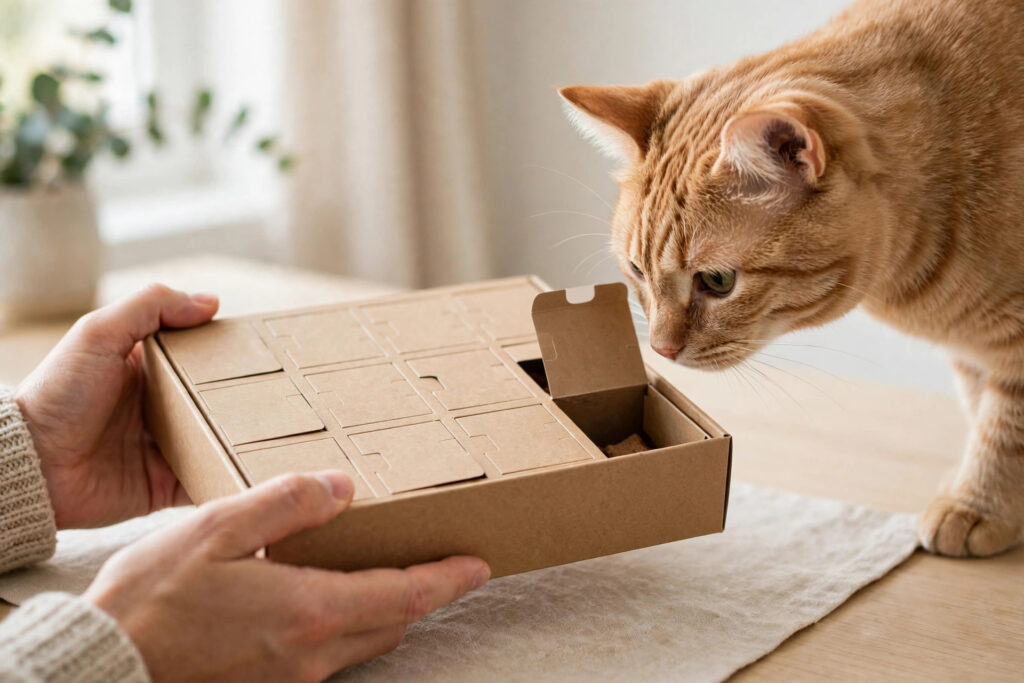
Cats have a reputation for being above the holiday frenzy, and it’s mostly earned — right up until there’s a small daily box of treats involved. Cat advent calendars have moved from novelty to a real category: the APPA’s 2026 holiday guide featured a 25-day air-dried cat treat calendar from PureBites, and pet retailers now stock treat, toy, and refillable versions aimed squarely at cats. Your cat will not care about the countdown. Your cat will care deeply, by about day three, about the sound of a tiny door opening.
But a cat is not a small dog, and the cat version of this ritual has its own traps. Cats run on a tight calorie budget. Many are on carefully chosen diets for urinary health or weight. And a calendar that introduces a brand-new protein every day can quietly wreck a sensitive stomach — or an elimination diet your vet has you running for a reason. So let’s do the math honestly, look at the formats that work for picky and medical cats, and figure out how December’s treats fit into a 200-calorie day.
Key Takeaways
- The budget is tiny: an indoor cat eats roughly 200–250 calories a day, so a daily calendar treat takes a real bite out of the 10% extras allowance.
- One protein, repeated, beats 24 surprises: a new protein every day can upset sensitive stomachs and completely undo an elimination diet.
- Medical diets change the pick: cats on urinary or weight-management diets do best with toy-only or fill-your-own calendars stocked with approved treats.
- Air-dried and freeze-dried treats are the quality end: single-protein calendars like the PureBites 25-day edition suit cats whose owners read labels.
- Lickable treats are stocking stuffers, not meals: for small cats, a partial tube is a treat; a whole tube a day is a habit with consequences.
The Calorie Math: What 24 Days Actually Adds
Start with the budget. A typical indoor cat needs roughly 200–250 calories a day to hold a healthy weight — call it 225 for a mid-size cat. Using the standard guideline that treats and extras should stay under 10% of daily intake, that cat’s entire treat allowance is about 20–25 calories a day. Every day, all treats combined.
Now the calendar. Treat calories vary by brand, so read the feeding guide on your box, but the arithmetic is unforgiving in a way it isn’t for dogs. Say a calendar’s daily portion comes to 10 calories of treats. That’s nearly half your cat’s extras budget — manageable, if the calendar replaces other treats. Say it comes to 25 calories, which plenty of generous portions do. That is the whole day’s treat allowance, spent before anyone slips the cat a bit of turkey or opens a lickable tube in the evening. Over 24 days, an unadjusted 25-calorie daily extra adds up to roughly 600 calories the cat didn’t need — in a species where a single extra pound is a meaningful percentage of body weight.
The fix is the same one that works for dogs, scaled down: the calendar is the treat budget for December. Trim a teaspoon or two of kibble on calendar days, pause the other extras, and don’t double up after a missed day. Cats are creatures of routine, and yours will adapt to the calendar ritual instantly. The discipline is for the humans.
The New-Protein-Every-Day Problem
Variety is the selling point of many treat calendars — a different flavor behind every door. For a cat with a sturdy stomach, fine. But cats are famously conservative eaters with sensitive digestive systems, and a daily rotation of chicken, then salmon, then duck, then rabbit is a recipe for soft stool, food refusal, or both. Cats also form strong preferences: a calendar that lands on a hated flavor on day 9 can poison the ritual entirely, because the cat starts approaching the box expecting disappointment.
The harder line is elimination diets. If your vet has your cat on a single-protein or hydrolyzed diet to hunt down a food allergy, a mixed-protein calendar doesn’t just add calories — it destroys weeks of careful work and can trigger the very symptoms you’re trying to diagnose. The same caution applies to cats with inflammatory bowel disease or a history of pancreatitis. For these cats, the calendar has to be built from the one protein (or the one approved treat) already in the plan.
This is why single-protein calendars deserve their good reputation. An air-dried calendar built on one protein, like the 25-day PureBites edition the APPA highlighted in its 2026 holiday guide, gives you the daily ritual without the daily ingredient lottery. Whatever brand you pick, the label question is simple: how many proteins are in this box, and are they all already in my cat’s diet?

Calendars for Cats on Urinary and Weight-Management Diets
Urinary diets work by controlling mineral levels and urine pH, and they only work if they’re essentially the whole diet. Random treats — especially fish-heavy ones — can work against the formula’s design. If your cat eats a urinary diet, the calendar options narrow to three safe lanes: treats made by the same prescription diet lines and approved by your vet, a toy-only calendar, or a fill-your-own calendar stocked with a few pieces of the cat’s own prescription kibble, which most cats accept as treats when they’re hand-delivered with ceremony.
Weight-management cats face the simpler math problem: their daily calorie target is already a deficit, so a daily treat surplus quietly erases it. Toy-only calendars are the clean answer — the ritual survives, the calories don’t happen. If you do use treats, weigh the cat at the start and end of December and let the scale audit the experiment.
Toy-only calendars for cats hide small balls, catnip toys, springs, and crinkle toys behind the doors. Two cautions: supervise string and ribbon toys, which are linear foreign body hazards if chewed and swallowed, and check catnip toys for a cat who’s never had catnip — about a third of cats don’t respond to it at all, which makes a catnip-heavy calendar a box of mild indifference.
Fill-Your-Own: The Cat Version
Refillable fabric or wooden calendars solve nearly every cat problem at once. You stock them with your cat’s actual treats, in portions you control, with zero new ingredients. For a cat on a medical diet, fill pockets with the approved treat or a few kibbles. For a picky cat, fill them with the one treat she’d commit crimes for. Mix in a few non-food days — a new spring toy, a fresh catnip mouse — and the calorie load drops further while the ritual stays intact.
Portion guidance that works: each day’s pocket should hold a genuinely small amount, roughly what you’d give as one treat session — a few small treats, not a filled compartment. If you can’t close the pocket without pressing down, it’s too much. Weigh the filled calendar’s daily portions once, at the start, and you’ll know exactly what December costs.
Reading a Cat Calendar Label Before You Buy
Cat treat labels reward a suspicious reader. Start with the protein list: a calendar that names one protein, in words like “chicken” or “salmon,” is a different product from one built on “meat by-products” and a rotating cast of flavorings. Count the proteins across the whole box, not just the first door — variety packs are where the daily-rotation problem hides. Then find the calorie statement or feeding guide and do the budget check from earlier: how big a slice of a 20–25 calorie daily treat allowance is each day’s portion?
Two more checks. Look for a best-by date that actually covers the holiday season; air-dried and freeze-dried treats hold up well, but soft treats in calendars bought on deep clearance may be near the end of their run. And if your cat takes any medication or eats any prescription diet, treat the calendar like any other new food — a quick call or message to your vet’s office before December is cheaper than an appointment during it.
Lickable Treats as Stocking Stuffers
Lickable treats — the squeezable tubes of puréed meat or fish — have become the default cat stocking stuffer, and they’re genuinely useful: great for bonding with shy cats, handy for pilling practice, and portion-controlled by design. The catch is in the words “by design.” One tube looks small, but for a small cat on a 200-calorie day, a full tube every day is a significant, permanent addition to the diet — the kind that shows up as a pound by spring.
A sensible pattern: half a tube for a small cat as an occasional treat, squeezed slowly and shared as an event rather than a snack, with the rest refrigerated and used within a day or two. Rotate lickable days with regular treat days instead of stacking both. And check the flavor against your cat’s diet rules — lickables come in many proteins, and the medical-diet cautions above apply to them exactly as they do to calendar treats.

Frequently Asked Questions
How many calories are in a cat advent calendar, total?
It depends entirely on the brand, so check the feeding information on the box. The useful comparison is daily: your indoor cat’s whole treat budget is roughly 20–25 calories a day. If the calendar’s daily portion is close to or above that, it needs to replace all other treats and come with a small trim to regular meals.
Can a cat on a urinary diet have a treat calendar?
Not a standard one. Random treats can interfere with how a urinary formula works. Use treats approved by your vet for that diet, a toy-only calendar, or a refillable calendar stocked with pieces of the cat’s own prescription food.
Is it okay that the calendar has a different flavor every day?
For a cat with a robust stomach, probably. For a sensitive cat, a new protein daily is a common cause of soft stool and food refusal — and if your cat is on an elimination diet, it invalidates the diet completely. Single-protein calendars or fill-your-own formats are safer bets.
How much of a lickable treat tube should I give my cat?
For a small cat, half a tube as an occasional treat is a good working portion; larger cats can have a full tube now and then. What matters is frequency — a tube a day, every day, adds up to real weight on a 200–250 calorie budget. Refrigerate the open tube and use it within a day or two.
My cat lost interest in the calendar after a week. What happened?
Usually one of two things: a flavor she disliked reset her expectations, or the treats were never that exciting compared with the box itself. Try hand-feeding the treat away from the calendar, rotate in a favorite on alternate days, and don’t take it personally if the cardboard ends up being the real gift.
The Bottom Line
A cat advent calendar can be a sweet December ritual — as long as it respects the two facts of cat life: the calorie budget is tiny, and the stomach prefers routine. Do the math on your box’s daily portion, favor single-protein or fill-your-own formats, keep medical diets fully intact, and portion lickable treats like they count, because they do. Do that, and the only thing your cat gains in December is a new morning habit.