Walk into any pet store in December and the bird aisle looks like an afterthought — a wall of brightly colored toys in random sizes, most of them wrong for the bird on your list. That’s the whole problem with gifting for birds. A toy built for a macaw can trap a budgie’s toe in its hardware. A toy built for a budgie gives a macaw about one satisfying crunch before it’s confetti. The bird doesn’t care that it’s Christmas. The bird cares whether the gift fits its beak, its feet, and its attention span.
So this guide is organized the way bird gifts should be: by size first, species second. Three bands — budgies and cockatiels, conures and other small parrots, and African greys up through macaws. Inside each band you’ll find the same winning formula: something to forage from, something to shred, and one bigger upgrade for the bird who’s been extra good this year. If you only remember one thing, make it this: a pet bird would rather work for a treat than be handed one, and the best gifts on this list are jobs disguised as presents.
Key Takeaways
- Size comes before everything: Match the toy to the bird’s beak and feet — a macaw toy can injure a budgie, and a budgie toy is a one-bite snack for a macaw.
- Foraging beats the food bowl: Foraging wheels, refillable foraging blocks, and treat-hiding toys keep a bird busy far longer than a new perch.
- Shreddables are meant to die: Palm, balsa, and pinecone toys exist to be destroyed — a shredded toy is a successful gift, not a wasted one.
- One upgrade per band: A play stand for small birds, a bigger play gym for conures, a flight-cage upgrade for large parrots.
- Skip the dangerous gifts: Loose rope fibers, tiny detachable parts, beak-trapping bell clappers, mystery metals, and fabric happy huts don’t belong in any stocking.
Band One: Budgies, Cockatiels, and Other Small Birds
Foraging gifts for small beaks
Small birds are patient workers. A budgie will spend twenty minutes worrying a single millet spray out of a woven holder, and that twenty minutes is the gift. Look for small foraging wheels — clear or colored spinning wheels with compartments you load with seed or chopped treats — sized for little beaks, with compartments a budgie can actually reach into. Refillable foraging blocks work beautifully at this size too: a soft block the bird picks apart layer by layer, restuffed with treats each morning. The American Pet Products Association featured holiday refill blocks for birds in its 2026 holiday gift coverage, and the format makes sense — the block is the toy, the refills keep it interesting through January.
Woven seagrass pockets and little palm-leaf pouches are the budget stars of this band. Tuck a few sunflower seeds or a piece of spray millet inside, hang the pouch near a favorite perch, and let the bird excavate. Cockatiels, who are ground foragers by nature, also love a shallow foraging tray scattered with seed and shredded paper on the cage floor — a gift that costs almost nothing and mimics how they’d feed in the wild.
Shredding gifts for small beaks
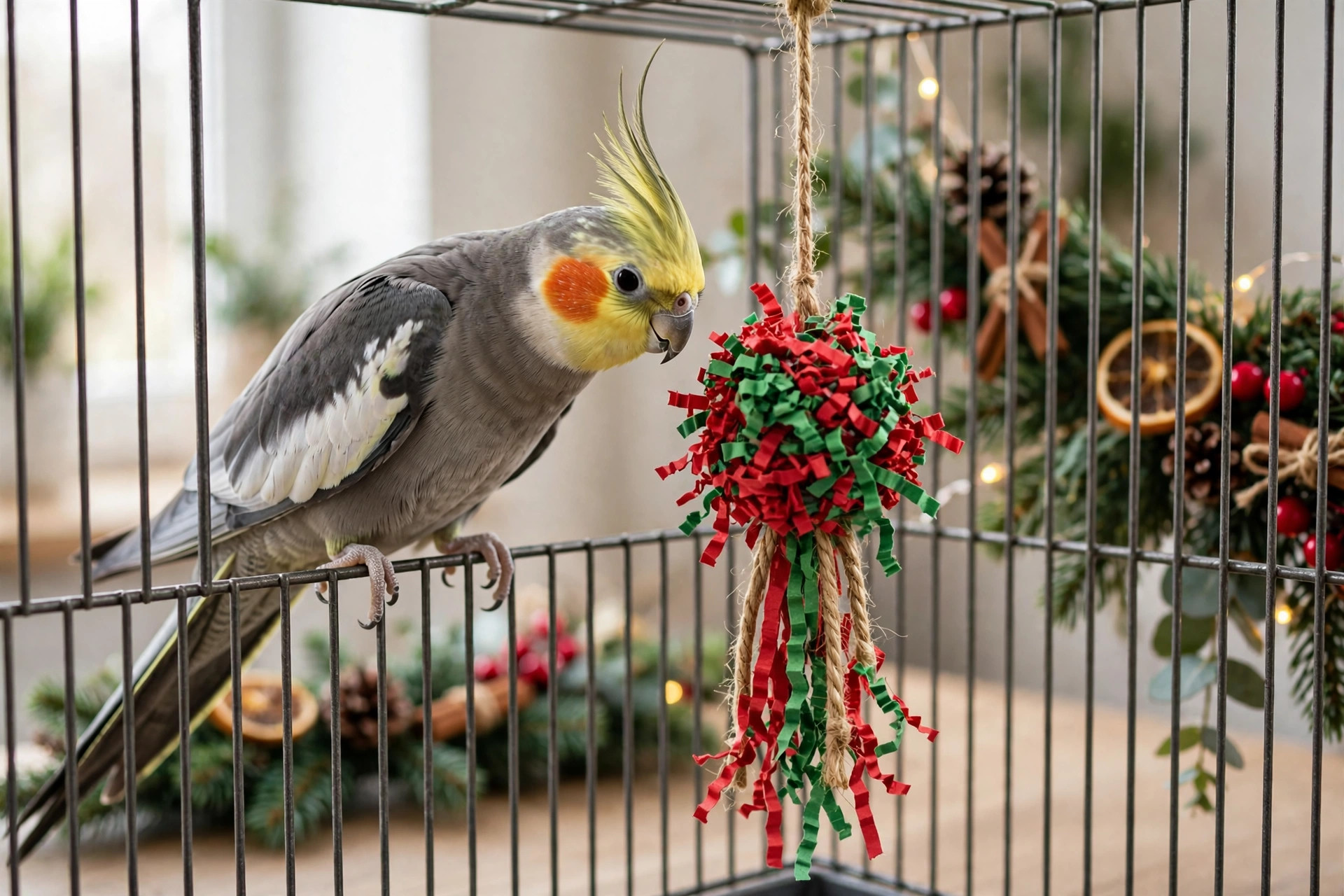
Balsa is the small bird’s best friend: soft enough for a budgie to carve, satisfying to destroy, and safe to chew. Palm-leaf shredders, finger traps stuffed with crinkle paper, and natural pinecones (cleaned and baked, or bought bird-safe) all land well. A cockatiel presented with a pinecone smeared lightly with a bit of nut butter and rolled in seed will forget you exist for an hour. That’s not rudeness. That’s enrichment working.
The upgrade: a tabletop play stand
For the small bird who has toys already, the bigger gift is real estate outside the cage. A tabletop play stand with a couple of perches, a ladder, and a swing gives a budgie or cockatiel a home base for out-of-cage time — somewhere to land that isn’t your laptop keyboard. It also makes holiday photos considerably easier, which nobody admits is a factor and everybody enjoys.
Band Two: Conures and Small Parrots
Foraging gifts for busy minds
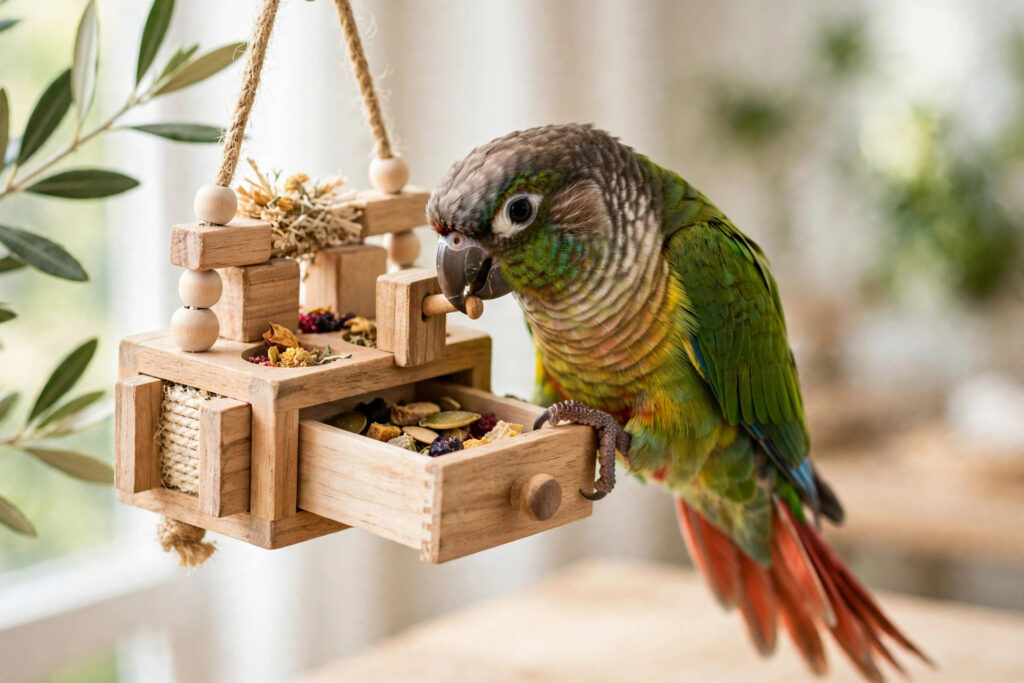
Conures are toddlers with bolt cutters. They need foraging toys with moving parts: wheels with compartments that spin and click, acrylic foraging drawers they learn to pull open, and refillable blocks sturdy enough to survive a determined beak for more than a day. A green-cheek or sun conure figures out a simple puzzle in an afternoon, so choose toys you can make harder — deeper hiding spots, lids that close, treats wrapped in paper inside the compartments.
Hanging foraging cups are a conure favorite: a row of small cups on a chain, treats in one or two, lids or paper covers on all of them. The bird checks every cup, every time, just in case. That checking behavior is exactly what you’re buying.
Shredding gifts for serious chewers
Step up the materials here. Soft pine, thicker balsa, yucca slices, and woven palm in bigger weaves all suit conure beaks. Pinecones still work — go bigger. A conure working through a yucca-and-palm shredder is doing the same beak maintenance and mental work it would do stripping bark in the wild. Expect destruction within days, and budget for these as consumables, not decorations. Our guide to shredding toys for birds goes deeper on materials by species if you want to stock a rotation drawer.
The upgrade: a proper play gym
The conure-band upgrade is a floor or tabletop play gym with room to climb — ladders, a swing, multiple perch levels, and space to hang two or three toys. Conures are athletic and social; a gym near the family’s main living space lets the bird be part of the holiday noise without being in the middle of the cooking. Place it away from the kitchen itself, since fumes from overheated nonstick cookware are dangerous to birds, and the holiday season is peak nonstick season.
Band Three: African Greys, Amazons, and Macaws
Foraging gifts for the honor students
African greys are famously methodical, and macaws are famously not — they’re powerful. Both need foraging toys built like safes. Large foraging wheels with heavy-duty compartments, stainless or thick acrylic puzzle boxes, and refillable foraging blocks in hard-wearing formats are the right tier. A grey will study a new puzzle, solve it, and then solve it faster every day; rotate two or three puzzles so the challenge stays fresh. For a macaw, the puzzle also has to survive being solved by force, so hardware matters as much as cleverness — thick materials, secure hangers, nothing that bends.
Lafeber Pet Birds, the avian vet resource, consistently frames foraging as a core daily need for large parrots rather than an occasional treat, and the holiday season is the perfect excuse to rebuild your bird’s whole foraging setup at once: wheel, block, puzzle, and a skewer for whole vegetables the bird has to dismantle to eat.
Shredding gifts for demolition crews
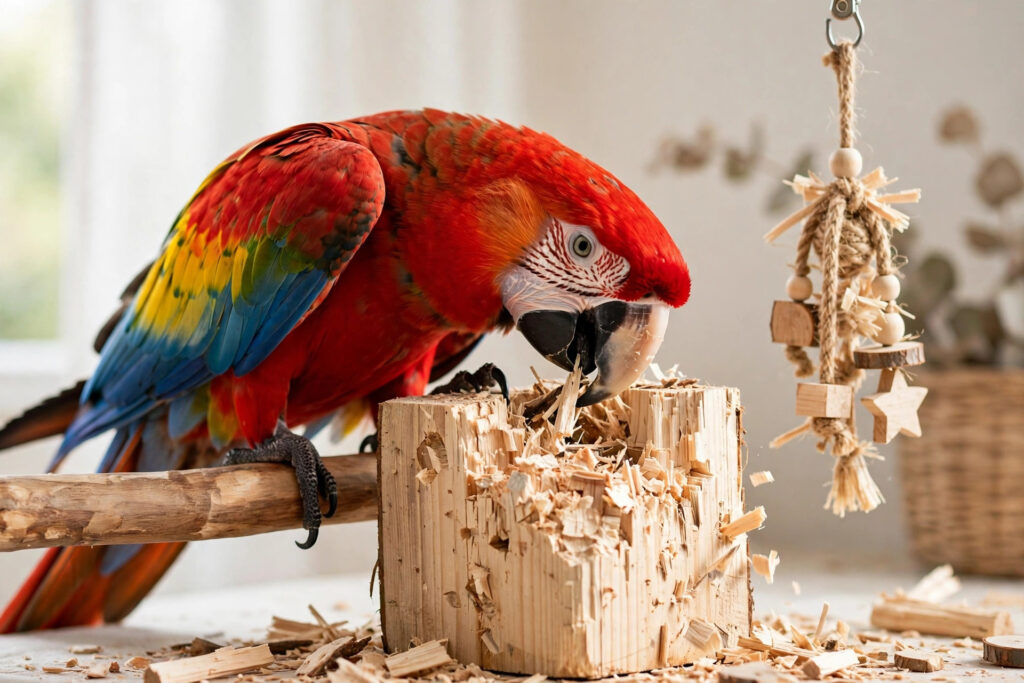
Macaw-grade shredding means chunky pine blocks, thick balsa stacks, coconut shells, and big pinecones. A large parrot reduces these to splinters with obvious joy, and that’s the correct outcome — chewing is beak exercise, stress relief, and entertainment in one. Buy these in multiples. A macaw with a fresh block to destroy is a macaw not redecorating your door frame.
The upgrade: the flight cage
The biggest gift in this guide is a flight-cage upgrade for a large parrot who’s been in a snug cage. More horizontal space, room for a full wing stretch and short flights, space for the foraging station and the shredding zone to exist at the same time. If a full cage upgrade isn’t in the cards this year, a large Java-wood or natural-wood play stand is the runner-up — a serious piece of furniture the bird will use daily for years. Our breakdown of cage bar spacing is worth a read before ordering any cage, since spacing that’s wrong for the species is a safety problem, not a detail.
Gifts to Skip: The Unsafe List
Every year, well-meaning people give birds things that hurt them. Run any gift against this list before it goes in the cage.
- Loose string and frayed rope: Worn rope toys shed fibers that wrap toes and legs, and swallowed fibers can tangle in the crop. Retire rope toys when they fray; never gift a bird a toy already unraveling.
- Tiny detachable parts: Small plastic pieces, cheap links, and decorations a beak can snap off become choking and ingestion hazards — a real risk in the larger bands, where beaks are tools.
- Bells with exposed clappers: The little ball or cylinder inside a cheap bell can trap a beak tip or tongue. Tube-style bells and intact, well-made bells are safer; inspect any bell before hanging it and weekly after.
- Unknown metals and coatings: Zinc and lead are toxic to birds, and mystery hardware from bargain toys is a gamble. Stick with stainless steel hardware and toys from bird-specific makers, and skip anything with flaking paint or a strong chemical smell.
- Fabric happy huts: The cozy fleece tent is the most debated gift in the bird world. Birds chew the fabric, and ingested fibers can build up in the crop; the enclosed nest-like space also encourages hormonal behavior in many species. A flat seagrass sleep platform gives the cozy corner without the tent. Skip the hut.
How to Give the Gift (Yes, There’s a Technique)
New objects scare many birds. A macaw may eye a new wheel like it owes him money; a budgie may refuse to approach a new pouch for three days. Hang new toys outside the cage, in sight, for a day or two. Move them to the cage door, then inside near — not on top of — the bird’s favorite perch. Play with the toy yourself if the bird is watching; parrots take social cues seriously. And introduce gifts one at a time across the holiday week rather than redecorating the whole cage on Christmas morning. A rotation also means the fun lasts into January, which is the entire point of a rotation drawer.
Frequently Asked Questions
How many new toys should I give my bird at once?
One at a time is the sweet spot for most birds. A cage suddenly full of new objects can stress a shy bird, and even a bold one can only play with so much. Give one gift, let the bird accept it, then add the next a few days later. The extras become your January rotation stock.
Are Christmas-themed bird toys safe?
The theme is fine; the construction is what matters. Check themed toys the same way you’d check any toy: bird-safe materials, stainless hardware, no loose fibers, no tiny detachable parts, and no exposed bell clappers. Red and green dye on wood is common in bird toys — buy from bird-specific brands that use bird-safe coloring, and avoid craft-store decorations, which aren’t made to be chewed.
My bird destroys every toy in a day. Am I wasting money?
No — you’re succeeding. Shredding toys are consumables by design, and a destroyed toy means the bird got hours of beak work and entertainment. If the budget stings, lean on the cheap end: cleaned pinecones, plain cardboard, and woven palm cost very little, and rotate the pricier foraging toys so they last longer.
Can I give a bird a gift card-style “experience” instead?
In bird terms, yes: time and novelty are gifts. A new play stand location, a supervised shower perch session, a window view of the yard, or an afternoon of foraging games scattered on a clean tray all register as enrichment. Birds don’t know what day it is. They know when their world got more interesting.
What’s the best gift for a bird I don’t know well, like a relative’s parrot?
Ask the owner for the bird’s size band and one thing it loves to destroy, then buy a quality shredding toy or refillable foraging block in that band from a bird-specific brand. If you’re truly guessing, a natural pinecone-and-palm shredder sized for the species is the safest crowd-pleaser — and skip food gifts unless the owner approves the brand, since diets vary and some birds have medical restrictions.
The Bottom Line
Buy by size band, spend on foraging before decoration, and treat shredding toys as the consumables they are. A budgie with a stuffed seagrass pouch, a conure rattling a foraging wheel, a grey dismantling a puzzle block — those are birds having a genuinely good Christmas. The unsafe list is short, the good options are many, and a bird working happily on a gift is a better holiday soundtrack than most carols.