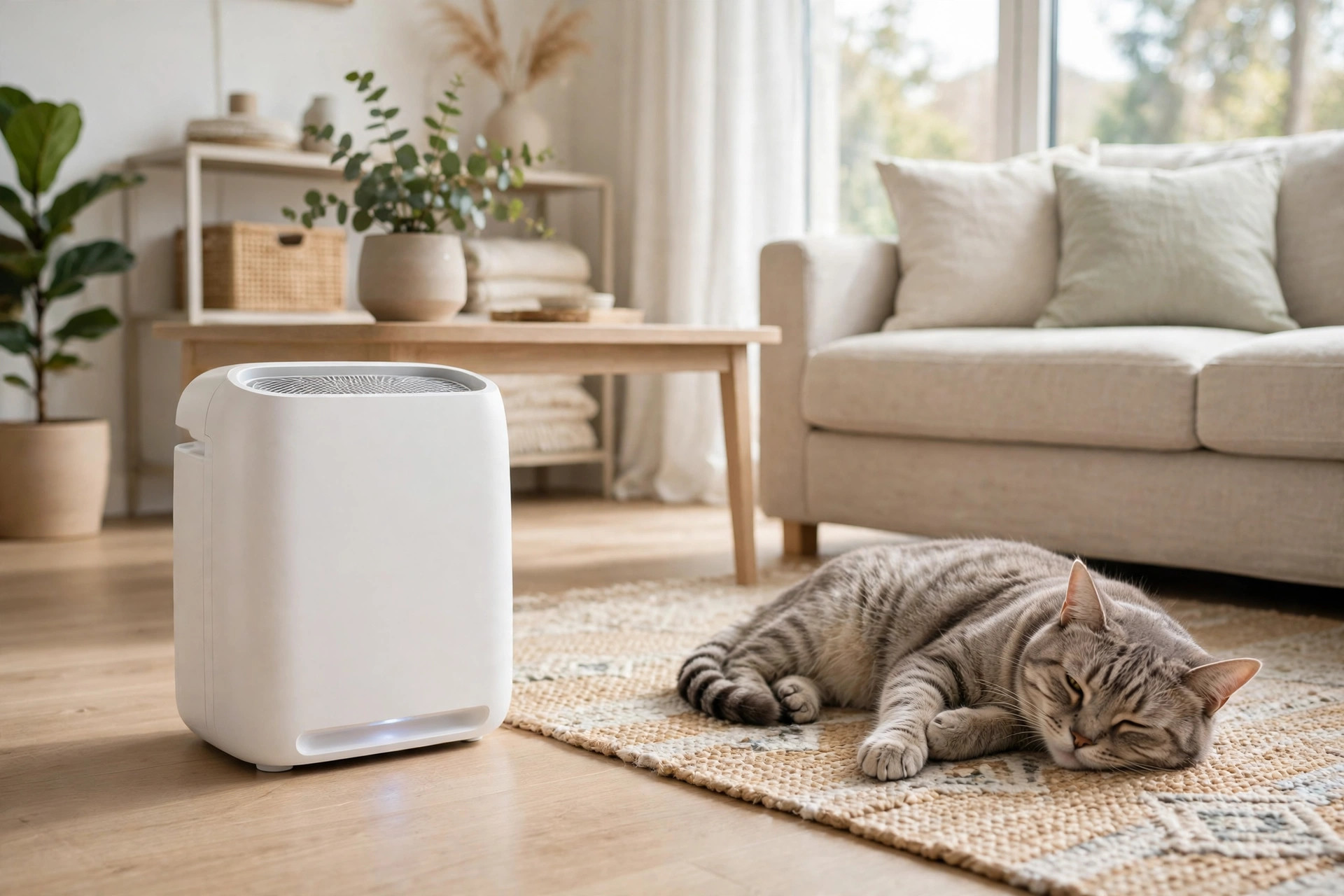
Searches for pet air purifiers are up about 109% year over year, and the reason is sitting in living rooms across the country, shedding. Cat ownership keeps climbing, more of those cats live fully indoors, and their owners have started asking a fair question: why does the house smell like the litter box by Thursday, and why is everyone sneezing? An air purifier sounds like the tidy answer — plug it in, breathe easier. And it can help, genuinely. But a purifier is two different machines wearing one box, and which half of it is strong decides whether it fixes your dander problem, your smell problem, both, or neither. That split is the whole ballgame, and most product pages blur it on purpose.
So before the placement tips and the buying math, here’s the one idea to hold onto: particles and gases are different problems. Dander is a particle. Litter smell is a gas. Filters that catch one barely touch the other. Everything below builds on that.
Key Takeaways
- HEPA is for dander: A true HEPA filter traps the tiny dander particles that trigger allergies. No HEPA, no dander control — whatever the box claims.
- Carbon is for smell: Litter-box odor is mostly ammonia and other gases, and only a substantial activated carbon filter absorbs those. A thin carbon sheet won’t cut it.
- Size it with CADR: Match the purifier’s clean air delivery rate to your room size, or it will run all day and lose.
- Placement matters: Near the litter zone but out of the dust kick-up path, with clear space around the intake.
- Filters are the real cost: Budget for replacements — a clogged filter quietly turns an expensive purifier into a fan.
The Filter Split: HEPA Catches Dander, Carbon Eats Smell
True HEPA and the Dander Problem
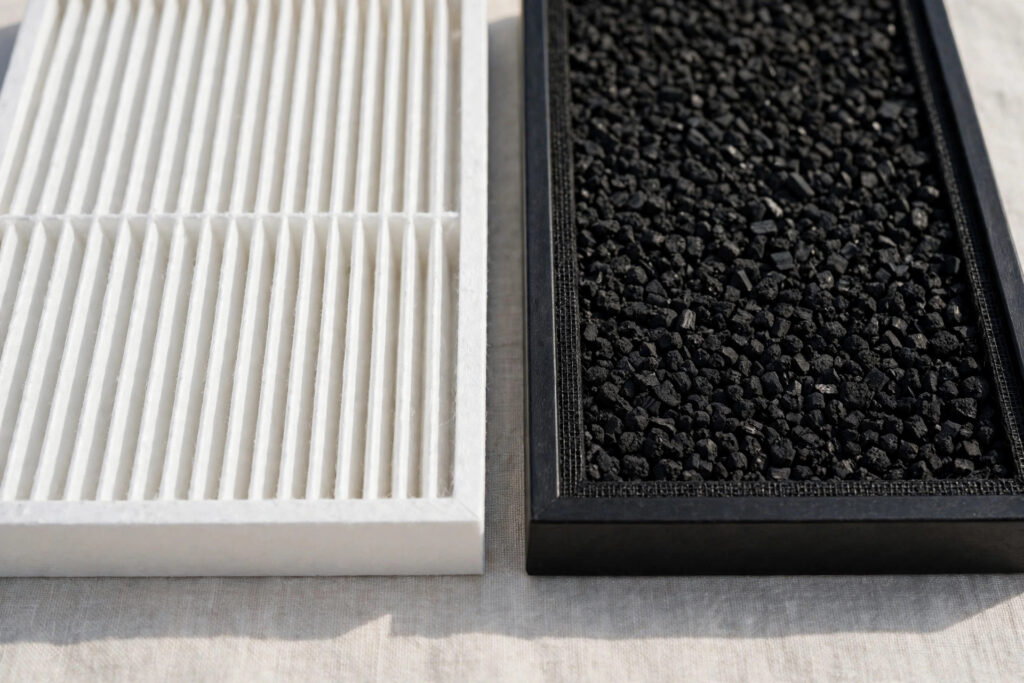
Cat dander — the microscopic flakes of skin and dried saliva proteins that set off allergies — is a physical particle, and a small one. A true HEPA filter is built to trap particles exactly in that range, pulling air through a dense mat of fibers that dander can’t pass. That’s the mechanism that matters if your problem is sneezing, itchy eyes, and a cat who sleeps on the pillow. Two cautions. First, “HEPA-type” and “HEPA-style” filters are not HEPA; they’re marketing cousins with looser standards, and the difference shows up in your sinuses. Second, HEPA only cleans the air that actually passes through the machine — which is why sizing and placement, covered below, decide whether a good filter does you any good.
Activated Carbon and the Litter Problem
Litter smell is mostly gas — ammonia from urine, plus a supporting cast of organic odors — and gases sail straight through a HEPA filter like it isn’t there. Absorbing them is activated carbon’s job: a bed of treated charcoal with enormous internal surface area that traps gas molecules as air passes. Here’s the catch that separates real odor control from decoration: carbon works in proportion to how much of it there is. A heavy, thick carbon filter with pounds of media can genuinely cut litter smell in a room. The paper-thin carbon pre-filter sheet on many units is there to catch dust and hair before the HEPA — useful, but it will not deodorize anything. If litter smell is your main complaint, shop by carbon weight and replaceable carbon filters, not by the word “carbon” on the box.
Many cat homes need both halves: HEPA for the allergic human, carbon for the litter corner. Some units do both well. Plenty do one well and gesture at the other. Reading spec sheets with the split in mind is the fastest way to sort them.
CADR and Room Size, in Plain Language
CADR — clean air delivery rate — is simply how much filtered air a purifier puts out, measured in cubic feet per minute. The working rule is easy: for good results, the CADR should be at least two-thirds of the room’s square footage. A 150-square-foot bedroom wants a CADR around 100 or higher; a 300-square-foot living room wants 200 or more. Manufacturers also print a “recommended room size” — check whether that number assumes the machine running on its loudest turbo setting, because many do, and nobody sleeps next to a purifier on turbo.
Running a purifier one size up, on a quieter medium speed, beats running an undersized one flat out. And keep expectations honest: a purifier treats the room it’s in. The litter corner in the laundry room will not be saved by a unit in the bedroom, which is why multi-cat homes often end up with the main unit where the litter boxes live and a smaller one where the allergic person sleeps.
Where to Put It: Near the Litter Zone, Out of the Dust Path
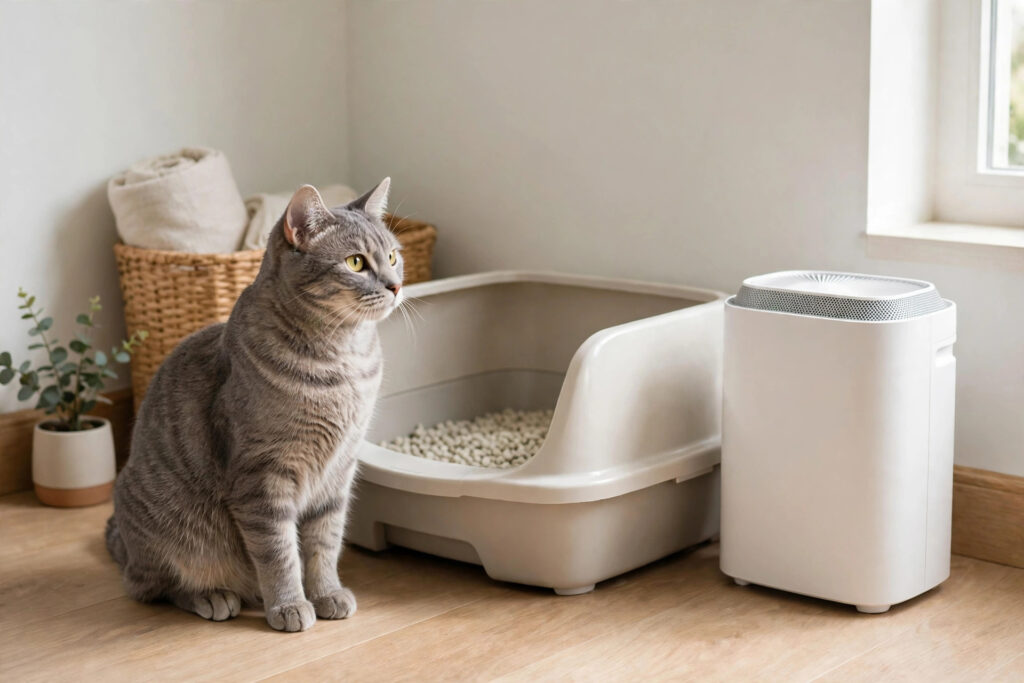
Placement is free performance. Put the purifier in the same room as the litter boxes, a few feet away from them — close enough that it draws in the air around the boxes, far enough that it isn’t sitting in the direct line of kicked-up litter dust, which will clog its pre-filter in a hurry and shorten the HEPA’s life. Give the intake room to breathe: purifiers pull air from the sides or back, so a unit shoved flush into a corner or boxed in by furniture is cleaning a much smaller room than you think. A few inches of clearance all around, per the manual, is the minimum.
Two more placement notes. Keep the unit on the floor or a low, stable surface — dander and dust circulate low, and that’s the air you want it processing. And think about the cat: don’t aim the outflow at the litter box itself or block the cat’s route to it. A purifier that startles a cat away from the box creates a much worse problem than the one it solves. Most cats accept a steady low hum within a day or two; run it on its quiet setting near the box and let them get used to it.
The Real Running Cost: Filters
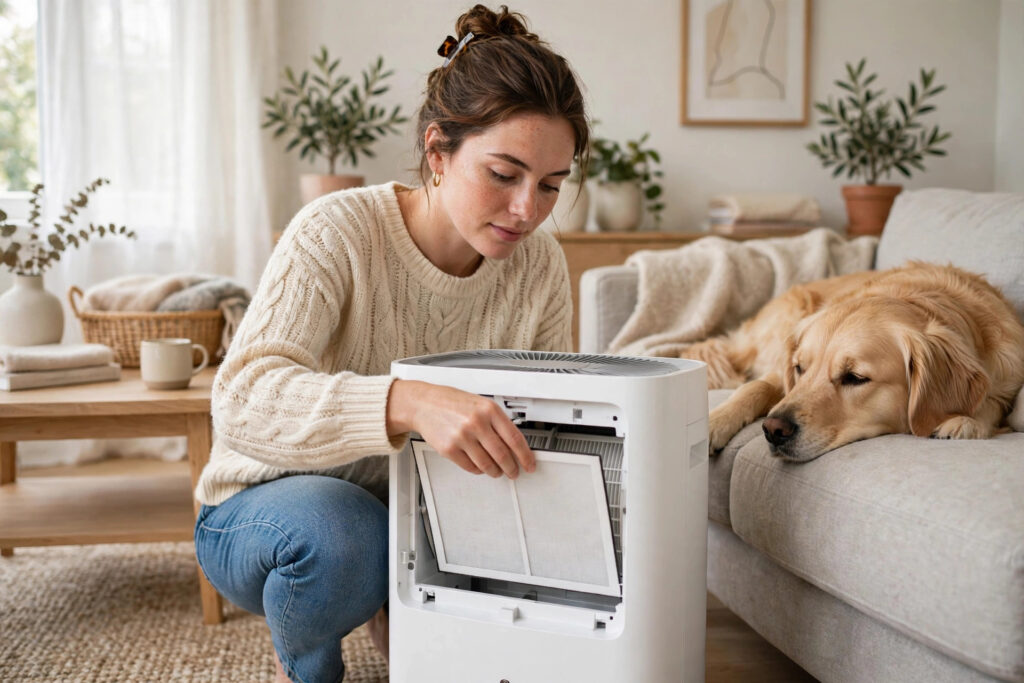
The purchase price is the down payment. The subscription you didn’t know you signed is filter replacement: HEPA filters typically need swapping every 6 to 12 months, carbon filters often sooner in a litter room, and a saturated carbon filter doesn’t just stop working — it can release trapped odors back into the air. A clogged HEPA chokes airflow, so CADR quietly falls while the electricity bill doesn’t. Before buying any unit, price its replacement filters and check they’re actually stocked by the maker; a purifier with cheap, available filters beats a superior machine whose filters cost half its price and ship from nowhere. Vacuum or wash the pre-filter monthly if the design allows — in a cat home, that hair-catching layer is doing heavy work, and keeping it clear extends everything downstream.
Noise: The Spec Nobody Reads Until Bedtime
A purifier only helps while it’s running, and it only runs if the humans can stand it. Decibel ratings are usually quoted for the lowest setting — the one too weak to matter — so look for the noise level at the medium speed you’ll actually use, not the whisper number on the box. As a rough guide, a purifier in the low-to-mid 30s in decibels on its working setting is library-quiet and fine for a bedroom; once you’re past the mid-40s, most people start turning it off at night, which defeats the purpose in the room where dander control pays off most. Cats, for their part, adjust to a steady hum quickly — it’s a constant sound, not a sudden one. What they don’t love is a unit that clicks, rattles, or changes pitch as it cycles. If your cat avoids the room after the purifier arrives, check the sound before you blame the cat.
Honest Limits — and One Safety Caution
A purifier improves the air in a room. It does not scoop the box, and it can’t compensate for litter hygiene that has slipped — if the smell problem is a box that needs more frequent scooping, a second box, or a litter change, fix that first and let the machine handle the remainder. The ASPCA’s general cat care guidance covers the litter basics that no appliance replaces. And a purifier is for the humans: it helps you breathe easier around your cat. It is not a treatment for the cat. A cat who is sneezing, wheezing, coughing, or breathing with effort needs a veterinarian, not a gadget — respiratory signs in cats can point to asthma, infection, or worse, and clean air is not a diagnosis.
One safety flag for mixed-pet homes: avoid ozone-generating purifiers and strong ionizer models if you keep pet birds. Birds have exceptionally efficient and sensitive respiratory systems, and ozone — a known irritant that some “air freshening” technologies produce — is dangerous to them at levels people tolerate. A plain mechanical setup, HEPA plus carbon with no ozone feature, is the safe configuration for bird homes and a perfectly good one for everyone else.
Frequently Asked Questions
Do air purifiers really help with cat allergies?
A true HEPA purifier reduces airborne dander in the room it runs in, and many allergic owners notice a real difference — especially in the bedroom, run overnight. It’s one tool among several (keeping cats off the pillow, washing bedding, grooming) and won’t eliminate dander, which also settles into carpets and furniture.
Why does my purifier not remove the litter box smell?
Probably because smell is a gas problem and your unit is a particle machine. Litter odor needs a substantial activated carbon filter; a thin carbon pre-filter sheet won’t absorb meaningful ammonia. Check the carbon weight of your filter, and whether it’s due for replacement — saturated carbon stops working.
What CADR do I need for my room?
Aim for a CADR of at least two-thirds of the room’s square footage — around 100 for a 150 sq ft bedroom, 200+ for a 300 sq ft living room. If a unit’s room rating assumes turbo speed, size up so you can run it quietly on medium.
Where is the best place to put an air purifier for litter smell?
In the litter room, a few feet from the boxes — near the odor source but out of the direct path of kicked-up litter dust, with clearance around the intake. Keep the outflow from blowing on the box itself so you don’t put your cat off using it.
Are ionizer or ozone air purifiers safe around pets?
Avoid ozone-generating models in homes with pet birds — ozone is hazardous to birds’ sensitive respiratory systems. Ionizers vary, but a straightforward HEPA-plus-carbon purifier with no ozone feature does the job without the question mark, for cats and birds alike.
How often do I need to replace the filters?
Typically every 6 to 12 months for HEPA, and often sooner for carbon in a litter room — follow the unit’s indicator and your nose. Factor replacement filter prices into the purchase decision; they’re the true long-term cost of owning a purifier.
The Bottom Line
The 109% surge in searches is easy to understand: more indoor cats, more owners who want the air to prove it less. Just buy with the split in mind — true HEPA for dander, serious activated carbon for litter smell, CADR matched to the room — put it near the litter zone with room to breathe, and keep up with the filters. Do that, and a purifier does exactly what it promises. Expect it to do the litter box’s job too, and no machine will save you.