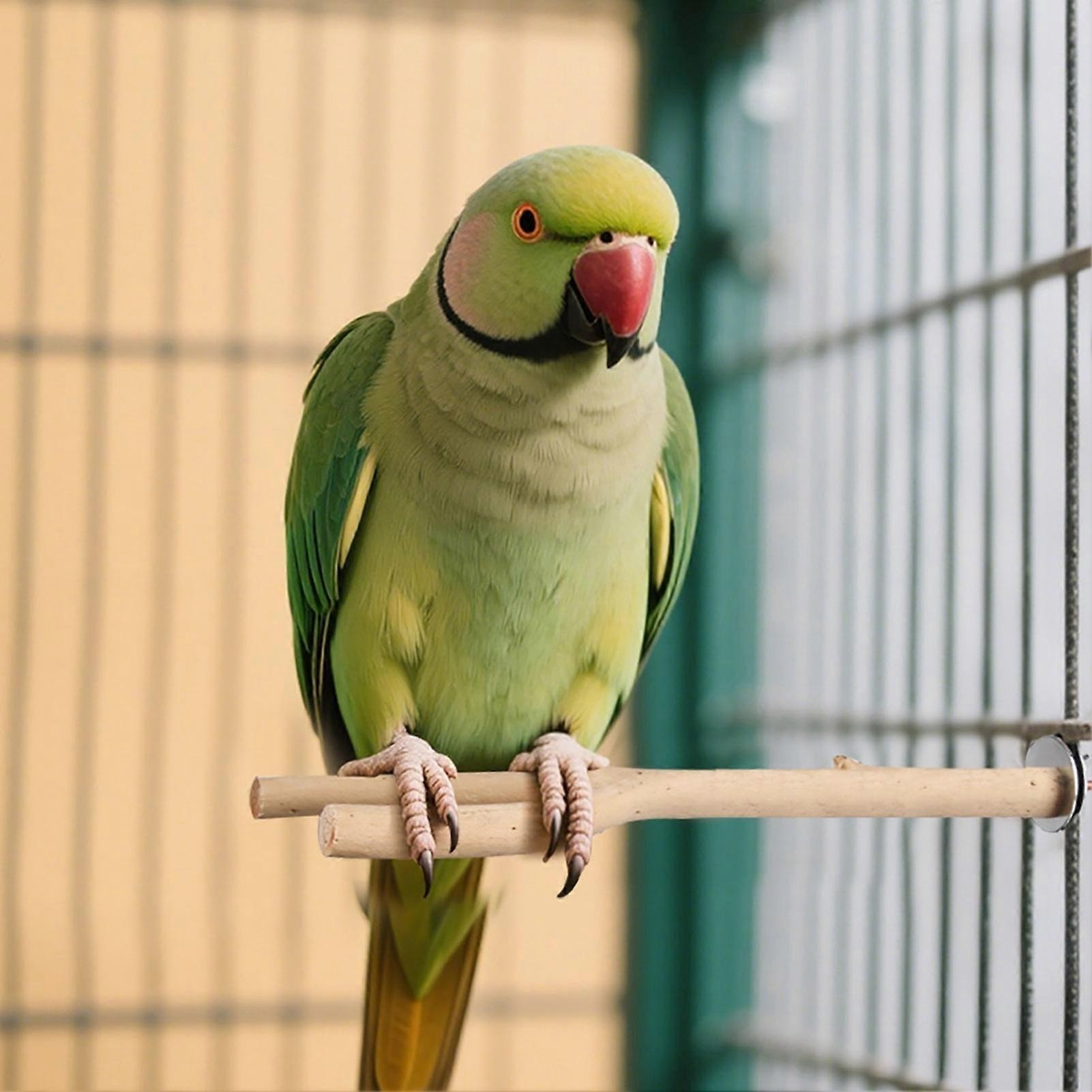
When I brought home my first cockatiel, his cage came with two smooth dowels, both the same width, stretched straight across like little highways. He used one. The other just collected dust — and, honestly, droppings. It took me a while to learn what experienced owners know: birds don’t need a cage full of perches. They need the right perches, in the right spots, in a few different sizes and textures.
So, how many perches does a bird cage need? For most pet birds, start with three to four: one high up for sleeping, one near food and water, one lower down for play and training, and one with a different texture — a natural branch, rope perch, or a single grooming perch used in moderation. A small cage might only fit three. A big flight cage can handle five or six, plus a swing. The real test isn’t a number. It’s whether your bird can move freely, spread his wings, reach his dishes, and still have a clear path to hop or flutter end to end. If he has to duck or fold his tail against the bars to turn around, you’ve overdone it.
Key Takeaways
- Most cages work best with 3 to 4 core perches: a high sleep perch, a feeding perch, a lower play perch, and one different-texture perch.
- Variety matters more than quantity. Mix diameters and surfaces so pressure on your bird’s feet keeps changing.
- Aim for toes that wrap roughly two-thirds to three-quarters of the way around a perch — not meeting underneath, not sitting flat on top.
- Never place a perch directly over food or water, and leave room behind it so a long tail isn’t bent against the bars.
- Skip sandpaper covers, remove rope perches when they fray, and check feet weekly for redness, swelling, or limping.
How Many Perches Does a Bird Cage Need? A Count by Cage Level

Think of a cage in levels, the way your bird does: a high, safe place to sleep, a middle zone for eating and hanging out, and a lower zone for playing and practicing step-ups. Give each level a job, and the count takes care of itself.
The high level: one sleep perch
Most birds head for the highest comfortable spot at night, returning to the same corner evening after evening. Make that perch a good one: sturdy, natural wood if you can, wide enough that he isn’t gripping for dear life all night. Don’t put the roughest grooming perch — or a swing — up here. Sleep calls for steady and boring, in the best way.
The middle level: one feeding perch and one hangout perch
Set one perch so your bird can reach food and water comfortably — close to the dishes, but offset, never directly above them. A second mid-level perch on the opposite side becomes the everyday hangout: preening, watching the room, supervising your morning coffee. Perches at opposite ends also encourage short flights or energetic hops, exactly the everyday exercise cage birds need.
The low level: one play or training perch
Down lower, add a perch near a toy, a foraging cup, or the door. This is the busy perch — for shredding, ringing a bell, or stepping up when it’s time to come out. A rope perch or small platform works well here, and the change of surface gives his feet a break from wood.
Your setup checklist
- One high sleep perch: natural wood, secure, in a quiet corner.
- One feeding perch: within reach of dishes, offset so droppings miss them.
- One mid-level hangout perch: a different diameter from the sleep perch.
- One low play perch: near toys or the door, a different texture if possible.
- Optional fifth: a swing, boing, or platform — only if the middle stays open.
- Open flight path: a clear lane end to end, no toys blocking it.
- Hardware check: every perch tight, no wobble or loose washers.
More ideas: browse our Bird Toys & Perches guides.
Why Variety Matters More Than the Number
Here’s the part nobody tells you at the pet store: your bird stands for nearly his entire life. He eats, plays, and sleeps standing. If all those hours are spent gripping a perch that’s the same width and smoothness, the same small patches on his feet take the pressure, day after day.
Outdoors, that never happens. A wild bird lands on a thick limb, then a skinny twig, then a rough branch that tilts a little. His toes wrap differently every time. Lafeber’s guide to parrot feet makes the same point for pet birds: perches should vary in size and shape so foot pressure keeps changing, and cleaned natural branches are ideal. That’s the goal — not more stuff, but more difference between the places your bird stands.
Perch Diameter Guide by Species Size

The simplest sizing check doesn’t need a ruler. Look at your bird’s feet while he’s perched. His toes should wrap about two-thirds to three-quarters of the way around. If front and back toes meet or overlap underneath, it’s too thin. If his toes sit flat on top like he’s standing on a sidewalk, it’s too thick. If he keeps shuffling, slipping, or avoiding a perch, believe him — something isn’t working.
VCA Animal Hospitals’ housing guide for small birds gives a similar rule, suggesting toes should wrap about three-quarters of the way around to grasp properly. Use the ranges below as cautious starting points, not exact prescriptions. Individual birds vary, and a natural branch varies along its own length — part of why branches are so useful.
- Budgies, parrotlets, and other very small birds: start around 3/8 to 5/8 inch (about 10–16 mm), with one slightly thinner and one slightly thicker option.
- Cockatiels and similar small-to-medium birds: start around 1/2 to 1 inch (about 13–25 mm). Many settle in the middle of that range, with a wider platform for resting.
- Conures and other medium parrots: start around 5/8 to 1 1/4 inches (about 16–32 mm), favoring sturdy wood that can stand up to an enthusiastic beak.
- Larger parrots: scale up, prioritizing strength and secure mounting over a precise number.
Diameter only works if the cage is big enough to hold perches without crowding. Still shopping? Read our guide to what size cage does a cockatiel need before stocking up on accessories.
Perch Types: Natural Wood, Rope, and Grooming Perches Compared
Natural wood perches

Pros: Your best everyday option. A real branch isn’t a perfect cylinder — it widens, narrows, and twists, so your bird’s grip changes with every step. It gives good traction, chewing it is enriching, and safe woods like manzanita, dragonwood, java wood, and applewood are widely sold ready-made. PetMD’s cockatiel care sheet likewise lists wood, braided rope, and natural branches as suitable materials, in assorted sizes and textures.
Cons: Wood is porous, so a badly soiled branch is harder to clean than plastic, and determined chewers will eventually destroy one. That’s not a failure — treat a chewed-up perch like a chewed-up toy: used up doing its job.
Rope perches

Pros: Soft, grippy, and kind to feet that need a break from hard surfaces. Rope bends, so you can run one in an L or a curve and create a route no straight perch could make. Many birds choose a rope perch or boing as a favorite lounging spot, and older birds often find it more comfortable.
Cons: Rope demands supervision. Check daily for fraying and chewed, fuzzy spots. A loose thread can wrap a toe, and swallowed fibers are a concern for birds that pick at them. The moment it looks ratty, trim the strands or take it out.
Grooming, mineral, and concrete perches
Pros: One textured grooming perch can help with nails and beak as your bird steps on and off it. Place it by a food dish or favorite toy — somewhere he visits often but doesn’t linger — so it gets used in short doses.
Cons: More isn’t better. A rough surface is a tool, not a home base. If your bird sleeps on it or spends most of the day there, constant abrasion can irritate the skin on his feet. One per cage is plenty, and never as the highest spot.
Platforms, dowels, and plastic perches
A flat platform lets your bird stand flat-footed and rest his grip completely — a real kindness for senior or disabled birds. As for the smooth dowels that come free with most cages, and basic plastic perches: they’re not poison, just bland. Keep one as a spare, but don’t let identical dowels be the whole setup.
Watch: Perch Types and Placement
Placement Rules That Make or Break a Setup

- Never perch over food or water. Anything under a perch gets droppings in it. Offset the feeding perch so your bird reaches the dishes from the side. If the water keeps getting soiled, a perch above it needs to move.
- Stagger the heights. One high, a couple in the middle, one low. Everything at one level means your bird only uses half the cage.
- Mind the tail clearance. Leave space between each perch and the bars behind it. A cockatiel’s long tail shouldn’t be bent or frayed against the wall every time he turns. Bent tail feathers? This is usually why.
- Keep the middle open. Perches belong at the edges and ends. The center is airspace — for wing stretches, short flights, and that dramatic morning flap session.
- Don’t stack perches in a column. A perch directly above another means the lower one gets rained on. Stagger sideways as well as vertically.
- Make every perch rock-solid. A perch that rolls or drops once can make a cautious bird avoid that whole corner. Tighten hardware on install, and re-check at every deep clean.
- Put a familiar perch by the door. A predictable “station” near the opening makes step-up practice calmer and gives a nervous bird a home base.
Foot-Health Signs Worth Watching For
Once a week, when your bird is relaxed, take a quiet look at his feet. You’re not looking for drama — you’re looking for change.
- Redness or swelling on the bottom of the foot
- A sore, scab, or smooth callus-like spot that wasn’t there before
- Constantly shifting weight from foot to foot, or holding one foot up more than usual
- Limping, reluctance to grip, or trouble staying on a perch he used to handle easily
- Overgrown nails that catch on rope and toys
- Sleeping on the cage floor, clinging to the bars, or avoiding perches altogether
Any of those signs is a reason to call an avian veterinarian rather than just swapping perches and hoping. A perch change can be part of the fix, but it isn’t a diagnosis.
Note: This section is general information, not veterinary advice. If your bird’s feet look sore or swollen, or he’s limping, contact a qualified avian veterinarian.
Cleaning, Rotation, and Replacement Routine
Perches get filthy, because your bird is standing — and, well, everything else — on them all day. A simple routine keeps them hygienic.
Daily: glance over every perch during your morning dish change. Knock off droppings, check rope for fraying, and confirm nothing loosened overnight.
Weekly: scrub perches with hot water and a bird-safe cleaner or diluted dish soap. Rinse thoroughly — residue matters to an animal that stands and chews on the surface — and dry completely before they go back in.
Every week or two: rotate for interest. Move the play perch, swap in a different branch, or change the nearby toy. But leave the sleep perch exactly where it is. At bedtime, a familiar roost is comfort, not boredom.
Replace without sentimentality when wood is cracked, deeply chewed, unstable, or too soiled to scrub clean; when rope frays faster than you can trim it; or when a grooming perch has worn smooth. For a shy bird, put the replacement alongside the old perch for a day — most hop on out of curiosity.
Unsafe Materials and Perches to Avoid
- Sandpaper perch covers: the classic bad buy. They don’t trim nails in any controlled way, and the abrasive surface can rub the skin on the foot raw. Skip them.
- Unknown or sprayed branches: wood treated with pesticide, collected beside a busy road, or taken from a toxic tree species has no place in a cage. If you can’t identify and clean it properly, buy a prepared branch instead.
- Galvanized or rusty hardware: flaking metal, rust, and unknown coatings on bolts and washers are a chewing hazard. Replace anything corroded.
- Frayed rope and loose fabric: once threads come loose, a comfortable perch becomes a toe trap — worn boings and rope swings included.
- Splintered, cracked, or wobbly perches: sharp splinters and sudden collapses are both avoidable. If it splinters or wobbles, it goes.
- Heated perches used carelessly: if you use one, make it one option among several — never the only warm place to stand — and check it regularly for damage.
Mistakes to Avoid
- Counting instead of watching. Four perches in a tiny cage is worse than three in a roomy one. Set up, then watch your bird move. His movement is the review that counts.
- Buying a matching set. Four identical perches is still just one perch, four times. Different widths, textures, and heights.
- Making the grooming perch the throne. The roughest perch should be a stop, not a residence — and never the sleep perch.
- Rearranging everything at once. A total makeover can unsettle a bird. Change one perch at a time and let him approve it first.
- Forgetting the birds who share. In a shared cage, watch who ends up on the floor at night. Somebody may need a high perch of their own.
- Ignoring the ignored perch. A perch unused for two weeks is the wrong size, texture, or place. Move it or replace it.
Frequently Asked Questions
Can a bird cage have too many perches?
Yes. Too many crowd out toys, block the open space your bird needs to stretch and flap, and make cleaning a chore you’ll start avoiding. If his tail brushes something on every turn, take one out. Open space is a feature, not a waste.
How many perches does a budgie need compared with a cockatiel?
The count is similar — three to four core perches — but sizes differ. A budgie needs thinner perches, starting around 3/8 to 5/8 inch, while a cockatiel does better around 1/2 to 1 inch. Cockatiels also need more tail clearance, so placement matters even more.
Should all perches be at different heights?
Mostly, yes. Varied heights encourage climbing and let your bird choose — high for sleeping, middle for eating, low for play. Two perches at a similar mid-level on opposite ends are fine, though, because that pairing invites movement back and forth.
How often should I replace wooden perches?
There’s no calendar date. Replace one when it’s cracked, deeply chewed, unstable, or too soiled to scrub clean. For a busy chewer that might be a few months; for a gentle budgie, much longer. Keep a spare on hand.
Is one grooming perch enough to keep my bird’s nails short?
It helps, but it isn’t a guarantee. Climbing and varied natural wood also wear nails, and some birds still need an occasional trim. If nails overgrow, catch on things, or change how your bird stands, ask an avian vet to check them rather than adding a second, rougher perch.