This guide contains affiliate links. As an Amazon Associate, PawChirp earns from qualifying purchases — at no extra cost to you. Read our full disclosure.
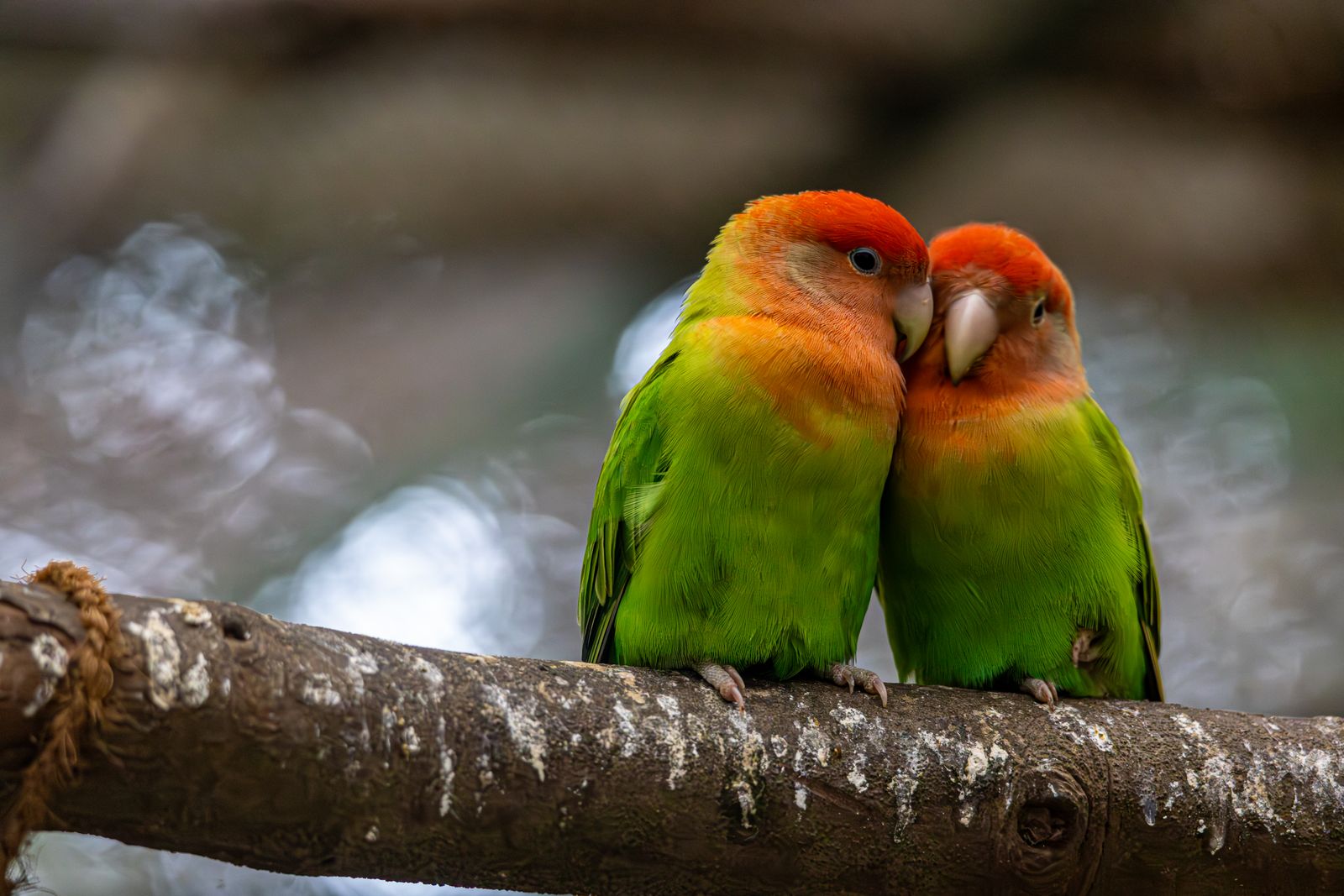
Lovebirds and budgies sit side by side in almost every pet store, and they look like near-identical choices: two small, colorful parrots, similar size, similar cage, similar food bag. They are not the same pet. One is arguably the best talking bird in the parrot family and socializes like a flock animal. The other bonds like a jealous best friend, bites harder, lives longer, and will test every latch on its cage. Lafeber’s species profiles sum up the lovebird as a “big parrot in a little bird’s body” — and that phrase explains most of what follows.
This lovebird vs budgie comparison covers the differences that decide daily life together — noise, talking, bonding, space, and lifespan — using figures from Lafeber, PetMD, VCA, and the Merck Veterinary Manual, each attributed where it appears. We finish with starter cage and food picks for whichever bird wins.
Key Takeaways
- Talking: the budgie wins easily — Lafeber calls it the best talking bird among the parrots. Lovebirds almost never learn speech.
- Noise: budgies chatter more, but softly. Lovebirds are quieter for longer stretches, then let out a high-pitched shriek that carries through walls.
- Bonding: a budgie spreads its affection around the flock. A lovebird picks one person (or one bird) and bonds hard — and needs daily handling to stay tame.
- Lifespan: the lovebird is the longer commitment — roughly 12–20 years in the sources below, against the budgie’s 7–15.
- Identical for both: the Merck Veterinary Manual sets the same floor for both species — a cage of at least 20 × 20 × 30 inches, bar spacing of 1/2 inch or less, and a pellet-first diet.
Lovebird vs Budgie at a Glance
| Trait | Budgie | Lovebird |
|---|---|---|
| Length | About 7 inches (PetMD) | About 5–6 inches (PetMD) |
| Typical weight | 30–40 g (2024 vet study) | 35–55 g (Lafeber) |
| Lifespan | 7–15 years (Lafeber); 10–12 with good care (PetMD) | 12–15+ years (Lafeber); captive average 10–20 (PetMD) |
| Noise style | Near-constant cheerful chatter and whistling | Quiet stretches, then a piercing call |
| Talking | Excellent mimic; learns words and phrases | Rarely mimics speech; whistles instead |
| Social style | Flexible flock bird; friendly with everyone | One intense, exclusive bond |
| Minimum cage | 20 × 20 × 30 in (Merck Veterinary Manual) | 20 × 20 × 30 in (Merck Veterinary Manual) |
| Bar spacing | 1/2 inch or less (Merck) | 1/2 inch or less (Merck) |
| Diet base | Pellets 60–80% of diet (VCA) | Pellets 70–80% of diet (PetMD) |
Size and Lifespan
On paper the two birds look evenly matched. A budgie runs about 7 inches from head to tail tip per PetMD, while a lovebird is a touch shorter at 5–6 inches — but the lovebird is the stockier bird, typically 35–55 grams to the budgie’s roughly 30–40. That extra density comes with a stronger beak, too.
Lifespan is where the gap widens. Lafeber puts the budgie at 7–15 years, while noting the average pet budgie often lives far less than seven because of accidents and poor care; PetMD gives 10–12 years with proper care. For lovebirds, Lafeber says about 12–15 years or more, with up to 20 possible, and PetMD gives a captive average of 10–20 years. Either way you slice the sources, plan on the lovebird being with you several years longer.
Noise: Chatter vs. the Shriek
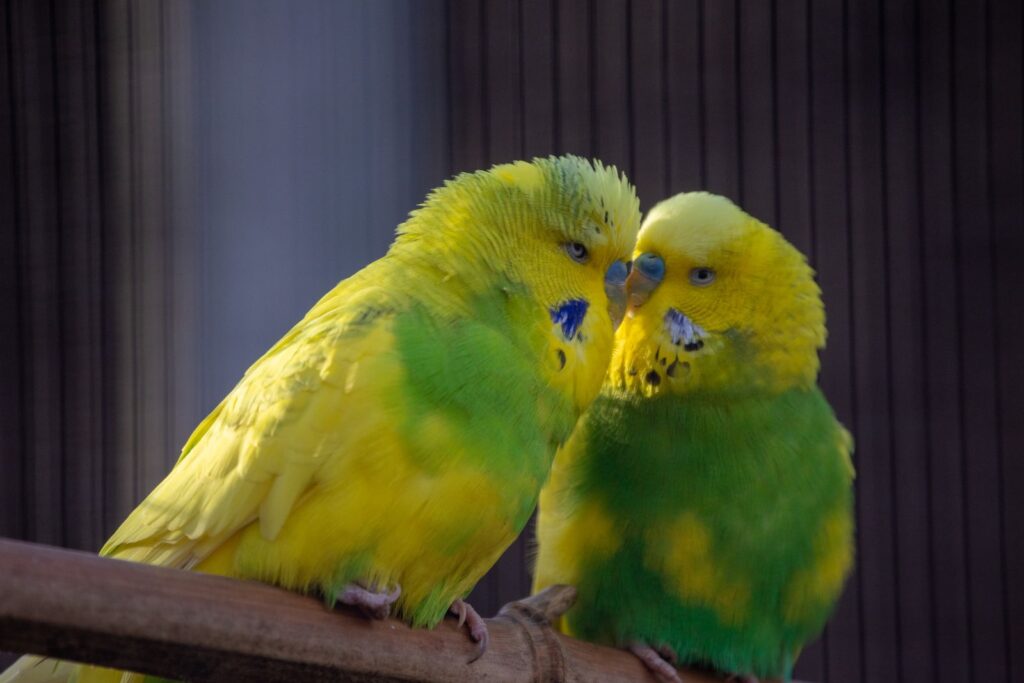
Lafeber classifies both species as “chatterers and whistlers,” which sounds like a tie. It isn’t. A budgie’s noise is volume-of-words rather than volume-of-sound: a near-continuous, cheerful burble of chirps, warbles, and whistles that most people find easy to live with.
A lovebird spends more of the day quiet — and then produces its natural contact call, which Lafeber describes plainly as a high-pitched shriek. It’s short, but piercing, and it carries through walls in a way budgie chatter doesn’t. They let loose mornings, evenings, and whenever something exciting happens. If you work from home on calls or have thin apartment walls, this single difference may decide the whole comparison.
Talking: The Budgie’s Clearest Win
If a talking bird is the dream, stop here — it’s the budgie. Lafeber calls it “the best talking bird among the parrots, able to learn words, phrases, and whistles easily,” and notes one budgie was recorded repeating more than 1,700 words. Males are the strongest talkers; females usually learn a few words and whistle well. PetMD is more conservative — “dozens of words” with training — but the direction is identical.
The lovebird has what Lafeber calls slim talking ability — perhaps one bird in a thousand learns to mimic speech — and PetMD agrees their chirping doesn’t develop into talking. Buy the lovebird for the bond, not the vocabulary.
Bonding and Social Needs: Flock vs. One Deep Bond
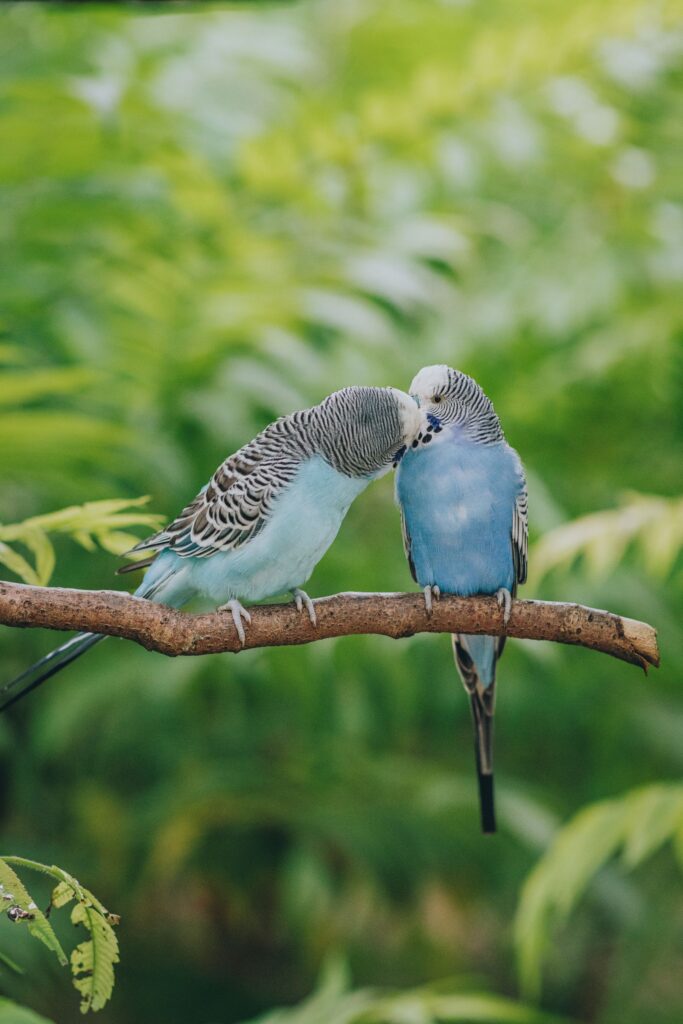
Budgies are flock birds with a flexible social life. Lafeber notes they won’t do well in isolation, but they’re adaptable: a pair stays friendly with enough human contact, and a single budgie with daily attention often becomes the most people-focused pet of all.
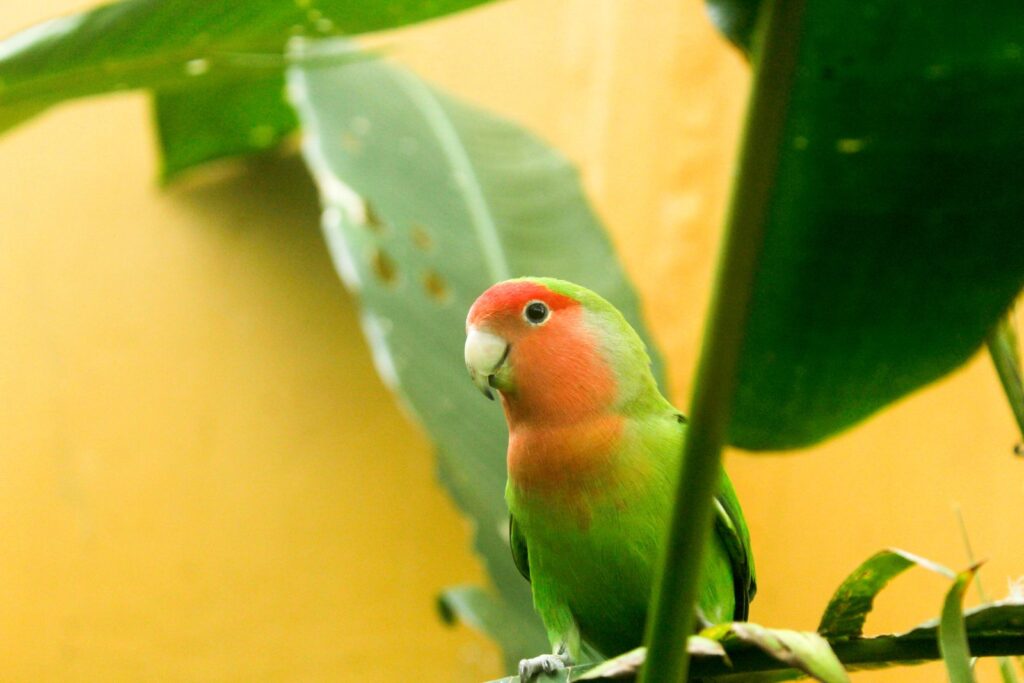
A lovebird does nothing by halves. Kept as a pair, two lovebirds tend to settle into what Lafeber calls the “married life — to the possible exclusion of the owner.” Kept alone with frequent attention, a lovebird can be, in Lafeber’s words, “as loving as the family lap dog.” But the bond demands maintenance: lovebirds must be handled daily to retain their tameness, and Lafeber warns that a bird neglected for even a few weeks can revert and become snappish. Females are more likely to be territorial and nippy, and the species is a famously bold escape artist with a bite that can break skin, where a budgie’s mostly hurts little fingers.
Hand-taming reflects the same split: Lafeber describes the budgie as easily hand-tamed, “a loyal, loving little friend to a patient owner.” The lovebird rewards the same patience with a deeper attachment, but its tameness is a daily habit, not a one-time achievement.
Space and Cage Needs: Same Minimum, Different Priorities
Here’s the surprise: the hard floor is identical. The Merck Veterinary Manual’s minimum size and bar spacing table lists budgerigar and lovebird in the same row — a minimum cage of 20 × 20 × 30 inches with bar spacing of 0.5 inches. PetMD suggests slightly smaller minimums; we use Merck as the standard. Neither bird should ever be in a cage with bars wider than 1/2 inch apart — heads get stuck, and small birds escape.
Within that shared floor, priorities differ. Budgies are horizontal fliers, so width is what counts — a long cage they can actually fly across beats a tall one; our best budgie cages guide is built around that rule. Lovebirds are climbers and chewers who work their cages hard, so latch security and bar strength matter as much as footprint — and Lafeber notes that the smaller a lovebird’s cage, the more out-of-cage time it needs. Our best cages for lovebirds guide goes deeper on escape-proofing. If a third species has entered the chat, our budgie vs cockatiel covers the other classic matchup.
Diet and Daily Care: The Same Pellet-First Rule
Feeding is the easiest part of the decision, because both birds follow the same rule: pellets are the base, seed is the garnish. VCA Animal Hospitals puts pellets at roughly 60–80% of a budgie’s daily diet, with fruit, vegetables, and greens at no more than 20–25%, and warns that all-seed diets cause malnutrition. PetMD gives lovebirds pellets at 70–80%, fresh produce at 20–30%, and seeds and nuts as occasional treats only, since they’re high in fat.
Daily care is similar too: fresh water, a quick cage tidy, and out-of-cage time for both. The lovebird generates more destruction per gram; a pair of budgies produces more seed-hull mess. Neither bird is a heavy lift next to a large parrot, but the lovebird’s daily handling is a real appointment on your calendar.
How We Chose These Starter Picks
The picks below are split by species: a cage and a food per bird, plus one accessory both genuinely use. We chose them from product research — specs checked against the Merck minimums above — not from testing in our own aviaries. Our how we choose products page explains the process. Two honesty notes: both foods are seed blends, included deliberately as the foraging portion of the diet — neither replaces the pellet base.
For Budgies: PawHut 65-Inch Double Rolling Bird Cage with Divider (D10-056V01)
Most budgie cages fail the width test. This PawHut is a double flight cage — one long horizontal space, or two separate homes with the removable center divider in — and each section measures about 30 × 18 × 33.75 inches, clearing the Merck minimum with real room to fly across. Chewy’s Q&A for this model puts the vertical wire spacing at about 0.43 inch, under the 1/2-inch maximum — measure it on arrival to be sure. It rolls on a stand with a storage shelf and comes with eight wood perches and eight plastic food containers.
Pros
- Genuine flight length — the thing budgies actually need
- Divider lets you house a pair together or apart in one footprint
- Bar spacing reported under the 1/2-inch safe maximum
Cons
- Big, heavy, and assembly-required at just over 56 pounds
- Included food containers are plastic, not stainless steel
For Budgies: Kaytee Fiesta Parakeet Food, 4.5 lb
Fiesta is the variety pick for the budgie side of the bowl: a seed, grain, fruit, and vegetable blend built on millet, canary grass seed, and oat groats, with flax seed for omega-3s and added prebiotics and probiotics. Scatter a measured amount (Kaytee’s guide: 1–3 tablespoons per bird per day) through a foraging toy and a budgie works for its food the way it evolved to. Owners rate it about 4.2 out of 5 across 96 reviews on PetPet.
Pros
- Wide variety of seeds, grains, and dried produce for foraging interest
- Fortified with prebiotics, probiotics, and omega-3 flax
- Good fit as the seed portion next to a pellet base
Cons
- Still a seed blend — budgies will selectively eat favorites, so it can’t be the whole diet
- Contains artificial colors (FD&C Red 40, Yellow 5, Blue 1)
For Lovebirds: A&E Cage Company Flight Cage & Stand, 32 × 21 in (13221)
This is the sturdy answer to the lovebird side’s core problem: a strong, busy beak attached to a proven escape artist. The A&E 13221 is a heavier-gauge flight cage — 32 × 21 inches with an interior height of about 35–36 inches on its stand, again clearing the Merck minimum — with 1/2-inch bar spacing and bird-proof locks a lovebird can’t work open the way it can a simple slide latch.
One honest disclosure: there’s no Amazon link for this cage. We couldn’t verify an Amazon listing for this exact model to our standard, so rather than risk a wrong listing, we’re naming it unlinked — it’s widely sold through bird retailers like Chewy and Petco.
Pros
- Heavier-gauge build and bird-proof locks suited to a strong, clever beak
- Roomy 32-inch width with 1/2-inch bar spacing
Cons
- Heavy — around 50 pounds with the stand
- No verified Amazon listing, so you’ll shop for it at a bird retailer instead
For Lovebirds: Higgins Mayan Harvest Yucatan Food Mix, 3 lb
Where the budgie blend is built for a small beak, Yucatan is built for a lovebird’s: safflower, oats, white millet, and canary seed alongside bigger work — pumpkin seeds, buckwheat, hemp seed, roasted soybeans, mung beans, lentils, cashews, coconut, dates, cranberries, and papaya. It’s formulated for cockatiels, lovebirds, and conures, and fortified with DHA omega-3 and probiotics. That chunkier mix is the foraging portion done right for a bird that loves dismantling its food — measured out next to the pellet base, not free-fed.
Pros
- Larger seeds, beans, and nuts sized for a lovebird’s stronger beak
- Formulated specifically for lovebirds, cockatiels, and conures
- Fortified with DHA omega-3 and probiotics
Cons
- A seed blend, not a base diet — lovebirds will pick out the fatty favorites first
- Rich pieces make portion discipline important
For Both: Niteangel Wooden Platform Perch, 2-Pack
One accessory honestly serves both species: a flat natural-wood platform that bolts onto the cage bars with wing nuts. Round perches are exercise; a flat surface is a rest — somewhere a small parrot can stand flat-footed, set down a treat, or work a foraging toy. It suits a budgie’s feet and a lovebird’s equally.
Pros
- Flat resting and foraging surface — a genuine break from round perches
- Simple bolt-on fitting for most cages with horizontal bars
Cons
- A supplement, not a substitute — both species still need varied-diameter natural perches
- A determined lovebird beak will eventually chew it down; treat it as replaceable
The Verdict: Which Bird Fits Your Life?
Choose a budgie if you want the friendlier first parrot: the best shot at a talking bird, easier hand-taming, softer noise, and a social style that flexes between a solo pet and a small flock. A budgie fits apartments, families, and schedules that allow good daily attention but not a strict handling appointment.
Choose a lovebird if you want one intense, devoted companion and you’re ready to earn it daily: handling every day to keep the bird tame, a commitment of up to two decades, tolerance for a piercing call and a nippy streak, and a cage built for an escape artist. The reward is a bond with a depth the budgie doesn’t quite match.
Either way, the foundation is the same: the right cage, a pellet-first diet, and daily time out.
Frequently Asked Questions
Are lovebirds or budgies better for beginners?
Budgies, for most people. They’re easier to hand-tame, more forgiving of an irregular schedule, softer in character, and their bites hurt less. A lovebird is a wonderful first bird only if you specifically want that intense one-person bond and can commit to daily handling.
Can a lovebird and a budgie live together?
Not in the same cage. A lovebird’s beak is much stronger than a budgie’s, and lovebirds can be territorial — a disagreement a budgie can’t win. Same home, separate cages is fine, with supervised out-of-cage time only if both birds stay calm.
Do lovebirds really need to be kept in pairs?
No — the name misleads people. A single lovebird with plenty of daily human attention bonds to its people instead and can thrive. A pair will bond primarily to each other. What it can’t do is be left alone and ignored.
Which bird is louder, a lovebird or a budgie?
It depends what bothers you. Budgies make noise more of the time, but it’s soft chatter. Lovebirds are quieter overall yet produce a shriek that carries much further. In an apartment with thin walls, the lovebird’s call is usually the bigger problem.
Can lovebirds learn to talk like budgies?
Realistically, no. Lafeber puts a lovebird’s chance of learning speech at perhaps one in a thousand, while budgies are the best talkers among parrots and can build vocabularies of dozens of words or more. If talking matters, that’s the budgie’s category, decisively.
The Bottom Line
The lovebird vs budgie choice isn’t about which bird is better — it’s about which relationship you want. The budgie is the sociable, talkative, forgiving flock bird. The lovebird is the devoted, demanding, longer-lived partner in miniature. Decide based on your ears, your schedule, and your appetite for daily commitment — either bird will repay you for years.