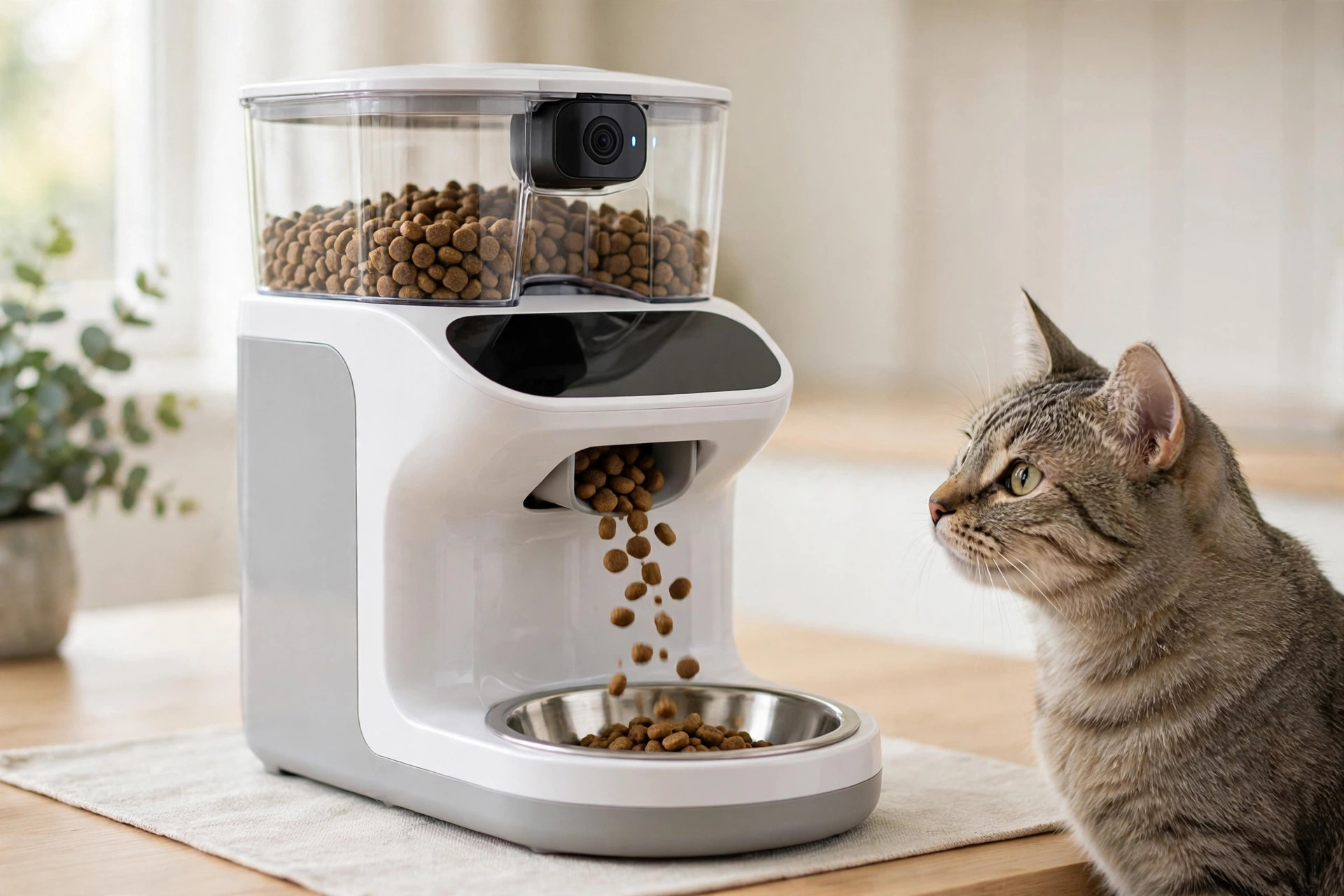
Searches for automatic cat feeders are up 40–60%, and the spike lands right where you’d expect: the weeks before the holidays, when half the cat-owning country is pricing flights and doing the math on pet sitters. The newest feeders make a tempting pitch. Cameras so you can watch your cat eat from the airport. App alerts for every meal. And the feature that sounds like science fiction — feeders that recognize which cat is standing in front of them, by microchip or even by face, so the cat on a prescription diet eats his food and the household food thief does not.
All of that can genuinely help. None of it should be trusted straight out of the box the night before a trip. A feeder is a machine with a motor, a Wi-Fi radio, and a hopper full of food your cat cannot reach if anything goes wrong. The difference between a feeder that makes your trip easier and one that makes it a disaster is a test week at home, while you’re still around to catch the failures. Here’s how to run it — and the honest limit every feeder owner needs to hear before they book anything.
Key Takeaways
- Test for a full week before any trip: Simulate a power cut, a Wi-Fi outage, and a kibble jam while you’re home to see how the feeder behaves.
- Battery backup must be verified, not assumed: Some feeders keep the clock but don’t dispense on battery. Pull the plug and watch a scheduled meal happen.
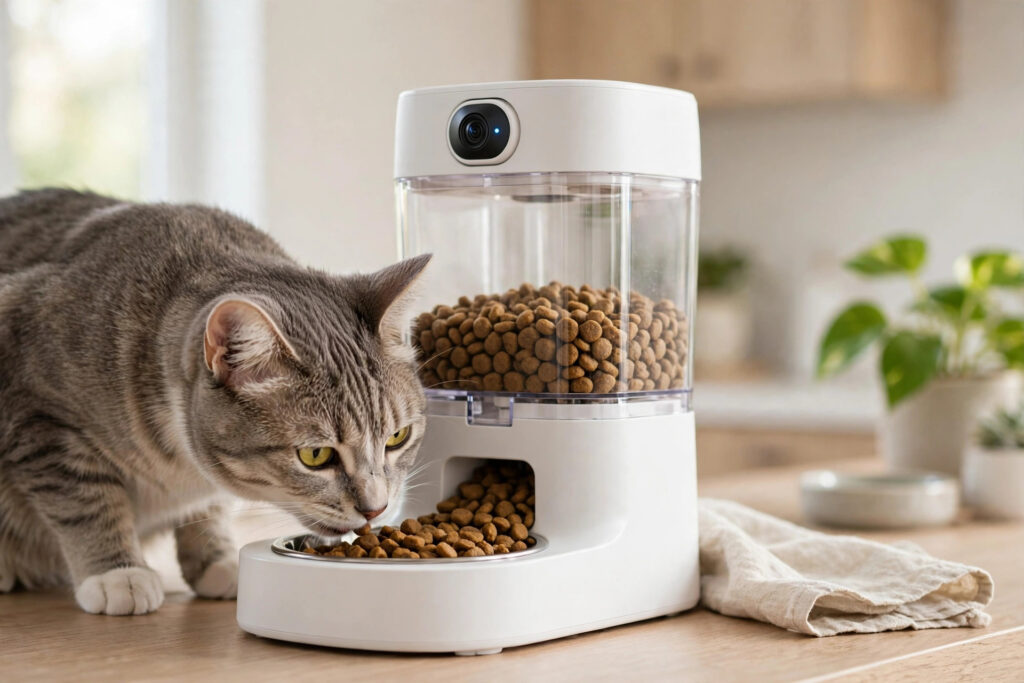
- Recognition feeders solve a real problem: Microchip and face-ID models (like PETKIT’s wet-food feeder and the Cheerble Match G1) stop food stealing in multi-cat homes.
- Wet food has hard limits: Refrigeration and spoilage windows make wet-food feeders a short-trip tool, not a week-long one.
- A feeder is not a sitter: Past 24–48 hours, your cat still needs a human physically checking in — no camera changes that.
What’s Actually New: Feeders That Know Your Cats Apart
The basic timed feeder hasn’t changed much in years: a hopper, a portion dial, a schedule. The real movement is in recognition. In a multi-cat home, an open feeder is a buffet with one name on it, and the cat who needs the food most is rarely the cat who gets it. Microchip feeders have answered that for a while — a flap or gate opens only for the cat wearing the right chip or tag. The newest wave adds camera-based face recognition: PETKIT’s latest wet-food feeder and the Cheerble Match G1 identify cats by their faces, no collar tag needed, and log which cat ate what, and how much.
That data matters more than the novelty. If you’re traveling and the app shows your senior cat has skipped two meals while her brother is eating double, you know to call your sitter today, not discover it on Sunday night. Recognition also protects prescription and calorie-controlled diets — the two situations where “they mostly share” quietly becomes a health problem. If you run a one-cat household with no diet issues, a simpler feeder plus a camera may do everything you need. Buy for your actual problem, not the flashiest spec sheet.
The Test Week: Break It Before Your Trip Does
Set the feeder up at least a week before you travel — two is better — and use it for every meal while you’re home. Then, deliberately, cause the three failures that happen on real trips.
Test 1: The Power Cut
Unplug the feeder mid-afternoon and leave it unplugged through the next scheduled meal. Does it dispense, on time, on battery? Some units use batteries only to preserve the clock and settings, which means a quiet evening outage at home becomes a missed dinner. Check how many meals the battery actually delivers, note whether the portion size stays accurate, and confirm the feeder sends an alert — or doesn’t. If it fails this test, it’s a convenience feeder for days you’re home, not a travel feeder.
Test 2: The Wi-Fi Drop
Turn off your router (or the feeder’s Wi-Fi connection) for several hours spanning a mealtime. A well-designed feeder stores its schedule locally and keeps feeding offline; a poorly designed one waits for the cloud and skips the meal. You also want to know whether the app tells you it lost connection — silence is the worst outcome, because from the airport, no news looks like good news. While you’re at it, check what the camera does: some stop recording, some stop streaming but keep feeding, and you want to know which one you own.
Test 3: The Jam
Kibble jams happen with oily food, oddly shaped pieces, and hoppers filled to the brim. During your test week, fill the hopper to the level you’d leave for the trip and watch for incomplete portions — a few kibbles short here and there is the early warning sign. Confirm the feeder alerts you to a jam rather than cheerfully reporting a successful meal that never landed. If your kibble jams twice in a week, switch kibble shape or accept that this feeder needs a human nearby.
Cameras and Apps: Useful, With Limits
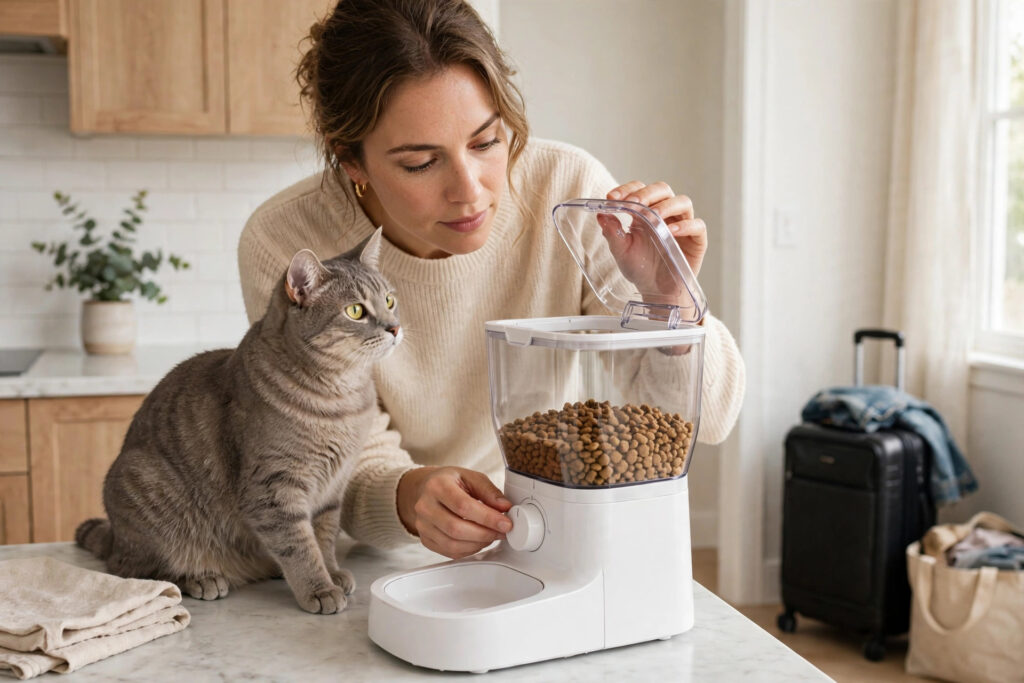
A feeder camera earns its place for one job: confirmation. You can see the bowl fill, see your cat eat, and spot an untouched meal the same day it happens. Two-way audio is a nice touch — some cats genuinely respond to a familiar voice at mealtime. But treat the app as a smoke detector, not a security guard. It tells you something’s wrong; it can’t fix anything. Every alert plan needs a human at the other end of it: a sitter, a neighbor with a key, someone who can be in your kitchen within hours, not days. Set that person up in the app’s sharing settings and make sure they know the feeder’s quirks before you leave, not during a 6 a.m. panic text.
Portions and Schedules: Dial Them In Before You Go
One more thing the test week reveals: whether the feeder’s idea of a portion matches yours. Dispense ten portions into a bowl and weigh or eyeball them — many feeders drift, serving noticeably more or less than the setting promises, and a cat on a calorie-controlled diet feels that drift within days. While you’re at it, reconsider the schedule itself. Cats generally do better on two or more smaller meals than one big drop, and a feeder makes that effortless: the same daily amount, split across the cat’s normal mealtimes, keeps hunger and 4 a.m. yowling down while you’re away. Program the schedule you’ll actually travel with during the test week, not the night before — if your cat objects to a new mealtime, you want the protest to happen while you’re home to adjust it. And set the feeder up in its travel position, in the room and spot it will occupy during the trip. A feeder that works on the kitchen counter but gets unplugged by a curious cat at floor level has failed a test you just didn’t run.
Wet Food Feeders: The Spoilage Clock Is Real
Kibble is forgiving; wet food is not. Wet-food feeders manage spoilage with ice packs or, in the newest models like PETKIT’s, actual refrigeration — a real step forward, since it stretches safe serving from hours to a few days. Even so, refrigerated wet-food feeders hold a limited number of portions, and once a portion is served and sits out, the clock runs out fast. Follow the manufacturer’s window and your own nose: if you wouldn’t serve it after that long on your counter, don’t ask the feeder to.
Practical takeaway: for a trip of a night or two, a refrigerated wet-food feeder with recognition is a solid setup for a cat who can’t eat kibble. For anything longer, wet food means a human visit on the schedule regardless of the gadget — which brings us to the rule that outranks every feature list.
The Honest Rule: A Feeder Is Not a Sitter
Here’s the line this whole article builds toward. An automatic feeder handles meals. It does not scoop litter, refresh water daily, notice a cat who’s hiding and unwell, clean up vomit, or catch the hundred small things a person in the room catches without trying. The ASPCA’s general pet care guidance and every vet you’ll ask land in the same place: cats left alone need a responsible person checking in. For a single overnight, a tested feeder plus fresh water and a clean box is a reasonable setup for a healthy adult cat. Beyond 24–48 hours, arrange a human — a sitter, a friend, a neighbor — to physically visit at least once a day. The feeder’s job on a longer trip is supporting that person: keeping meal times exact, protecting the special diet, and sending you proof at every feeding. That’s a genuinely useful job. It’s just not the whole job.
Your Pre-Trip Checklist
- Run the feeder for all meals for at least a week at home.
- Pass all three tests: power cut, Wi-Fi drop, and a full-hopper jam check.
- Load fresh batteries before the trip even if the old ones test fine.
- Fill the hopper with a buffer — more food than the trip needs, in case you return late.
- Set up app sharing with your sitter or neighbor and brief them on the feeder.
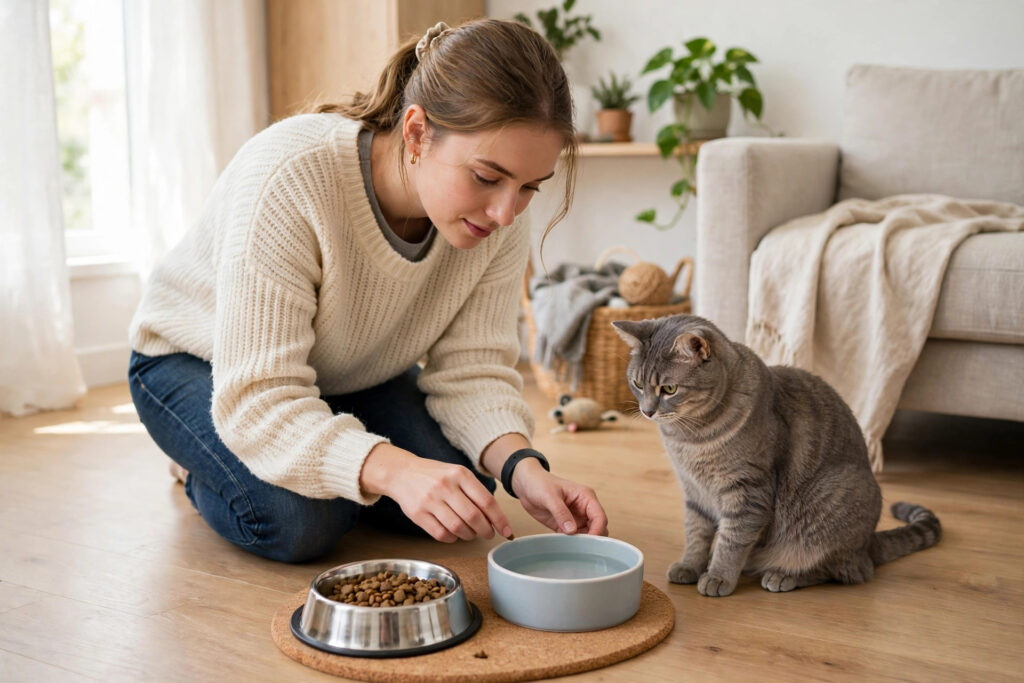
- Leave a backup bowl of kibble out for the first day, so a total failure never means a hungry cat.
- Book human visits for any absence beyond 24–48 hours.
Frequently Asked Questions
How long can I leave my cat with just an automatic feeder?
For a healthy adult cat, one overnight — roughly 24 hours, stretching to 48 at most — with a tested feeder, plenty of water, and a clean litter box. Beyond that, your cat needs a person visiting daily. Feeders handle meals, not welfare checks.
Do face-recognition cat feeders actually work?
The current generation — models like PETKIT’s wet-food feeder and the Cheerble Match G1 — identifies cats by face and logs individual meals, which solves food stealing and protects prescription diets in multi-cat homes. Run the test week anyway: recognition accuracy and gate behavior are worth confirming with your own cats before a trip.
What happens to an automatic feeder when the power goes out?
It depends on the model, which is exactly why you test it. Good travel feeders dispense scheduled meals on battery backup. Others only keep the clock running and skip meals. Pull the plug during your test week and watch a meal happen before you rely on it.
Can an automatic feeder handle wet food?
Yes, within limits. Ice-pack models cover a day or so; refrigerated models stretch safe storage to a few days but hold few portions, and served wet food spoils quickly at room temperature. For trips longer than a couple of days, wet food requires a human visiting anyway.
Should I get a feeder with a camera?
If you travel, yes — the camera’s real value is confirmation: you see the meal dispense and your cat eat, and you spot a missed meal the day it happens. Just pair it with a human who can act on what the camera shows.
The Bottom Line
The new generation of feeders — cameras, battery backup, even face-ID — is genuinely good, and the 40–60% jump in searches says cat owners have noticed. But the gadget is only as trustworthy as your test week. Break it at home, confirm the battery really feeds, and keep a human in the loop for anything past a night or two. Do that, and you can actually relax on your trip — which was the point of buying the thing.