Your parrot’s ancestors lived where “winter” means the rain changes, not the temperature. Then December arrives in Ohio, the furnace kicks on, and your tropical bird is suddenly living in a warm desert — air at a comfortable temperature but dried out to a fraction of the humidity it evolved in. Here’s the part most owners miss: in a heated home, the temperature half of winter care usually takes care of itself. It’s the humidity half that quietly fails, week after week, until you’re looking at itchy skin, dull feathers, dusty sneezes, and a bird who’s just vaguely off.
The good news is that winter parrot care isn’t complicated or expensive. It’s a thermometer, a hygrometer, a sensible cage location, and a few small habits. Set them up once, early in the season, and they run on autopilot until spring.
Key Takeaways
- Most pet parrots are comfortable at 65–80°F with 40–60% humidity — aim for both numbers, not just the warm one.
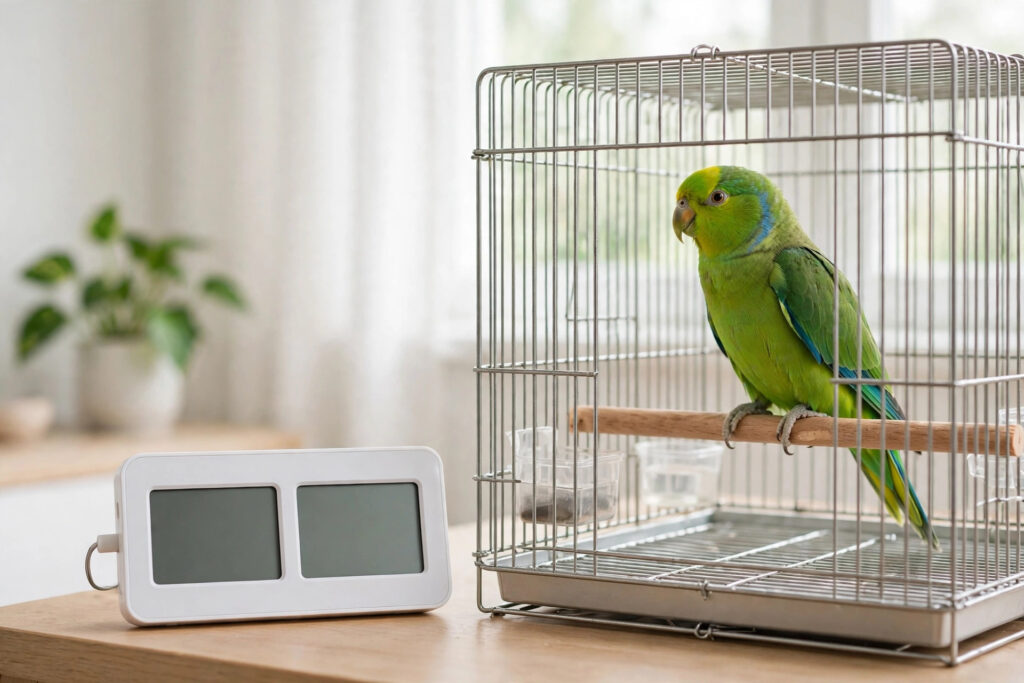
- Measure at the cage with a thermometer and hygrometer. Your hallway thermostat describes a different room than the one your bird lives in.
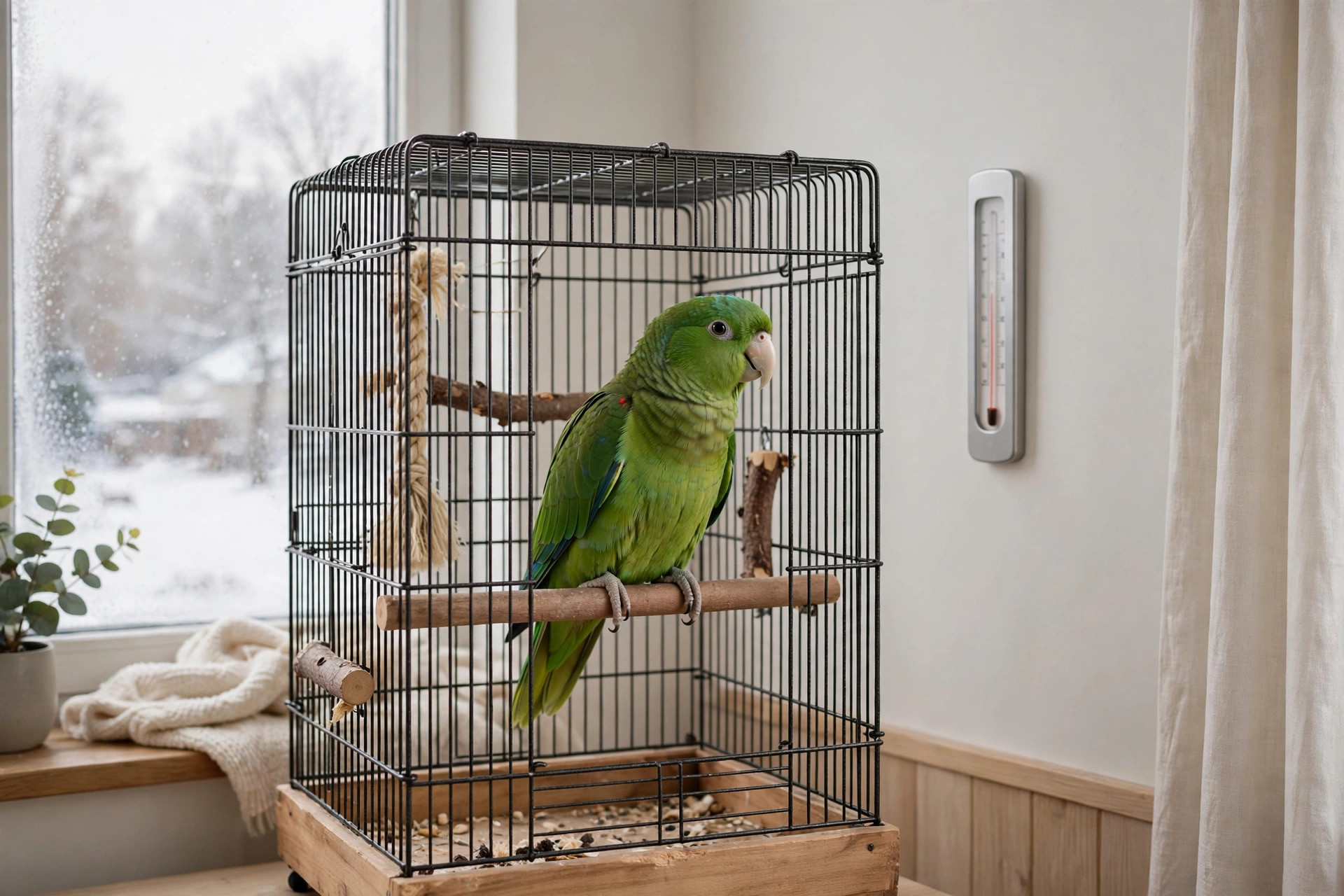
- Keep the cage away from windows, exterior doors, and heating vents — drafts chill, and vent blasts cook, sometimes in the same hour.
- Supplemental heat must be PTFE-free, and heat lamps or space heaters should never run unattended near a cage.
- Beat dry air with regular baths or misting and a clean room humidifier, and offer warm — not hot — soft foods on cold mornings.
The Two Numbers That Run Winter Care
Most pet parrots do well in the same range you’d set for yourself: roughly 65–80°F. Healthy, acclimated birds are tougher than their tropical origins suggest. Lafeber’s avian experts make the point in their winter prep guide for pet birds: pet birds can adapt to cooler environments, but they cannot handle quick changes in temperature. That’s the real rule hiding inside the range. A bird eased into a 67°F house over the autumn is fine. A bird moved from a 75°F room to a 60°F porch in an afternoon is not. Stability beats perfection.
Humidity is the second number: 40–60% is the comfort zone for most parrots. A healthy bird in 72°F air at 45% humidity is in good shape. The same bird at 72°F and 18% humidity — a completely normal reading for a forced-air heated home in January — is breathing desert air through a respiratory system built for a rainforest. That’s where the dry skin, the extra dust, the scratchy preening marathons, and the irritated airways come from. You can’t feel the difference as clearly as your bird can. Which is why you measure it.
Measure at the Cage, Not at the Thermostat
Buy two cheap instruments and put them where the bird actually lives: a thermometer and a hygrometer (many units combine both) at cage height, on or beside the cage. The thermostat in your hallway governs the furnace, but it knows nothing about the corner by the picture window where the cage stands, or the room over the garage that runs five degrees colder than the rest of the house.
Check the readings at a few different times — morning, mid-afternoon, evening — for the first week of the heating season. You’re looking for two things: the daily low, which usually arrives just before dawn, and the size of the swing. A room that drifts between 66°F and 74°F across the day is fine. A cage that gets blasted to 85°F when the furnace runs and slides to 61°F overnight has a placement problem, and placement is fixable. Write the numbers down for a week; after that, a glance whenever you walk past is enough.
Cage Placement: The Three Things to Avoid
Windows. Even good windows are the coldest surface in a winter room, and the air beside them is colder and draftier than the room average — exactly the air your cage-side thermometer will catch. A cage that was perfect in July can sit in a cold downdraft in January. Interior walls win in winter.
Exterior doors. Every arrival and departure sends a slab of outdoor air across the room. A cage near the front or back door gets a dozen cold gusts a day, and a bird can’t move away from weather that comes to it. A few feet of distance and a turn around a corner make a real difference.
Heating vents. The opposite problem, and sneaky: a vent under or behind the cage blasts hot, extremely dry air straight at the bird each time the furnace cycles, then stops, then blasts again. Temperature swings plus desert air, delivered on a timer. If the cage has to share a wall with a vent, angle the vent away or move the cage so the airstream passes beside it, not through it.
Lafeber’s winter guidance lands in the same place: dial the house to the upper 60s or low 70s if you like, and keep cold drafts near the cage to a minimum. One caution from the same guide — don’t swaddle the cage in dark blankets to block a draft. A dark, enclosed cage reads to a parrot like a nest cavity and can stir up hormonal, breeding-type behavior. If you must shield one side from a draft, use clear plastic sheeting the bird can’t reach or chew, on the draft side only.
Reading a Cold Bird
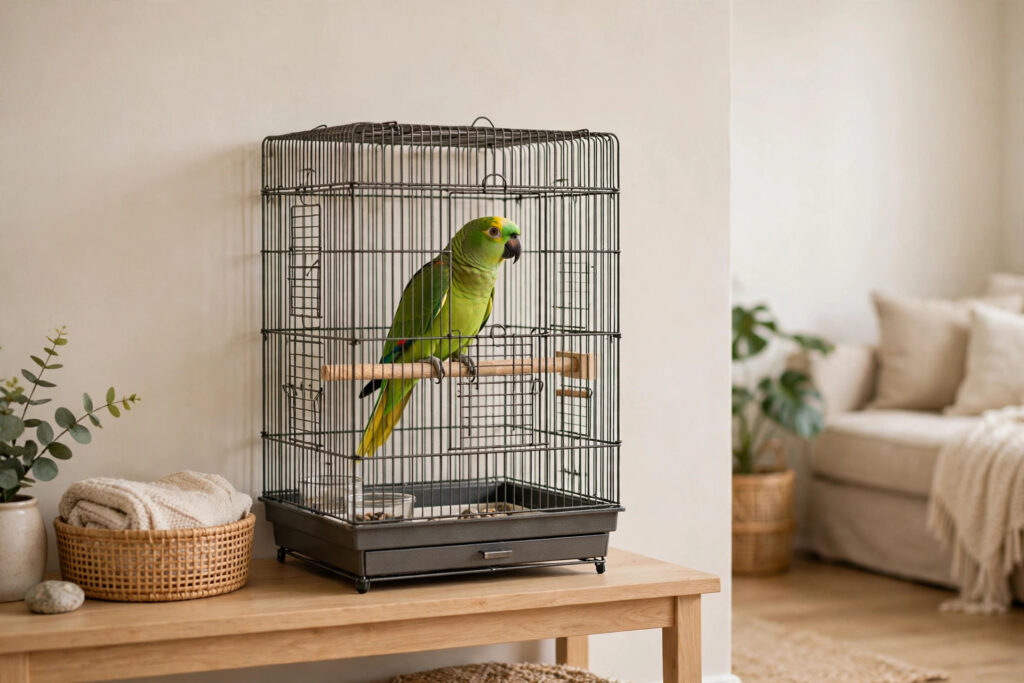
Birds don’t shiver theatrically or complain. A chilled bird tells you quietly:
- Fluffed feathers, held for long stretches. A brief fluff-and-shake is normal grooming. A bird who sits puffed up like a feather duster for an hour is trapping air to conserve heat — or is unwell.
- Sitting low on the perch, body hunched down over the feet.
- Unusual quiet. Less calling, less playing, less interest in what’s happening around the cage.
- Tucking the beak into the back feathers for long naps outside normal sleep times.
One cold morning with a fluffed bird after a furnace hiccup is a “warm the room and watch” situation. A fluffed, quiet bird that stays that way — especially with reduced appetite or changed droppings — is a vet call, because illness and cold look alike and birds hide illness well. Warmth is supportive care, never a diagnosis.
Supplemental Heat, Done Safely
Most homes in the 65–80°F range need no extra heat at all. If your bird’s room runs cold — an older house, a bird room over an unheated garage — you have options, with two hard rules attached.
Rule one: PTFE-free only. Some space heaters and heat lamps use PTFE-coated elements, and overheated PTFE releases fumes that can kill a bird in minutes. VCA Hospitals’ PTFE guidance lists heating elements and heat lamps among the household sources. Before any heater shares a room with your bird, confirm with the manufacturer that it’s PTFE-free — ceramic and oil-filled radiator-style heaters are the types bird owners most often choose — and run a new heater in a separate, ventilated space first to burn off any factory residues, with the bird elsewhere.
Rule two: never unattended. Don’t leave a space heater or heat lamp running near a cage while you sleep or leave the house. Heat sources meant for cages — heated perches and cage-side radiant panels made for birds — give your parrot a warm spot to sit against and the choice to move away, which is how birds regulate themselves. Whichever you use, the bird should always be able to retreat to a cooler part of the cage. A warm corner is comfort. A uniformly hot cage is a trap.
Fixing the Dry Air
This is the heart of winter care, because forced-air heating will pull your indoor humidity down no matter what the temperature does. Three habits fix most of it:
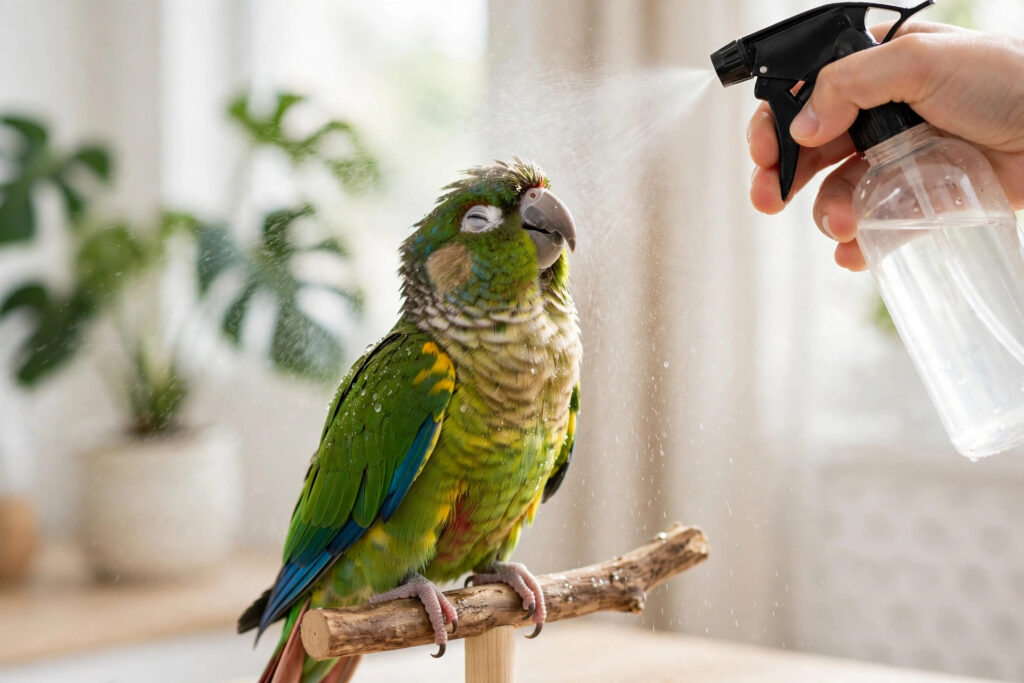
Baths and misting, on schedule. Offer a bath dish or a gentle misting several times a week — daily suits many parrots. Winter birds often bathe less eagerly, so make it inviting: lukewarm water, a sunny spot, and time to dry fully in a warm, draft-free room afterward. Bathing keeps skin and feathers in condition and gives the respiratory tract a break from dry air.
A room humidifier — kept clean. A cool-mist humidifier in the bird’s room can hold the 40–60% zone through the heating season. The non-negotiable part is hygiene: a neglected humidifier grows mold and bacteria and then aerosolizes them into the very air you’re trying to improve. Empty it, rinse it, and disinfect it on the manufacturer’s schedule, and use fresh water daily. Your hygrometer tells you whether it’s working and whether you’ve overshot — sustained readings above 60% encourage mold in the room itself.
Everyday moisture. A wide, shallow water dish does a little evaporative work; the bird’s own bath splashing does a little more. These are garnish, not the meal — the humidifier and the bathing routine carry the load.
Cold-Morning Comforts: Warm Food, Normal Routine
On the coldest mornings, a small serving of warm — never hot — soft food is a genuine comfort: cooked sweet potato, warm oatmeal-style mash, or steamed vegetables, served at a temperature you’d comfortably touch. Warm food is also a useful vehicle on days when a bird seems a bit subdued and you want calories and hydration in. Keep the rest of the routine boringly normal: same wake time, same lights-out, same out-of-cage hours. Winter already shortens your bird’s days; a steady schedule is its own kind of warmth. Our bird molting guide covers another winter-adjacent event — many birds molt into the season — and the extra nutrition that growing feathers demands.
Frequently Asked Questions
How cold is too cold for a pet parrot indoors?
For a healthy, acclimated parrot, a stable home in the 65–80°F range is comfortable, and brief dips a little below that are usually tolerated well. What harms birds is speed, not the number itself: Lafeber’s avian experts stress that birds adapt to cooler environments but can’t handle quick temperature changes. If your home drops fast — a furnace failure in a cold snap — warm the bird’s room gradually, offer a heated perch or cage-side heat source, and call your avian vet if the bird stays fluffed and quiet.
Do I really need a hygrometer? The temperature feels fine.
Yes — because you can’t feel humidity the way your bird’s respiratory system experiences it. A heated home can sit at a pleasant 72°F while the humidity craters below 20%, and that dry air is behind much of the winter itching, dust, and feather dullness owners notice. A combined thermometer-hygrometer at the cage costs very little and turns guessing into knowing.
Are space heaters safe in a parrot’s room?
Only with care. Choose a model confirmed PTFE-free by the manufacturer — VCA Hospitals lists heating elements among the household PTFE sources whose fumes can be lethal to birds — run a new unit in a ventilated room away from the bird first, place it so it warms the room rather than blasting the cage, and never leave it running unattended near the cage. Oil-filled radiators and bird-specific heated perches or panels are the options most owners settle on.
How often should my parrot bathe in winter?
Several times a week is a good baseline; daily is fine for birds who enjoy it. Offer a bath dish or a light misting with lukewarm water, and let the bird dry in a warm room away from drafts. Don’t force a bath on a bird who hates it — a misting while it perches, or a dish placed where it can choose, gets the same skin-and-feather benefit without the fight.
My parrot sits fluffed up every morning. Should I worry?
A short fluff during a morning preen is normal. A bird who stays fluffed, sits low, and goes quiet for long stretches is conserving heat or feeling unwell — the two look alike. Check the cage-side temperature first. If the room is in range and the bird stays fluffed, eats less, or seems off for more than a day, that’s an avian vet visit, not a wait-and-see.
The Bottom Line
Winter parrot care comes down to two numbers and a location. Hold the cage zone at 65–80°F and 40–60% humidity, measure both where the bird actually sits, and keep the cage clear of windows, doors, and vents. Add baths, a clean humidifier, and PTFE-free heat only if you need it. Do that, and the furnace can run all it wants — your tropical bird will come through the season with skin, feathers, and airways in the same good shape they had in October.