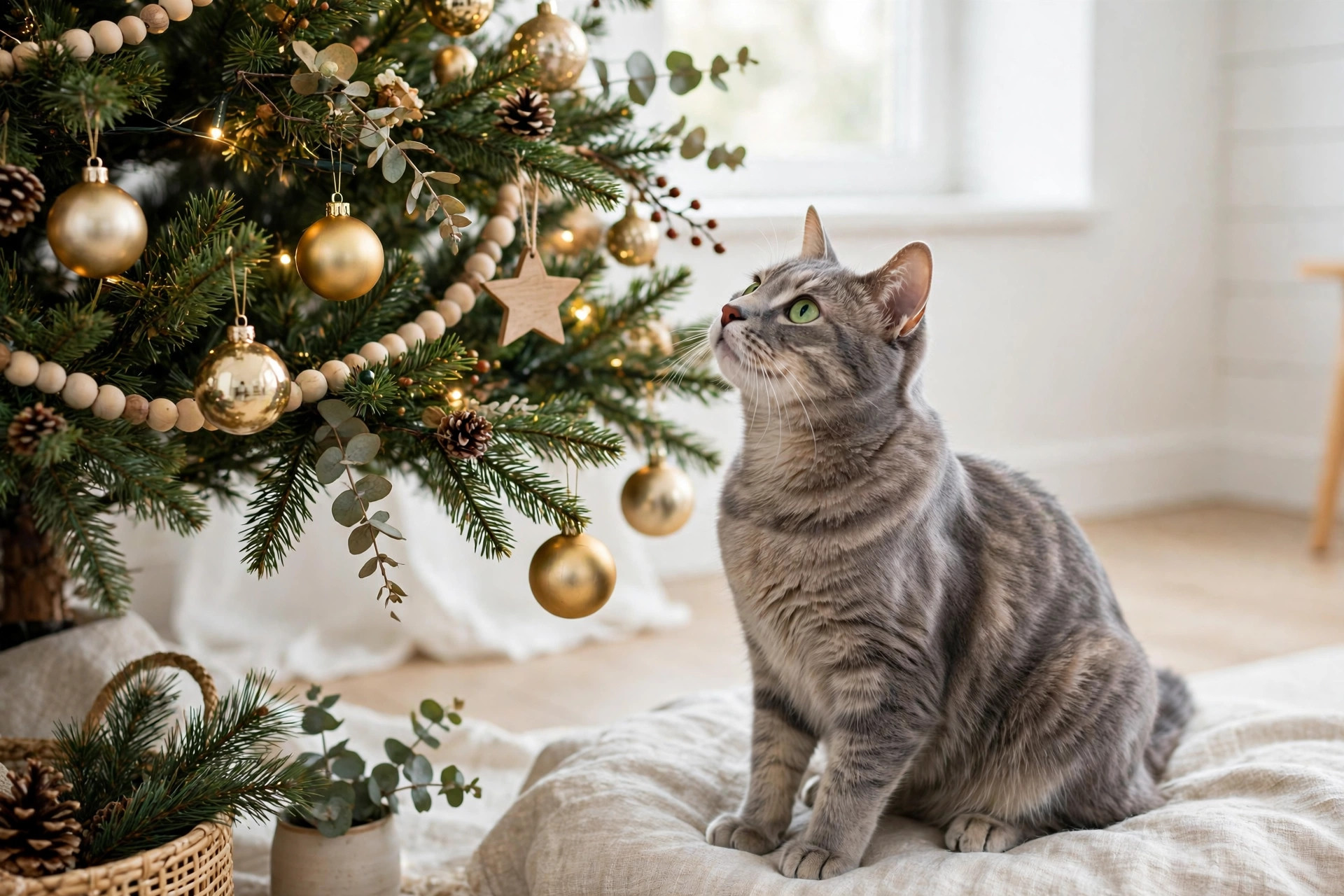
The tree goes up on Saturday. By Saturday night, your cat is sitting in it like a furry ornament, batting a bauble with one paw and wearing the expression of an animal who has found the greatest cat tree ever built — one that smells like a forest, sways when touched, and is covered in dangling toys. You are not going to win this fight by telling a cat no. You win it by changing the setup: make the tree boring, make it stable, remove the parts that can actually hurt your cat, and put something better within paw’s reach.
That last point matters more than most people expect. A Christmas tree is, from a cat’s point of view, a tall scratchable trunk with climbable branches and built-in toys. Every strategy below works with that instinct instead of against it. Some are about physics — a tree that cannot tip is a tree that stops being a climbing challenge. Some are about safety, because a couple of classic decorations are genuinely dangerous to cats. And the final piece is redirection: give your cat a tree of their own, close by, and make it the more interesting option.
Key Takeaways
- Anchor the tree: Tie it to a wall stud or ceiling hook with fishing line or a strap so it physically cannot tip, even with a cat in the branches.
- Skip tinsel and ribbon entirely: Swallowed strands can cause a linear foreign body blockage in a cat’s intestines — an emergency that usually means surgery.
- Use shatterproof ornaments, placed high: Keep anything breakable, small, or dangling out of the bottom third of the tree.
- Cover the tree stand: Cats drink from it, and additives that keep a tree fresh can be toxic. A skirt or cover keeps paws and tongues out.
- Redirect, don’t punish: Put your cat’s own tree or scratcher near the Christmas tree and play there. Vet guidance advises against spray bottles and essential-oil deterrents.
Step One: Make the Tree Impossible to Tip
Everything else on this list is secondary to stability. A tree that wobbles invites climbing, and a tree that falls can injure a cat, break everything on it, and start the kind of holiday story nobody wants to tell. Start with the base: use the heaviest, widest stand you can fit under the tree, and if you’re choosing between a real tree and an artificial one, know that artificial trees on weighted bases tend to be the steadier option.
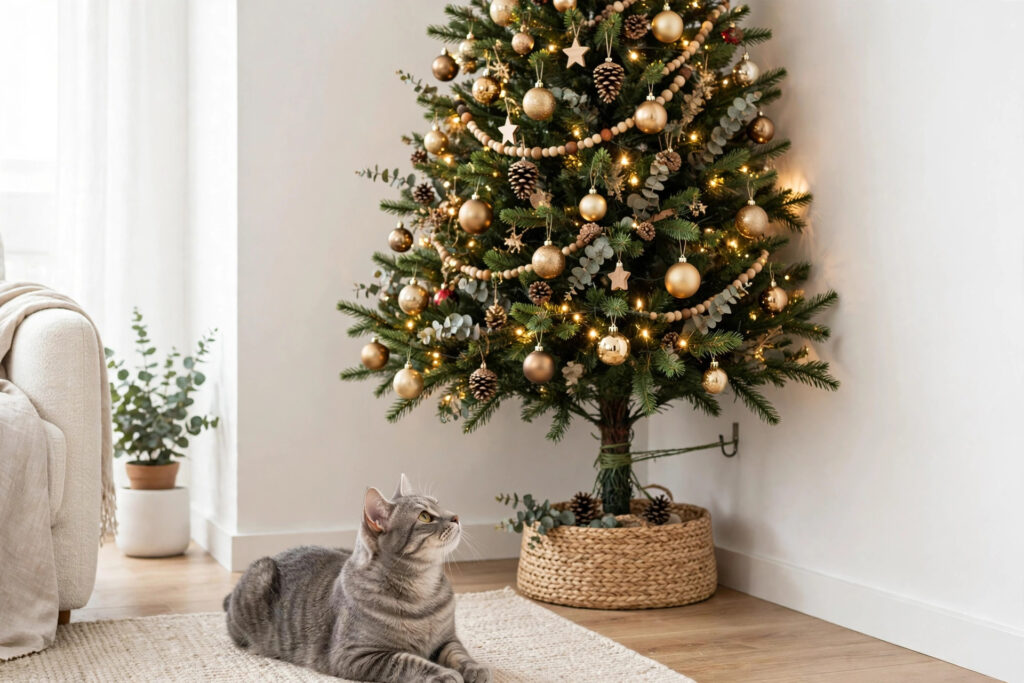
Then anchor it. Run clear fishing line or a discreet strap from the top third of the trunk to a hook screwed into a wall stud, or up to a ceiling hook. The line should be snug enough that the tree can sway an inch but never gain momentum. Corner placement helps too — a tree tucked into a corner has two walls working as backup. If your cat is a determined climber, this single step converts the tree from a ride into a piece of furniture, and most cats lose interest in furniture that doesn’t move.
Clear the Launch Pads
Cats rarely levitate into a tree from the floor. They launch from the arm of the sofa, the back of a chair, a side table, or a bookshelf — anything tall within jumping range. Walk around your tree and look at it from cat height. Any furniture within roughly three feet of the branches is a runway. Move it, even if the new arrangement looks slightly odd for a few weeks. The tree becomes much harder to reach, and most cats won’t bother with a difficult jump to a tree that no longer wobbles.
The Decorations That Are Actually Dangerous
Most holiday cat advice is about protecting the decorations. This section is about protecting the cat, because two traditional items earn their bad reputation.
Tinsel and Ribbon: Just Don’t
Tinsel is the single most hazardous classic decoration in a cat home. Cats are drawn to it — it’s shiny, it moves, it crinkles — and a cat who chews it tends to swallow it. A long strand doesn’t pass through the digestive tract the way a small object might. One end can lodge while the intestines keep trying to move the rest along, bunching the gut like fabric on a drawstring. Vets call this a linear foreign body, and it’s a surgical emergency. The ASPCA’s pet safety resources flag tinsel as a holiday hazard for exactly this reason, and vet clinics see these cases every December. Ribbon on presents carries the same risk, as do the thin curling ribbons on gift wrap. If it looks like a shiny string, keep it out of the house or locked in a drawer.
Ornaments: Shatterproof and High
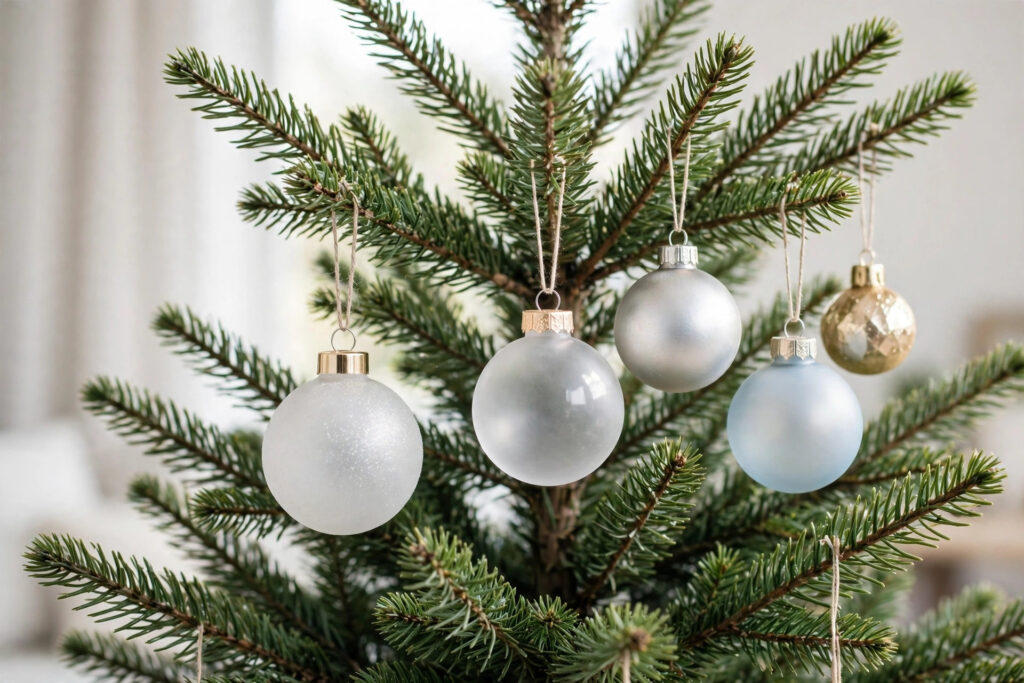
Glass baubles shatter into shards that cut paws and mouths. Swap the bottom half of the tree over to shatterproof ornaments — the plastic kind that bounce instead of breaking — and hang anything glass, heirloom, or small enough to swallow in the top third, well above leaping height. Secure each ornament with a closed hook or a loop of twine tied to the branch rather than a loose wire hook; loose hooks get batted off and then become a sharp toy on the floor. Skip dangling ornaments on the lowest branches entirely. A bare bottom branch is a small price for a quiet December.
The Tree Stand Is a Water Bowl (to Your Cat)
Real trees sit in water, and cats will drink from any water that isn’t in their bowl, plus most water that is. Plain water is mostly harmless, but many households add tree preservatives, aspirin, sugar mixes, or commercial freshness additives to the stand — and several of those are toxic to cats. Stagnant stand water also grows bacteria over the weeks the tree is up. The fix is simple: cover the stand so your cat can’t reach the water at all. A tree skirt tucked snugly around the trunk, a hard plastic stand cover, or even a ring of foil over the reservoir opening does the job. Foil has a bonus effect — many cats dislike walking on it, so it doubles as a mild, harmless barrier around the base.
Make the Base Uninviting
For cats who stalk the lower branches, a barrier at the base buys you peace. Options that work without looking like a construction site:
- A decorative fence or playpen panel around the tree — festive versions exist, and even a plain one reads as “garden edging” in December.
- Foil or a textured mat under and around the stand, for cats who hate the feel of it underfoot.
- Keeping the floor clear: no wrapped presents under the tree early in the season — boxes with ribbon are a climbing gym and a chewing station in one.
None of these need to be permanent. Most cats test the tree hard for the first few days, then accept the new rules. Barriers that come down in week two, once the novelty has worn off, are a win.
The Real Fix: Give Your Cat a Better Tree
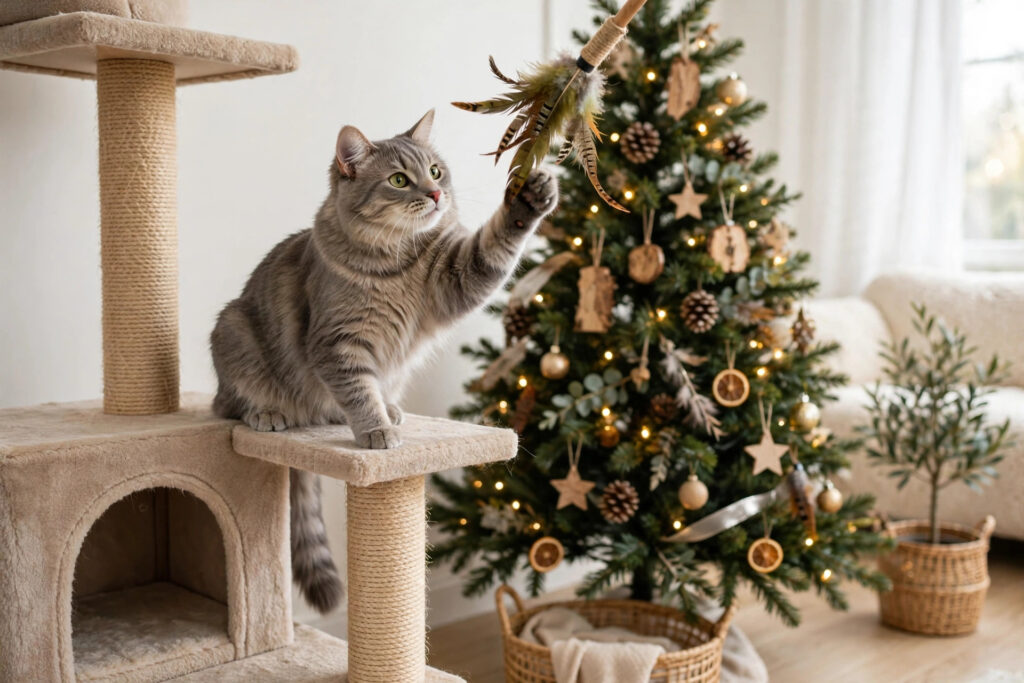
Here’s the part that separates a peaceful December from a month of skirmishes. Your cat wants height, scratching texture, and something fun to attack. Set up their own station right in the same room — their cat tree or a tall scratcher positioned near the Christmas tree, ideally with a view of it. Then make that spot pay: run wand-toy play sessions next to the cat tree, not next to the Christmas tree. Sprinkle treats on its perches. The ASPCA’s guidance on scratching behavior makes the same point year-round — a scratcher only works if it’s stable, appealing, and placed where the cat actually wants to be. For the holidays, “where the cat wants to be” is wherever the action is, which is the room with the tree.
Timing helps too. A solid play session before guests arrive, before dinner, or before bed burns off the energy that otherwise goes into a 9 p.m. assault on the branches. A tired cat naps under the tree. An under-stimulated cat redecorates it.
What Not to Do
Skip the spray bottle. Vet guidance from sources like PetMD advises against spray bottles as a deterrent — they don’t teach a cat that the tree is off-limits; they teach the cat that you’re scary and that the tree is fair game when you’re not in the room. The same goes for essential-oil sprays and citrus deterrents marketed for this purpose: many essential oils are toxic to cats, whose livers can’t process the compounds the way ours can, and spraying them around a tree your cat might chew is trading a small problem for a dangerous one. Noise-makers and motion-activated air cans fall in the same category — they startle rather than teach, and a startled cat in a tree is how trees fall. Physical setup plus redirection is slower to arrange and far more effective.
A Realistic First-Week Plan
Day one: anchor the tree, cover the stand, clear the launch furniture, decorate the top two-thirds only. Day two: set up the cat’s station and play there twice. Days three through seven: expect testing — a paw here, a climb attempt there — and respond by moving play and treats to the cat’s tree, not by scolding. Most cats settle into the new arrangement within the week. Kittens and known climbers may need the base barrier all season, and that’s fine. The goal was never a cat who fears the tree. It’s a cat who finds their own tree more rewarding — and a Christmas tree that’s still standing on the 25th.
Frequently Asked Questions
Will a spray bottle keep my cat out of the tree?
It’s not recommended. Vet guidance, including PetMD’s, advises against spray bottles: they frighten your cat without teaching anything about the tree, and the behavior usually returns the moment you leave the room. Anchoring the tree and redirecting your cat to their own tree works better and lasts.
Is tinsel really that dangerous for cats?
Yes. If a cat swallows tinsel, the strand can anchor at one end while the intestines bunch around it — a linear foreign body obstruction. It typically requires emergency surgery. Ribbon and curling gift ribbon carry the same risk, so the safest move is keeping all of them out of a cat’s home.
Are essential oils a safe way to deter my cat from the tree?
No. Many essential oils are toxic to cats, and deterrent sprays based on them can be licked off branches or inhaled at close range. Vet guidance advises against using essential-oil deterrents around cats. Physical barriers and redirection are the safer tools.
My cat drinks the Christmas tree water. Should I worry?
Plain water is low-risk, but additives sold or mixed to keep a tree fresh can be toxic to cats, and standing water grows bacteria. Cover the stand so your cat can’t drink from it — a snug tree skirt or stand cover solves it.
How do I stop my cat climbing the tree at night?
Combine the physical fixes — anchored tree, no launch furniture nearby, shatterproof ornaments up high — with an evening play session to burn off energy, then close the door to the tree room overnight if you can. Most cats test the tree less each night once it stops being rewarding.
The Bottom Line
You can’t out-stubborn a cat, and you don’t need to. Anchor the tree so it can’t fall, remove the tinsel and breakables that turn mischief into a vet visit, cover the stand, and put a better tree — theirs — in the same room. Set it up once, play where you want your cat to play, and December gets a lot quieter for everyone.