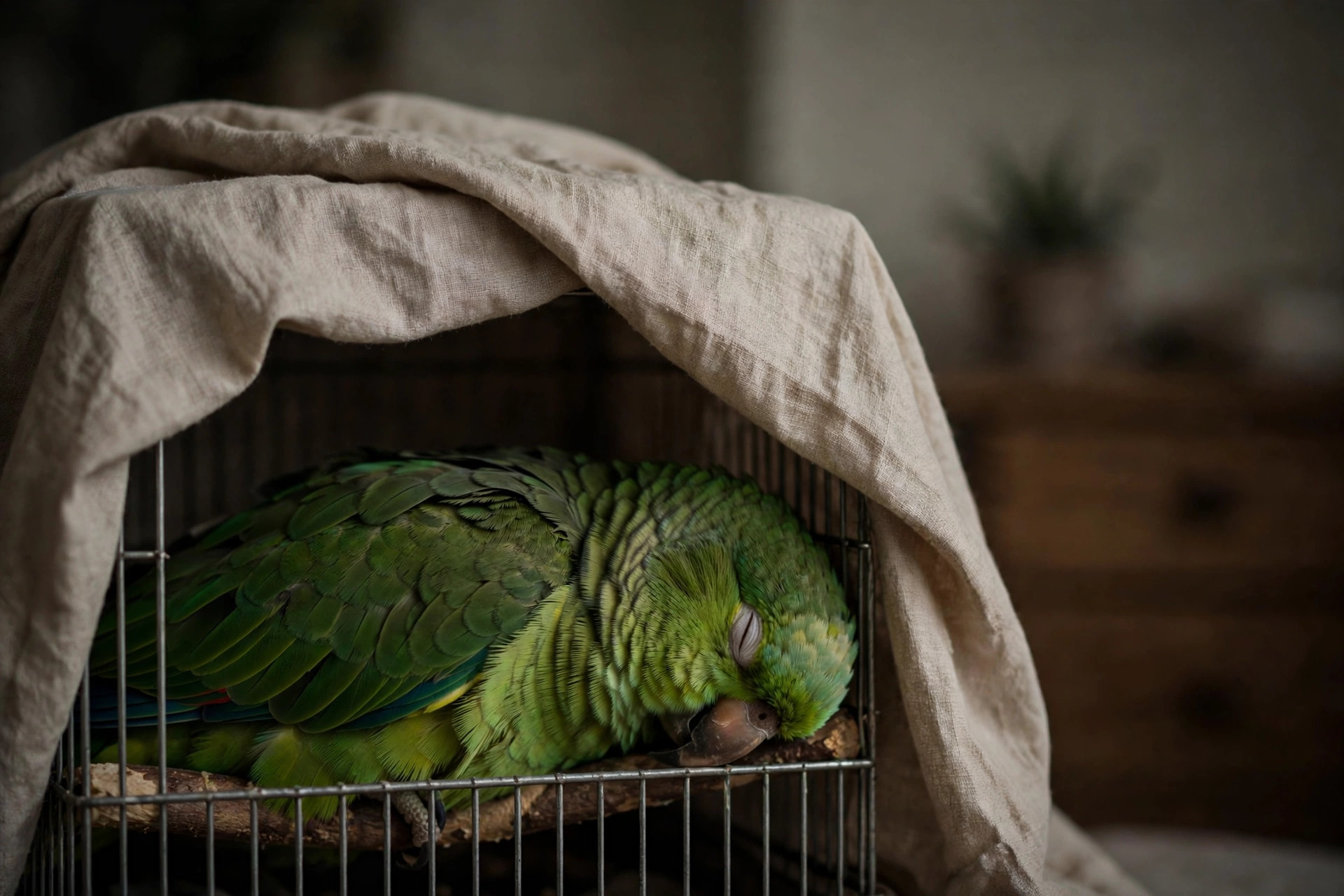
Picture your parrot’s December. The tree lights go on at five and stay on past eleven. The TV runs late. Guests laugh in the next room until midnight. Your bird, sitting in the middle of it, is getting maybe seven hours of real darkness — and not quiet darkness either. Then January arrives with a bird who screams more, bites faster, shreds everything, and has started treating a corner of the cage like a construction site. Owners usually blame the season, the bird’s age, or a sudden personality change. Very often, the cause is simpler and more fixable: the bird hasn’t had a proper night’s sleep in six weeks.
Parrots are built for the equator, where day and night split the clock almost evenly all year. Ten to twelve hours of dark, quiet sleep isn’t a luxury in that design. It’s the setting the whole system — mood, immune function, hormones — runs on. Take it away, and the bird’s body doesn’t just get tired. It gets a message: the days are long, it’s breeding season, act accordingly.

Key Takeaways
- Parrots need 10–12 hours of quiet, dark sleep every night — not dozing under a half-cover in a lit, noisy room.
- Light until 10 or 11 p.m. reads to a parrot as a long summer day: melatonin drops, breeding hormones switch on.
- Hormonal signs include regurgitation on a favorite person, shredding, nest-seeking, territorial biting — and chronic egg-laying in hens, which is a genuine health risk.
- The fixes are routine, not medication: a sleep cage or cover in a quiet room and a bedtime that holds even during parties.
- Pet head and neck only — full-body stroking is a mate behavior and a hormonal trigger.
Why 10–12 Hours? The Equator Explanation
Nearly every popular pet parrot — budgies, cockatiels, conures, Amazons, greys, macaws, cockatoos — comes from regions near the equator, where night lasts roughly twelve hours in every month of the year. Wild parrots roost at dusk and wake at dawn, and their bodies run on that rhythm. Darkness triggers melatonin, and melatonin does more than make a bird sleepy: it helps hold the reproductive system in its off-season state. Long stretches of darkness, night after night, are how a parrot’s body knows it is not breeding season.
Lafeber’s avian team describes the pet version of this in their guide to parrots as pets: some birds turn hormonal when daylight hours lengthen, and this happens artificially in our homes when we watch movies past sunset or keep lights on in the bird’s area. Their advice for a bird who’s excessively hormonal is to cover the cage so the bird gets only 10 to 12 hours of daylight — and if that doesn’t work, to use a separate sleep cage in a dim, quiet room so the bird spends its night in real dark. Note the direction of the math: it’s not “at least 10 hours of light.” It’s a cap on light, set by the sleep the bird needs.
What Holiday Light Does to a Parrot’s Brain
A parrot doesn’t experience your December evenings as “festive.” It experiences them as data. Lights blazing until 11 p.m., a glowing tree, a bright television — from the bird’s side of the cage bars, the day has stretched to sixteen or seventeen hours. In the wild, days that long mean one thing: peak breeding season, food everywhere, time to find a mate and a nest.
So the hormones rise, right on schedule, in the middle of your winter. Melatonin stays suppressed because true darkness never quite arrives — a cage cover in a lit room with a loud TV leaks light and noise, and many birds under covers in busy rooms are resting at best, not sleeping. Layer in the other holiday signals — rich food within reach, warm rooms, a dark cage corner that looks nest-shaped, extra cuddles from home-all-day humans — and you’ve assembled the full breeding-season package. The bird is not being difficult. The bird is responding, correctly, to the environment it was given.
The Signs: What a Hormonal, Under-Slept Bird Looks Like
Regurgitation on a favorite person. Your bird bobs its head and brings up food for you, a toy, or a mirror. To the bird, this is courtship — feeding a mate. It’s flattering and it’s a hormone flag.
Shredding with intent. All parrots shred; it’s healthy play. Hormonal shredding has a destination: paper carried to one corner, a growing pile, a bird who works like it’s employed. That’s nest lining.
Nest-seeking. Suddenly your bird is obsessed with the gap under the couch, the inside of a cabinet, the dark space behind the cage — any cavity. Lafeber’s guide lists excessive chewing and hunting for a dark place to nest among the signs a bird is becoming broody.
Territorial aggression. Lunging at hands near the cage, biting people who were fine last month, guarding a perch, a toy, or a person. The bird is defending a nest site and a mate, in that order, and you’re standing in the territory.
Screaming. A sleep-deprived bird is a short-fused bird, and a hormonal one has things to announce. Contact calls get louder, longer, and harder to interrupt.
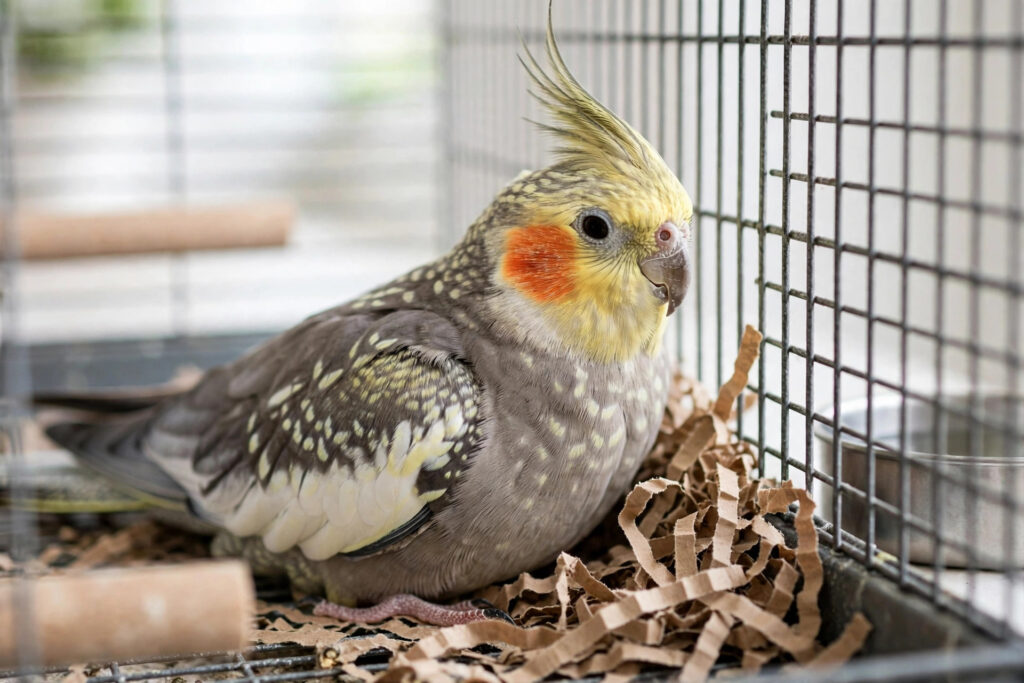
Chronic egg-laying. The serious one. Hens — cockatiels and lovebirds are notorious, but any hen can do it — may begin laying egg after egg with no mate anywhere in the picture. Each egg costs calcium and energy; repeated laying drains both and raises the risk of egg binding, a life-threatening emergency where an egg can’t pass. A hen laying repeatedly is not a quirky phase. She’s a bird whose light schedule needs fixing and whose vet needs a phone call.
The Fix, Part 1: A Real Night
Give the bird a sleep space, not just a cover. The gold standard is a smaller sleep cage in a quiet, dark room — a spare bedroom is ideal — where the bird goes at bedtime and stays for 10–12 hours. No TV, no foot traffic, no tree lights. If a second cage isn’t possible, a breathable, light-blocking cover over the main cage in the quietest room you have is the next best thing. A cover in the middle of the party is the option that fails quietly.
Hold the bedtime during the holidays. This is where December breaks good intentions. The bird’s bedtime doesn’t move because guests are over — the bird moves, to its sleep room, at the usual hour, while the party continues without it. Most birds settle faster in a consistent routine than owners expect; within a week, many walk to the sleep cage on cue. Protect the wake time too: 10–12 hours means counting backward from when the household actually gets up.
Dark means dark. Check the sleep room at bird height after lights-out. Streetlight through thin curtains, a hallway light under the door, a glowing charger — small leaks add up for an animal built to read light as information. Blackout curtains or a properly fitted cover close the gaps.
The Fix, Part 2: Stop Sending Mixed Signals
Pet the head and neck only. This is the rule owners resist and the one that matters most. In parrot body language, touch below the neck — stroking the back, wings, chest, or under the tail — is mate behavior. You may mean “affection.” Your bird reads “courtship,” every time, and files it with the long days and the nest corner. Head scratches: yes, all day. Full-body stroking: that’s for mates, and you are not one.
Remove the nest sites. Block access to cabinets, boxes, and under-furniture gaps during out-of-cage time. Take out tents, huts, and cozy dark hideaways in the cage for a hormonal bird — they read as ready-made nest cavities. Rearranging the cage layout periodically also helps break the “this corner is my nest” spell.
Watch the warm, soft extras. Rich, warm, mushy food offered constantly is another breeding-season cue in the wild pattern — abundant food, good times. Keep treats measured during a hormonal stretch and lean on foraging toys for occupation instead; a busy beak pointed at a puzzle is a beak not building a nest. Our signs of stress in pet birds guide helps you separate hormone behavior from stress behavior, since the two can look similar from across the room.
A Word About Daytime Light
Owners who learn about light often ask about the other half: full-spectrum daytime lighting. It’s a legitimate topic — indoor birds get little natural UV — but it’s a vet conversation, not a shopping trip. The wrong lamp, the wrong distance, or a sudden jump in daytime brightness can push the same hormonal buttons you’re trying to un-push, and birds with eye conditions need individual advice. If you want to explore daytime lighting, bring it to your avian vet at the next visit and change one variable at a time. The night, meanwhile, you can fix tonight: dark, quiet, long.
Frequently Asked Questions
Is 8 hours of sleep enough if my parrot seems fine?
Probably not, even if the bird copes quietly. The standard avian guidance is 10–12 hours of dark, quiet sleep, matching the near-equatorial rhythm these species evolved with. A bird can look “fine” on short nights for weeks while hormones build — the bill arrives as screaming, biting, nest behavior, or eggs. If your schedule only allows one change, protect the full night.
Will a cage cover alone solve it?
Only if the room cooperates. A cover blocks light at the cage, but it doesn’t block the television’s noise, the conversation, or the light show leaking around the edges in a busy living room. Lafeber’s avian team suggests a cover first — and if the bird is still hormonal, a separate sleep cage in a dim, quiet room. Most owners who make the move to a sleep cage wonder why they didn’t do it sooner.
How long until a hormonal bird calms down on a proper sleep schedule?
Give it two to three weeks of consistent 10–12 hour nights before judging. Hormones don’t switch off overnight, but owners commonly see the screaming ease first, then the nest obsession fade. If a hen is laying eggs repeatedly, don’t wait out the schedule fix alone — call your avian vet, because chronic laying drains calcium and can end in egg binding.
My parrot screams at dawn no matter what. Is that hormones?
Dawn calling itself is normal parrot behavior — wild flocks check in at first light. What points to a sleep or hormone problem is the package around it: screaming that escalates through the day, plus regurgitation, nest-seeking, territorial biting, or eggs. Fix the night first; a well-rested bird’s dawn chorus tends to shrink back to a few minutes of honest good morning.
Should I pet my parrot’s back if it clearly loves it?
It loves it because it means something specific: in parrot language, body stroking is what mates do. That’s exactly why it fuels hormonal behavior — the regurgitation, the territoriality, the eggs. Redirect the affection to head and neck scratches, which parrots read as friendly flock grooming. You lose nothing; the bird still gets its cuddle, minus the mixed signal.
The Bottom Line
Your parrot’s December behavior is probably not a mystery and not a character flaw. It’s a tropical bird running equatorial software in a house that’s simulating June. Give it back its night — 10–12 hours of genuine dark and quiet, in a sleep space away from the party, at the same time every night — keep your hands to head scratches, and take away the nest sites. Do that through the holidays and you’ll likely meet a calmer bird in January: one who got to sleep through the season, in every sense.