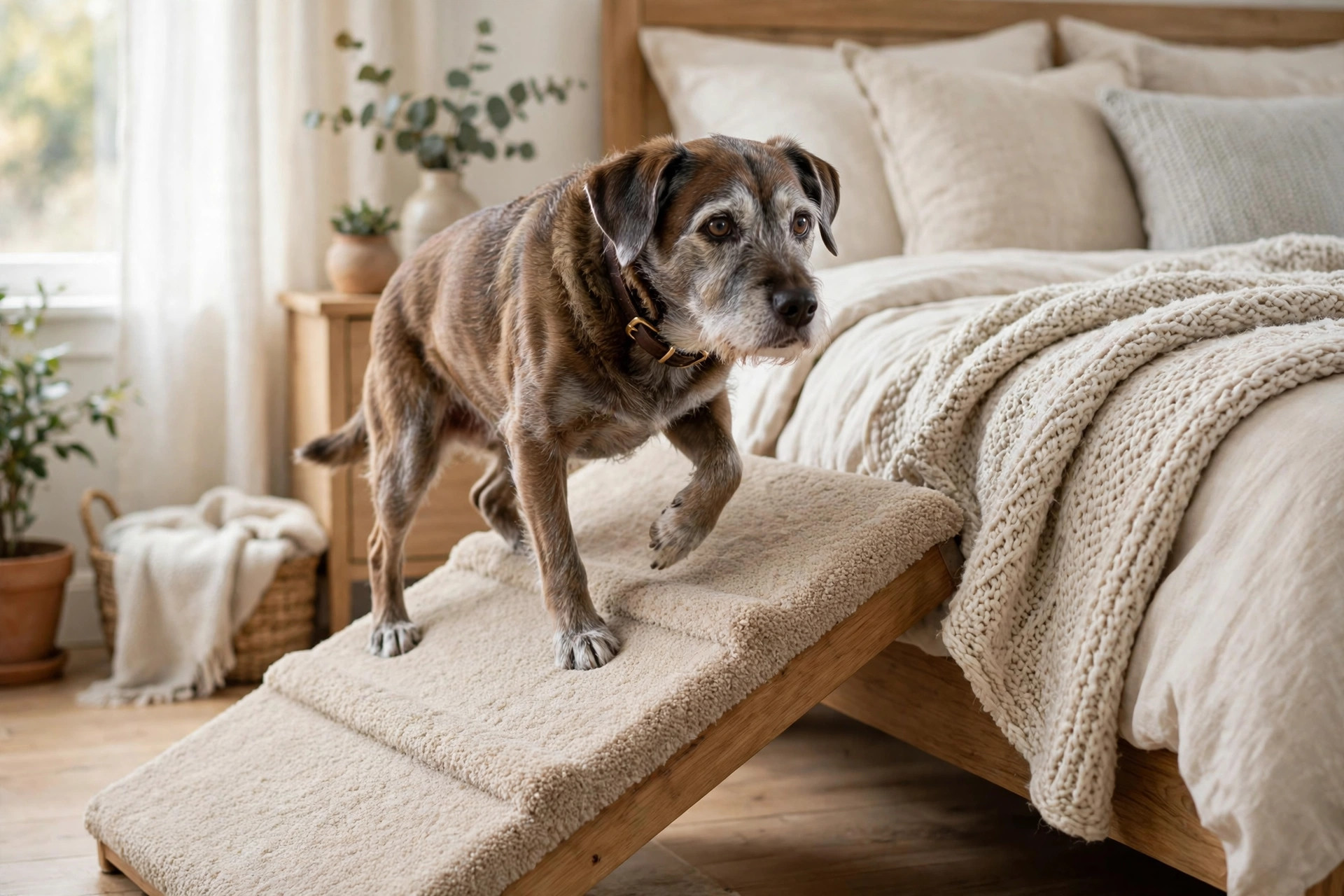
The jump is the first thing to go. A dog who has launched himself onto the bed ten thousand times starts, one evening, to stand at the edge and look at it. Then look at you. Senior dogs, dogs with sore hips, and long-backed breeds who shouldn’t be jumping at all all arrive at the same problem: the bed and the couch are up there, the dog is down here, and lifting a squirming 40-pound animal twice a day is nobody’s long-term plan.
That’s why searches for dog bed stairs are up about 83% year over year, at roughly 40,500 searches a month. But stairs and ramps are not interchangeable, and the right answer depends on your dog’s body, not your furniture. Here’s how to choose by condition, measure the thing properly (the step almost every buyer skips), and train a dog to use it like it was always there.
Key Takeaways
- Ramps are the safer default for IVDD-prone long-backed breeds like dachshunds and for post-op dogs — a smooth slope means no jumping, no step impact, no twisting.
- Stairs can suit mobile seniors who just need a boost and can still step up comfortably.
- Measure before you buy: furniture height, the ramp’s slope (longer is gentler), tread grip, and width for your dog’s body.
- Train in short, rewarded steps over several days. A dog who is lifted onto the ramp and pushed will avoid it forever.
- Place stairs or ramps at the bed, couch, and car — and check the non-slip backing, because a shifting ramp teaches a dog not to trust it.
Stairs vs Ramp: Choose by Condition, Not by Looks
When a ramp is the right answer
A ramp asks the least of a dog’s body. There’s no upward launch, no landing impact, and no moment where the spine has to flex and twist to make a step. That makes ramps the clear choice for:
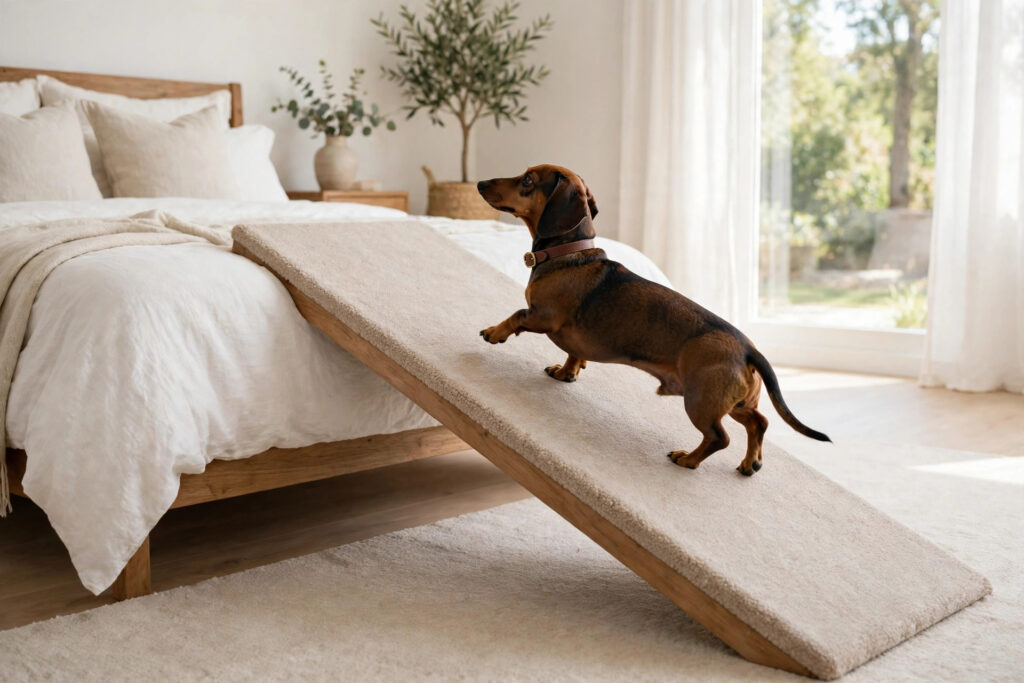
- IVDD-prone long-backed breeds. Dachshunds are the headline case — and a huge one: dachshund breed searches run around 246,000 a month, up 31%, reflecting how many owners are actively managing long-backed dogs. For breeds built long and low, jumping off furniture is one of the classic triggers owners are warned about, and a ramp removes the jump in both directions. The American Kennel Club’s dachshund profile notes the breed’s long-backed build, which is exactly why ramp training is standard advice in dachshund homes.
- Post-op dogs. A dog recovering from orthopedic or spinal surgery shouldn’t be stepping up and jolting the repair. A gentle ramp, used on leash under control, is the controlled way up.
- Dogs with significant arthritis or weakness. When lifting a leg high enough for a step is itself the painful part, a slope wins. Steps still require the full step-up motion on every tread.
- Very small dogs facing tall furniture. For a tiny dog, a “step” can be a climbing problem. A ramp scales to any height with enough length.
When stairs can work well
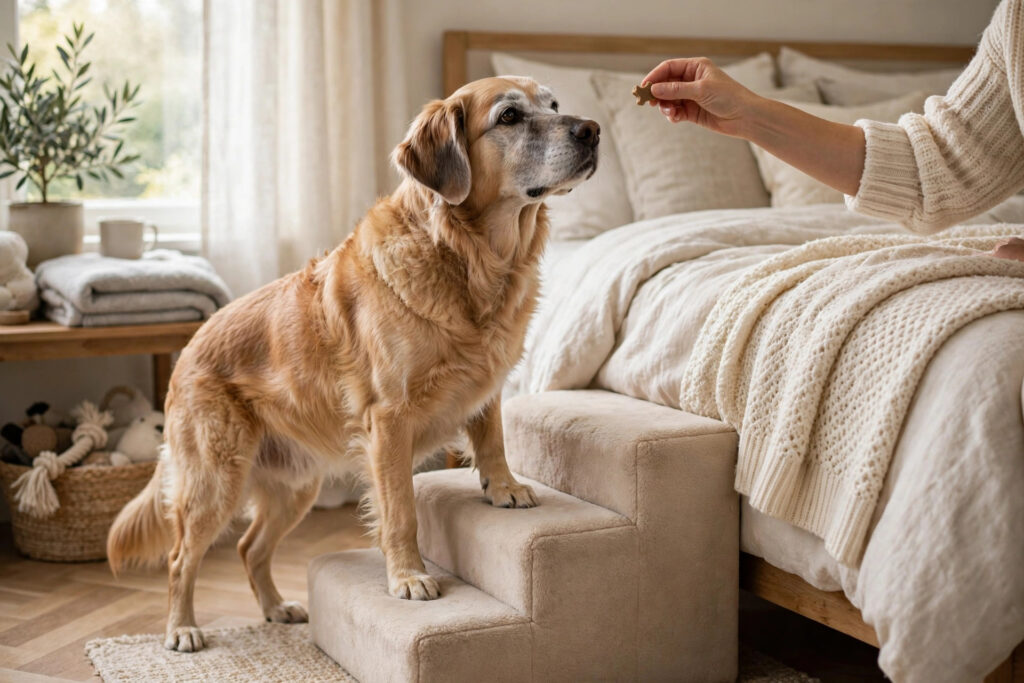
Stairs suit the dog who is fundamentally mobile: the senior who moves fine on the flat, climbs the house stairs without trouble, and just needs the bed’s height broken into smaller pieces. Steps also take up less floor space than a properly gentle ramp — a real consideration in a small bedroom — and many dogs take to them faster because stepping is a motion they already know. If your dog handles stairs in the house confidently and has no spinal history, bed stairs are a reasonable, simpler choice.
The honest middle ground: many households end up with both — a ramp at the bed, where the height and the IVDD stakes are highest, and steps at the couch, where a mobile dog hops up twenty times a day.
The Measuring Guide Most Guides Skip
Most returns and most “my dog won’t use it” stories are measurement failures. Four numbers decide whether the thing works:
1. Furniture height
Measure from the floor to the top of the mattress or cushion — the surface your dog actually lands on, not the frame. Beds with toppers are taller than owners think. The top step of a stair set should sit just below that surface, and a ramp’s top edge should meet it flush, so there’s no final mini-jump at the top. That last little hop is where the whole purpose quietly fails.
2. Ramp slope
Slope is the measurement everyone gets wrong, because a steep ramp is barely better than jumping. The gentler the angle, the easier the climb — and gentleness costs length. A ramp for a tall bed needs to be long, which is why adjustable and folding ramps exist. As a working rule, aim for the longest ramp your room allows, and be suspicious of short ramps marketed for tall beds: if it looks like a playground slide, your dog will treat it like one and refuse. Dogs with weak hind ends need the gentlest slope of all.
3. Tread grip
A dog climbs on confidence, and confidence comes from the surface. Look for high-traction tread — ribbed rubber, coarse carpet, or textured fabric — not smooth wood or slick plastic. Test it the way your dog will: if your hand slides on it at an angle, his paws will too. Some owners add a washable carpet runner over a too-smooth ramp, which works, as long as it can’t bunch or slide underfoot.
4. Width
The ramp or stairs should be wide enough that your dog doesn’t have to walk a tightrope. Nervous dogs and wobbly seniors hug edges; a narrow ramp with a drop on both sides is a balance beam, and they’ll vote no. Wider is calmer. If your dog is genuinely anxious about heights, a ramp with a slight raised edge or rail can help him feel the boundary.
Training: Short Sessions, Paid Well
A ramp your dog won’t use is just furniture that accuses you. Training takes a few days of short sessions, and it follows the same pattern as any new-equipment introduction:
- Flat first. Lay the ramp flat on the floor (or set stairs up in the middle of the room) and let your dog investigate. Treats on the surface, no agenda.
- Walk the flat version. Lure your dog across the ramp while it’s flat until crossing it is boring. For stairs, reward stepping onto the first step, then back down.
- Add a small angle. Raise the ramp to its lowest setting or prop it against something low — a curb-height platform, the couch’s low edge. Short, easy wins.
- Full height, high pay. At the bed or couch, use the treats your dog actually cares about, one step or a few inches at a time. Keep sessions to a couple of minutes, a few times a day, and always end on a success.
- Practice the down trip. Owners train “up” and forget “down” — but down is where the jumping habit lives. Reward the full descent until the ramp is the default route both ways.
Two rules that decide whether this works. Never lift your dog onto the ramp mid-height and encourage him from there — being placed on a slope feels unstable and teaches avoidance. And never let anyone in the house “help” by boosting the dog’s rear up the stairs; a dog who expects a boost learns to wait for one. If your dog is post-op, ask your vet when ramp training can start and whether it should be done on leash — for spinal recoveries, controlled leash use is often the requirement, and it doubles as a safety line against a sudden leap.

Where to Put Them (and the Non-Slip Detail)
The bed is the highest-stakes spot: it’s the tallest furniture, and it’s where a groggy dog attempts a jump at 2 a.m. Put the ramp or stairs on the side your dog actually uses, not the side that looks tidy. The couch is the highest-frequency spot — twenty small jumps a day add up to more impact than the bed ever delivers, which is why couch access matters even for dogs who “can still make it.” The car is the forgotten one: a portable ramp for the vehicle saves the lift-and-twist that hurts owners’ backs and dogs’ joints alike, and it’s close to essential for a post-op dog traveling to rechecks.
Whatever you place, check what’s underneath. The whole structure needs non-slip backing or rubber feet that grip your floor, and the top needs to sit stable against the furniture without a gap a paw can catch in. Walk up it yourself with a hand pressing hard — if it shifts, slides, or rocks, your dog will feel that on his first try and remember it. Stability isn’t a feature; it’s the entire foundation of the dog’s trust. Re-check monthly: rubber feet wear, carpet tread compresses, and a ramp that was solid in month one can be a sled by month six.
One placement trap: don’t block the ramp with laundry baskets, shoes, or the vacuum “just for today.” Dogs are creatures of route. If the route is blocked twice, many will simply go back to jumping, and retraining a dog who has re-learned the jump is slower than training him the first time. The AVMA’s senior pet guidance makes the broader point that small environmental adjustments at home are a real part of keeping older dogs comfortable and safe — ramps that stay put and stay clear are exactly that kind of adjustment.
FAQ
Are stairs or a ramp better for a dachshund?
A ramp. Long-backed, IVDD-prone breeds shouldn’t be jumping or repeatedly flexing up steps, and a ramp’s smooth slope removes both the launch and the landing. Choose a long ramp with a gentle angle and strong tread grip, and train it as the only route onto the bed and couch.
How steep is too steep for a dog ramp?
If the ramp looks like a slide, it’s too steep. Gentler is always easier, and gentleness comes from length — so for a tall bed you need a long ramp. Dogs with arthritis, weak hind ends, or spinal issues need the shallowest angle your space allows. A dog who hesitates, scrambles, or tries to jump off the side is telling you the slope is too much.
My dog ignores the stairs and still jumps. What do I do?
Go back to training at a lower height with better treats, in short sessions — most refusals are confidence problems, not stubbornness. Meanwhile, block the jumping route if you can (position the stairs where he jumps, close the bedroom door) so the habit doesn’t keep paying off. If he scrambles or slips on the surface, fix the tread grip before retraining.
What height stairs does my dog need?
Measure from the floor to the top of the mattress or cushion, then choose stairs whose top step lands just below that surface. Steps that end well short of the top leave a final jump; steps that overshoot create an awkward step-down. Individual step height matters too — smaller rises suit small and arthritic dogs better than a few tall steps.
Can I use a ramp for a puppy?
Yes, and for long-backed breeds it’s a genuinely good idea to make the ramp the habit from the start, before jumping ever becomes the routine. Train it with the same short, rewarded sessions. Just remember a ramp manages furniture access — puppies still need play, exercise, and training time on the ground.
How do I stop the ramp from sliding on hardwood?
Use the non-slip backing or rubber feet it came with, place it so the top rests firmly against the furniture, and consider a non-slip rug pad underneath on slick floors. Test it with hard hand pressure before your dog’s first climb, and re-check monthly — a ramp that shifts once can undo weeks of training.
The Takeaway for Your Dog’s Joints
Stairs and ramps look like small purchases, but they’re really a decision about how your dog’s next few years go. Pick the ramp for backs and surgeries and sore hips, the stairs for the still-mobile senior, measure the height and slope like it matters — because to your dog, it does — and spend three days training it properly. After that, the 2 a.m. jump becomes a quiet walk up a slope, and nobody in the house has to lift anybody.