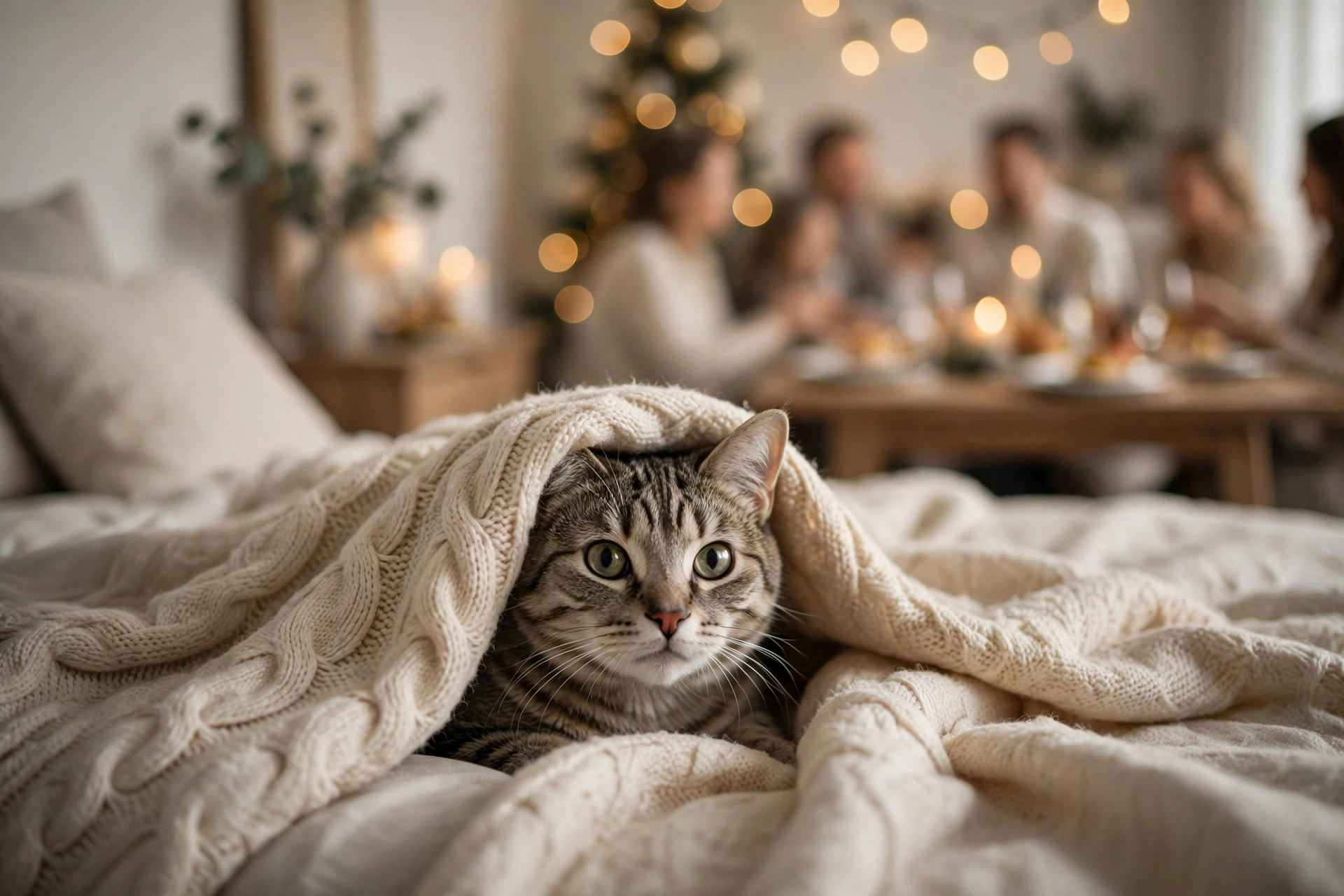
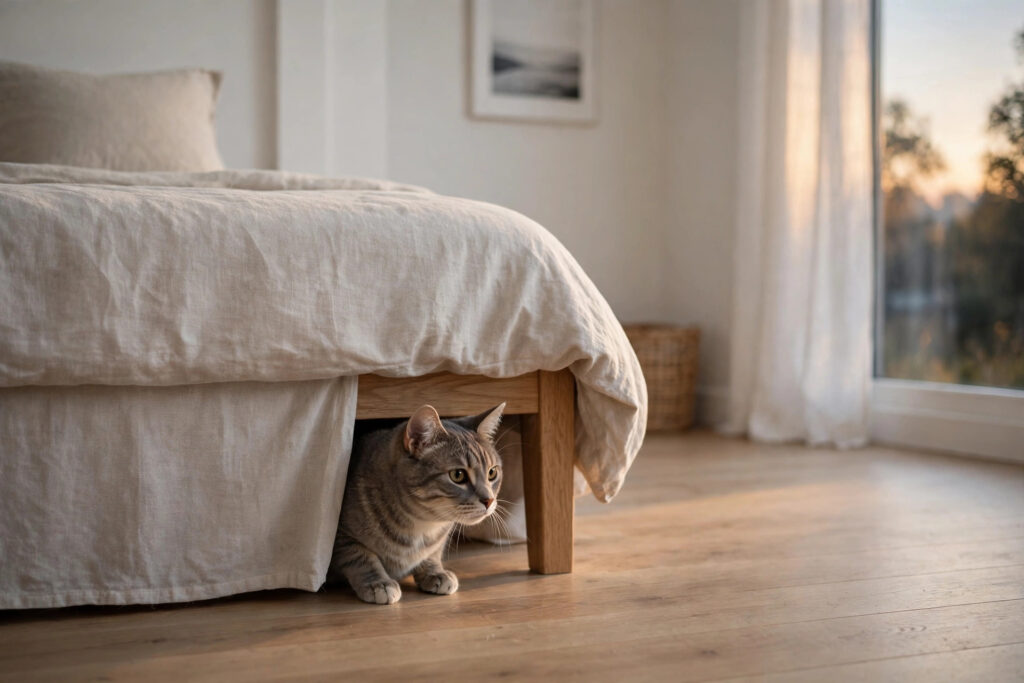
The doorbell rings, and your cat is gone. Not “in another room” gone — under-the-bed, behind-the-water-heater, flattened-into-a-space-no-cat-should-fit gone. Meanwhile your guests are asking where the cat is, someone’s toddler is crawling toward the bedroom, and your aunt is saying, “Just pull her out, she’ll be fine once she meets everyone.” She will not be fine, and please don’t pull her out. Holiday dog stress gets all the attention — the barking, the door-dashing, the counter-surfing. Cats get stressed just as hard; they just do it silently, in the dark, where nobody thinks to worry until the hiding stops being funny.
Most holiday hiding is normal, healthy cat behavior — a prey animal’s sensible response to a house suddenly full of loud strangers. But hiding has a shadow side: it can be the first visible sign of pain, illness, or stress that’s tipping into something medical. Here’s how to set your cat up to cope before the first guest arrives, how to handle the gathering itself, and the specific red flags that turn “she’s just shy” into “call the vet.”
Key Takeaways
- Hiding from guests is normal: For most cats, retreating from noise, strangers, and doorbells is healthy self-protection, not a problem to fix.
- Set up the retreat room before guests arrive: Litter box, water, scratcher, a real hiding spot, food, and a sign on the closed door.
- Never pull a hiding cat out: Not for greetings, not for photos. Forced socializing teaches the cat that hiding places aren’t safe either.
- Not eating for 24+ hours is a vet flag: Cats that stop eating risk hepatic lipidosis — don’t let holiday chaos hide a hunger strike.
- Hiding plus litter-box changes or new spraying is different: That combination points to medical or serious stress causes that need professional help.
Why Cats Hide From Guests (It’s Not Personal)
Your cat’s world is a map of smells, sounds, and routines, and she patrols it like a tiny security guard. Guests blow up the map. Strangers bring foreign smells on their shoes and coats, voices she doesn’t know, laughter at volumes your household never reaches, furniture moved for extra seating, cooking smells, a tree that appeared indoors, and a doorbell that fires at random. Dogs read a party as an event. Most cats read it as an occupation.
Hiding is the strategy that kept her ancestors alive. A small predator is also prey, and the correct response to a large, loud, unfamiliar animal in your territory is to become invisible until it leaves. When your cat vanishes under the guest bed, she isn’t being rude, broken, or dramatic — she’s executing the plan correctly. The cats who stroll out to greet visitors are the statistical oddballs, not the standard.
Age and history shape the response. Kittens raised with lots of visitors often stay bolder. Senior cats, cats in pain, and cats adopted from quiet homes tend to hide longer and deeper. Expect the individual version of hiding, not a schedule.
The Retreat Room: Set It Up Before the First Doorbell
The single best thing you can do for a holiday cat is decide where her sanctuary is before the chaos starts — ideally a day or two ahead, so she discovers it while the house is still calm and claims it as hers.
Pick the right room. Your bedroom is usually ideal: it smells like you, it’s away from the front door, and it has a bed to hide under. A spare room or a home office works too. What matters is a door that closes and stays closed.
Stock it completely. The retreat room needs everything, because a cat who has to leave the sanctuary to reach the litter box doesn’t have a sanctuary:
- A litter box — in the room, not down the hall
- Fresh water, and her food served in the room during the event
- A scratcher or scratching post, because scratching is a stress outlet
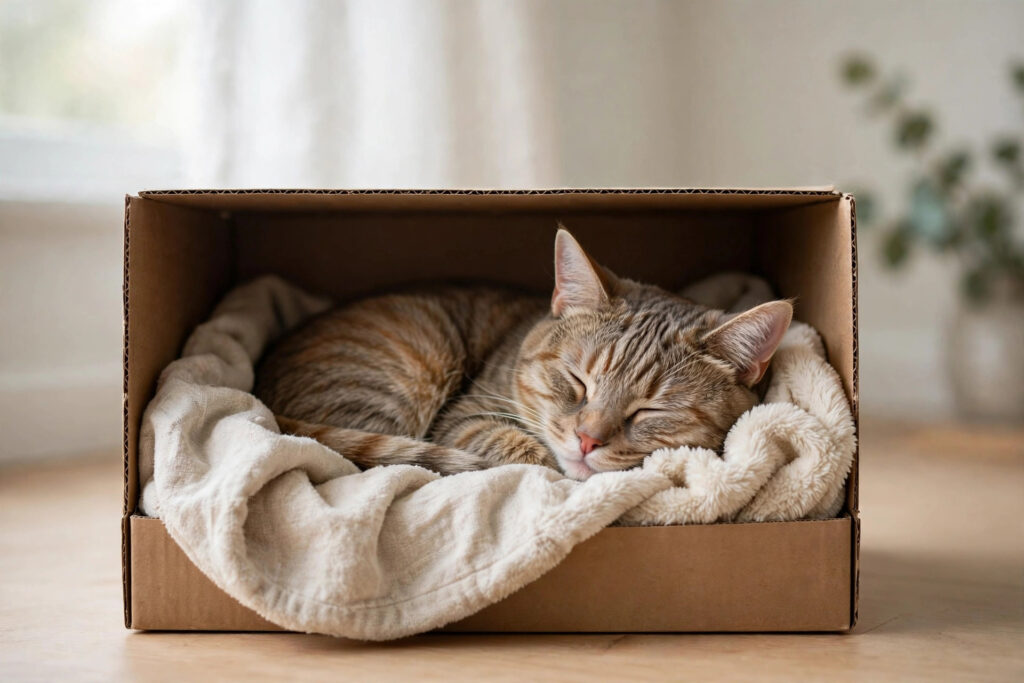
- A genuine hiding spot: a box with a blanket, a covered bed, or access under the bed
- Something that smells like you — a worn sweatshirt works perfectly
Put a sign on the door. Literally. “Cat resting — please don’t open” on a sticky note saves you from the well-meaning guest who goes looking for the bathroom and flushes your cat out of her one safe place. Brief your guests at the door: the cat is in the bedroom, the bedroom is closed, and no, she doesn’t want to meet anyone. Say it warmly and say it once, clearly.
Start early. Move the supplies in the day before, play with her in the room, feed a meal there. If the retreat room appears at the same moment as the invasion, some cats read it as part of the invasion. A room she’s already napped in is a fortress; a room she’s carried into is a question mark.
During the Party: House Rules That Actually Help
Never pull a hiding cat out. Not for a photo, not so grandma can see her, not “just for a second.” Dragging a cat from her hiding spot delivers the worst possible lesson: the hiding place doesn’t protect her. Cats who learn that lesson escalate — they hide harder, in worse places, and some start swatting or biting the hands that reach for them. If a guest wants to see the cat, the guest can be quietly shown the room and peek from the doorway, if the cat is visible. Usually she won’t be. That’s the system working.
Let the cat choose any contact. Some cats emerge after an hour, once the noise pattern becomes predictable, and inspect the gathering from a doorway. Great — let her. A cat who chooses to appear can also choose to leave, and that exit option is exactly what keeps her calm. Guests should let her sniff a hand and decide; nobody should follow her, pick her up, or corner her for affection.
Watch the doors. A stressed indoor cat plus a front door opening every ten minutes is an escape waiting to happen. Ask guests to be door-aware, and keep the cat’s retreat room door closed so the front door is never her problem.
Mind the extras. Keep party food, alcohol, and gift ribbon out of cat reach, keep an eye on toddlers (the feeling is mutual — toddlers are unpredictable, loud, and exactly face-height for a cornered cat), and give the dog, if you have one, his own instructions. A dog barking at the bedroom door undoes the whole retreat concept.
Fireworks and New Year’s Noise
The holiday season saves its loudest trick for last. Fireworks hit cats the same way they hit dogs — unpredictable booms that no amount of routine can normalize — and New Year’s Eve adds midnight doorbells and shouting. The retreat room protocol covers most of it: cat settled in her sanctuary before dark, door closed, curtains drawn against flashes, and some familiar sound in the room — a TV or radio at normal volume — to blunt the contrast between quiet and boom. Check that windows in the room are shut; a panicked cat can push through a cracked window or a loose screen. And make sure her microchip details and your phone number are current before the season starts, because the one night a scared cat does bolt is the night you’ll want that chip to work. The ASPCA’s holiday safety tips cover the wider seasonal hazard list and are worth a skim each December.
Gentle Tools That Can Take the Edge Off
Two low-key supports help some cats, with honest expectations attached.
Pheromone diffusers. Feliway-style diffusers release a synthetic copy of the feline facial pheromone — the “this place is familiar and safe” signal cats deposit when they rub their cheeks on furniture. Plugged into the retreat room a few days before guests arrive, they can soften the stress response for some cats. They are not sedation and they don’t work on every cat; think of them as turning the volume down one notch, not off.
Routine, defended. Cats run on schedule. Feeding at the usual times, keeping the usual play session, and sleeping in the usual bed (yours, in the retreat room) tell your cat that the core of her world is intact even while the edges are loud. Of all the interventions in this article, boring consistency is the one with the most reliable effect.
Anything stronger — calming supplements, anxiety medication — belongs in a conversation with your vet, ideally before the holidays, not improvised mid-party.
When Hiding Is a Vet Flag, Not a Personality Trait
Here is where this article earns its keep. Hiding overlaps with illness so heavily that vets treat “she’s hiding more” as a symptom in its own right. During the holidays, real problems get dismissed as party stress — sometimes for days. These are the patterns that should break through your “she’s just shy” explanation:
Not eating for more than 24 hours. This is the big one. A cat who skips a party-day meal because the bowl is in a scary room is understandable — that’s a setup failure; move the food into the retreat. But a cat who won’t eat even in her sanctuary, for a full day, needs a vet call. Cats — especially overweight cats — can develop hepatic lipidosis, a dangerous liver condition, after only a few days without adequate food. Holiday weekends shrink vet hours, so don’t let a second day pass hoping. (Our raw-food article covers the same liver risk from the diet side: with cats, “not eating” is never a wait-and-see strategy.)
Hiding combined with litter-box changes. Hiding plus straining in the box, crying while urinating, tiny frequent urinations, blood in the urine, or suddenly going outside the box is a medical picture until proven otherwise. A male cat straining and unable to urinate is a same-day emergency — a blocked bladder can kill in a day or two. Stress can genuinely trigger feline urinary flare-ups, which is precisely why holiday hiding plus box trouble deserves a vet, not a shrug.
Spraying that starts after guests arrive. A cat who begins urine-spraying walls or furniture during or after a gathering is sending a stress signal with a bullhorn. Rule out the medical causes with your vet first (urinary issues again), then treat it as a behavior case: more resources, more retreat space, possibly a referral to a veterinary behaviorist if it persists after the house empties.
Hiding that outlasts the guests. The party ends, the house quiets — and the cat still won’t come out the next day, or the day after. Normal guest-hiding resolves when the trigger leaves. Hiding that persists in a calm house, especially with appetite loss, reduced grooming, or a cat who flinches when touched, is a vet visit. Pain hides. So do a dozen other conditions you’d rather catch early. The Cornell Feline Health Center has solid guidance on recognizing subtle illness signs in cats if you want to read up.
Frequently Asked Questions
Is it normal for my cat to hide the entire time guests are over?
Yes — completely. Many cats stay hidden for the whole visit and emerge within an hour or two of the house emptying. As long as she’s eating, drinking, and using the litter box in her retreat room, a full-party disappearance is normal cat behavior, not a problem.
Should I force my cat to socialize so she gets used to guests?
No. Forced greetings backfire — they pair strangers with being cornered and dragged out, which makes the next visit worse. Cats habituate to guests by observing from safety at their own pace, over many calm repetitions. The doorway peek she chooses herself is worth more than ten forced cuddles.
My cat didn’t eat during the party. Should I worry?
First, check the setup: was her food in her retreat room, away from the noise? If she eats once she’s in a quiet room with the food nearby, it was logistics. If she still refuses food for more than 24 hours, call your vet — cats that stop eating risk hepatic lipidosis, a serious liver condition, and the risk climbs after just a few days.
Do pheromone diffusers really help stressed cats?
They help some cats modestly. Feliway-style diffusers mimic the facial pheromone cats leave when cheek-rubbing, and many owners and vets find they take the edge off situational stress. They’re a gentle support alongside the retreat room and routine — not a treatment for serious anxiety or a substitute for vet care when red flags appear.
Why did my cat start spraying after our holiday party?
New spraying after a stressful event usually means the cat’s stress overflowed into territorial marking — but urinary tract problems can look identical and can also be triggered by stress. Get a vet check to rule out medical causes first; if she’s clear, treat it as a stress case with more resources, retreat space, and cleanup with an enzymatic cleaner.
How can I help my cat with New Year’s fireworks?
Settle her in the retreat room before dark with the door closed, curtains drawn, and a TV or radio on at normal volume. Shut the windows, confirm her microchip details are current, and keep her routine — feeding and play — on schedule. If fireworks panic is severe every year, ask your vet ahead of the season about stronger options.
The Short Version
A cat under the bed during your holiday party is a cat doing her job. Give her a stocked retreat room, a closed door with a sign on it, and the right to be left alone, and she’ll re-emerge when the invaders leave. Your job is the other half: knowing the difference between shy and sick. Not eating past 24 hours, hiding paired with litter-box trouble, spraying that starts with the guests, or hiding that lingers after the house goes quiet — those aren’t personality. Those are phone calls. Make them early, and let the rest of the hiding be what it is: a small, sensible animal waiting out the noise in the dark.