This guide contains affiliate links. As an Amazon Associate, PawChirp earns from qualifying purchases — at no extra cost to you. Read our full disclosure.
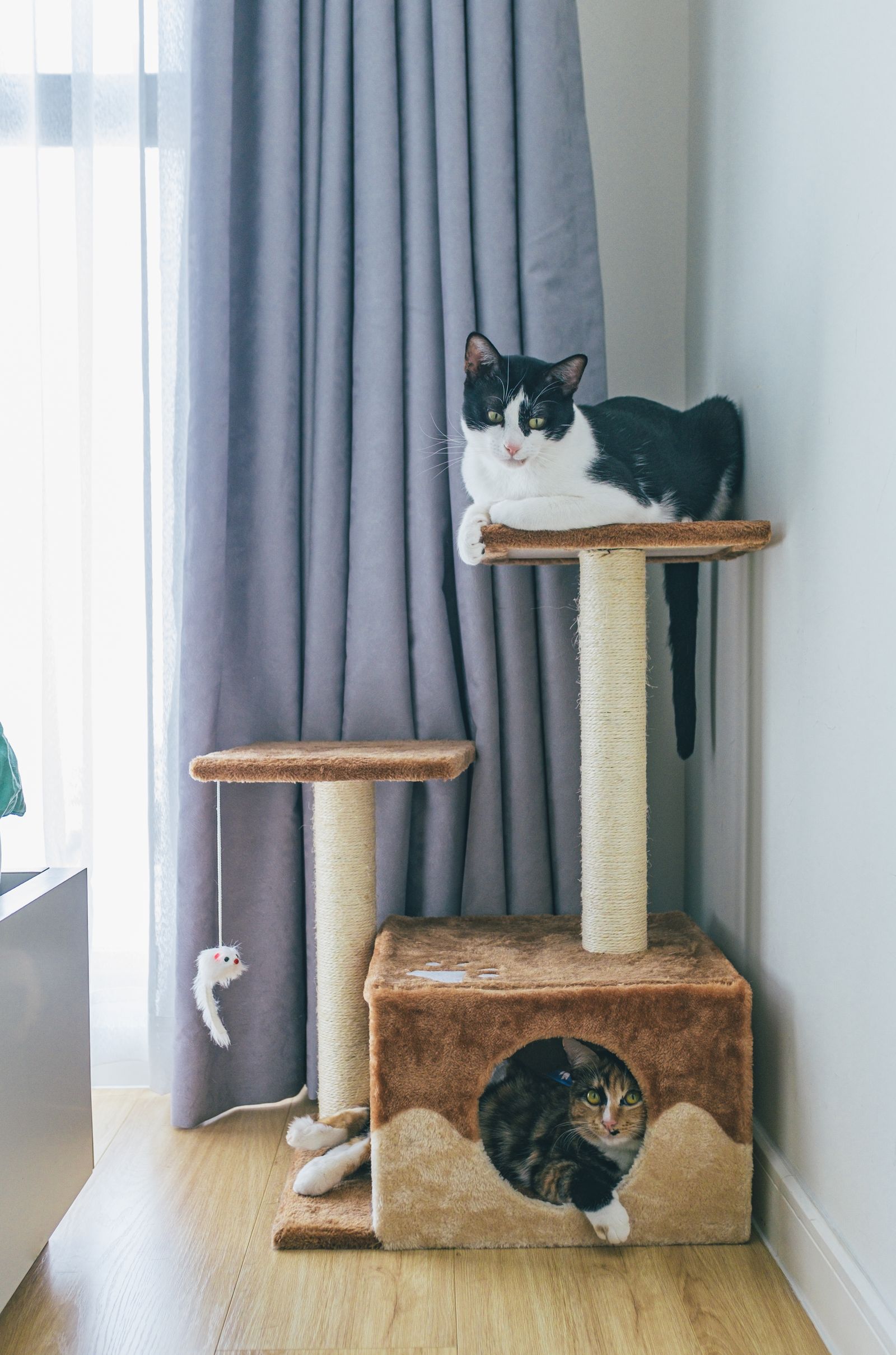
In a small apartment, floor space is the one thing you can’t buy more of — but your cat still needs somewhere to climb, scratch, and survey the room from above. That isn’t spoiling her. Ohio State University’s Indoor Pet Initiative lists scratching and climbing structures among a cat’s basic indoor needs, and advises providing places to climb and look out of windows. A cat tree is how you give her that territory vertically instead of horizontally.
So this roundup is organized around one number most guides treat as an afterthought: footprint. Every pick below earned its place with a published base of roughly 22 inches square or less — including one tree standing 43 inches tall on a 19-inch square, and one slimline model just 13 inches deep. Because a small base changes how a tree behaves, we also talk honestly about stability — which picks are heavy and planted, and which need a corner and a strap.
Key Takeaways
- The Catit Vesper High Base gives the most height per square foot — about 48 inches on a 22.1 × 22.1 in base — and at roughly 40.5 lbs it’s the most planted pick here.
- The Yaheetech 36″ Double Condo is the two-cat pick: two condos and an extra-large top perch on a 19.3 × 18 in base, with a 26.5 lb per-level limit.
- The rabbitgoo 39″ packs the most features per square foot — condo, hammock, and a large perch on a 19.6 × 19.6 in base — but it’s sized for small cats and kittens.
- The FEANDREA UPCT59G is the pick when there’s no corner to spare: at 20.9 × 13 in, the narrowest footprint here, it slides against a wall.
- Small bases demand smart placement: taller, lighter trees go in a corner, strapped to a wall stud, with screws re-checked after the first few weeks.
Quick Picks: Best Cat Trees for Small Apartments at a Glance
| Cat Tree | Best For | Footprint | Height |
|---|---|---|---|
| Catit Vesper High Base (Walnut) | Most height per square foot; furniture look | 22.1 × 22.1 in | ~47.8 in |
| Yaheetech 36″ Double Condo | Two cats; under-window spots | 19.3 × 18 in | 36 in |
| rabbitgoo Cat Tree 39″ | Most features per square foot | 19.6 × 19.6 in | 39 in |
| Amazon Basics Cat Tree Tower with Tunnel | Tallest on smallest square base | 19 × 19 in | 43 in |
| FEANDREA Small Cat Tree (UPCT59G) | Narrowest footprint | 20.9 × 13 in | 26.8 in |
How We Chose These Cat Trees
We research the way we always do at PawChirp — comparing manufacturer specifications, retailer listings, and independent roundups and reviews, not making hands-on testing claims we can’t back up. Our how we choose products page explains the process in full. For this guide, footprint came first: a tree only qualified if its published base fit a small-apartment corner, and we judged stability by base size, height, and the unit’s own weight — not marketing language. Where a maker doesn’t publish a cat weight limit, we say so. Color variants often have their own listings, so confirm the exact version before ordering.
1. Catit Vesper High Base — Best Furniture-Grade Pick for Tight Corners
If your cat tree’s corner is also a corner of the living room guests see, start here. The Vesper High Base is a modern MDF tower in a walnut-look finish that reads as furniture, not pet gear, delivering about 48 inches of height on a true square base — roughly 3.4 square feet of floor. Inside it: a two-entrance cube condo (no cat gets trapped by a housemate), a tall observation platform, an extra-long scratching post, and removable memory-foam cushions. Owners rate it around 4.2 out of 5 on Amazon.ca across roughly 3,700 ratings.
- Footprint: 22.1 × 22.1 in square base
- Height: ~47.8 in
- Unit weight: ~40.5 lbs
- Materials: MDF with walnut-look laminate; seagrass and sisal scratching surfaces
- Cat weight limit: Not published by Catit in the sources we checked — we won’t guess one
- Best for: One average-size cat; design-conscious living rooms
Stability, honestly: the heaviest pick here by a wide margin, on a full square base — the most planted-feeling tree in the roundup. We’d still slide it into a corner, as with any 48-inch tower.
Pros: Wipe-clean laminate shrugs off fur in a way carpeted towers never will, and replaceable cushions, posts, and scratching parts mean a worn section doesn’t retire the whole tree.
Cons: Scratching coverage is modest next to fully wrapped carpet-and-sisal towers, so a power scratcher may still want a separate post. Laminate edges can chip in a move, and cushions are hand-wash only.
2. Yaheetech 36″ Double Condo — Best for Two Cats in a Small Space
Most compact trees assume one cat. This one doesn’t. (Note: this is Yaheetech’s compact 36-inch double-condo model — a different, smaller tree than the 54-inch Yaheetech in our general cat tree guide.) On a 19.3 × 18 in rectangle you get three tiers, two condos — each with two doors — an extra-large edged top perch (18.5 × 16 in), two scratching posts, a scratching board, and a dangling ball. Yaheetech rates each perch and condo for up to 26.5 lbs; owners rate it around 4.6 out of 5 on Chewy across roughly 1,570 ratings.
- Footprint: 19.3 × 18 in
- Height: 36 in
- Unit weight: ~24.5 lbs
- Materials: CARB P2-compliant particleboard, plush fabric, sisal rope
- Weight limit: 26.5 lbs per perch/condo (per manufacturer)
- Best for: Two small-to-average cats; spots under windows or shelves
Stability, honestly: at 36 inches, the low center of gravity on a 24.5 lb frame is inherently steadier than the taller picks. What matters more here is the 26.5 lb per-level limit — respect it with a large cat.
Pros: Two private condos on this footprint is unmatched here, and the big edged perch lets a cat stretch, not curl into a postage stamp. The low profile fits under most windowsills, too.
Cons: The condos are snug — roughly 14 × 12 × 12 in each — and the per-level weight limit rules out heavy breeds. At 36 inches this is napping density, not climbing height.
3. rabbitgoo Cat Tree 39″ — Best Features per Square Foot
If you want the classic cat-tree checklist — condo, hammock, big perch, dangling toy — without giving up a 2-foot square of floor, this is the squeeze. The rabbitgoo stacks three tiers, a condo, a large top perch, a hammock, a hanging toy ball, and multiple sisal-wrapped posts onto a 19.6 × 19.6 in base, at a modest 39 inches that tucks under most windowsills. It’s built from P2-grade particleboard with faux-fur plush and natural sisal.
- Footprint: 19.6 × 19.6 in square base
- Height: 39 in
- Unit weight: 22 lbs
- Materials: P2-grade particleboard, faux-fur plush, natural sisal posts
- Weight limit: Not published in the sources we checked; the listing positions it for small cats and kittens
- Best for: Kittens and small cats; first cat tree in a studio
Stability, honestly: a 22 lb tree at 39 inches is reasonably grounded for a small cat, but a loaded hammock hangs weight off one side — park it in a corner rather than floating it mid-room.
Pros: No other pick fits this many features into a sub-20-inch square: perch, hammock, and condo give a cat three different places to sleep, plus several full scratching posts, not one token pole.
Cons: Thirty-nine inches is short for a cat whose main joy is altitude, and the perch and condo are sized for small cats and kittens — one reviewer on the listing called it “too small, not tall enough,” the honest trade-off of the footprint.
4. Amazon Basics Cat Tree Tower with Tunnel — Tallest Tree on the Smallest Square Base
This is the minimalist’s tower: 43 inches of height — second-tallest here — on a 19 × 19 in square, the joint-smallest base in the roundup. Instead of a condo, the hideaway is an enclosed tunnel cylinder, with tiered platforms, scratching posts, and a plush toy above it. The square footprint slides into the gap at the end of a sofa or beside a bookshelf, where rectangular trees waste triangles of floor.
- Footprint: 19 × 19 in square base
- Height: 43 in
- Features: Enclosed tunnel hideaway, tiered platforms, scratching post(s), plush toy
- Weight limit: Not sourced — check the live listing
- Best for: One cat; corners and sofa-end gaps
Stability, honestly: the tallest tree here relative to its base, so placement does the work — corner plus a furniture strap anchored to a stud. We wouldn’t free-stand it in open floor for a big cat who hits the top perch at speed.
Pros: Real tower height on the smallest square footprint, a proper enclosed hideaway, and a simple design with fewer parts to work loose.
Cons: Two honest caveats. This is an older listing — price-tracking records were last updated in 2023 in our sources — so confirm color and stock on the live listing; the tracked listing is beige only. The tunnel suits smaller cats better than large breeds, and materials weren’t spelled out in our sources, so check the product page if fabric type matters.
5. FEANDREA Small Cat Tree UPCT59G — Best When There’s No Corner to Spare
Every other pick here still wants a corner. This one wants a sliver. The FEANDREA UPCT59G is a slim rectangle just 13 inches deep — the narrowest footprint here — made to slide against a wall, beside a desk, or alongside a dresser where no square-base tower fits. In that sliver: a cave condo at the base, a hanging basket lounger, a scratching post, and a top perch, in smoky gray plush.
- Footprint: 20.9 × 13 in — narrowest here
- Height: 26.8 in
- Unit weight: 12.3 lbs
- Materials: Particleboard, plush, sisal
- Load figure: FEANDREA’s size table lists a 110 lb maximum static load for the whole unit — a structural figure, not a per-perch cat rating
- Best for: Kittens and small cats; studios with only wall-adjacent space
Stability, honestly: at 26.8 inches tall there’s barely anything to tip — the low height compensates for the light 12.3 lb build. It belongs flat against a wall, the spot it was designed for.
Pros: It fits dead space no other tree here can use, it’s light enough to shift aside for vacuuming, and the cave-plus-basket combo gives a small cat an enclosed hideout and an open lounger.
Cons: Let’s be plain: at under 27 inches, this is a perch-and-hideout, not a climbing tower. The basket and platforms are small-cat-sized, and a height-driven cat will ignore it for your bookshelf.
Buying Guide: Fitting a Cat Tree Into a Small Apartment
Measure the corner, not the room
Tape the tree’s footprint on the floor before you order — painter’s tape works — and live with the outline for a day. Check door swing, baseboard heaters (never block one with a plush tree), and how close the top perch lands to a windowsill. A perch ending a few inches below sill height becomes a step up to the window, which is exactly what most cats want. The footprints above are the base only; your cat also needs a landing zone in front, so budget clearance beyond the tape.
Vertical space vs. footprint: the real trade-off
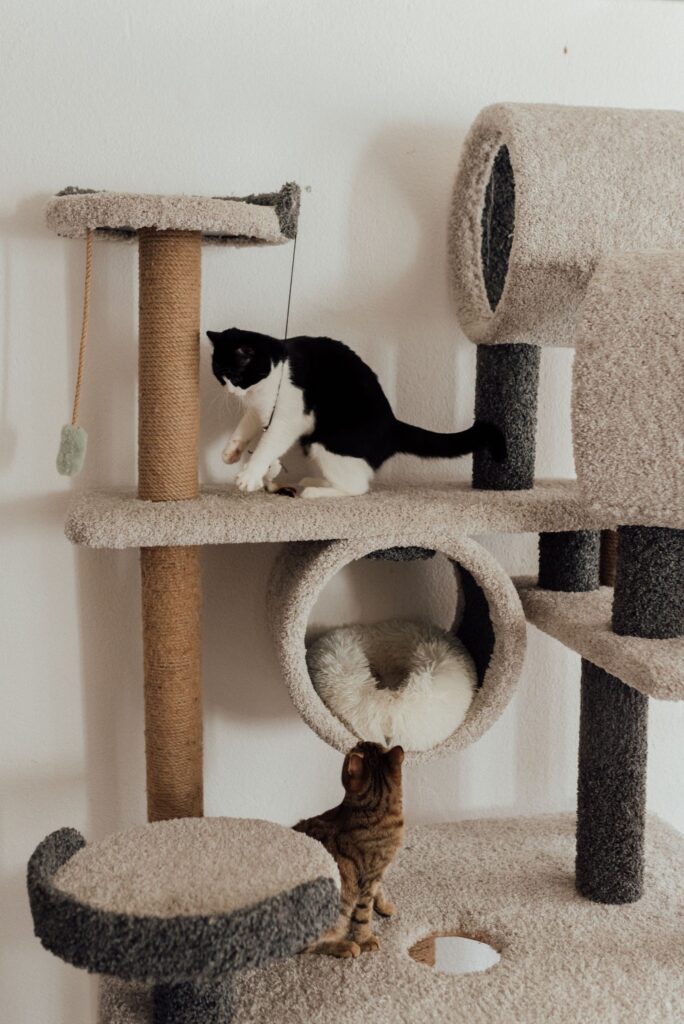
Height per square foot matters in an apartment, but it comes with physics attached. As a tree gets taller on the same base, its center of gravity rises and a leaping cat gains leverage to rock it. So the picks above follow two strategies: go genuinely heavy and square (the 40.5 lb Vesper), or stay under about 40 inches, where a modest base is plenty. And weigh what the height is for: a perch at window height beats a taller one facing a blank wall, and one platform big enough for a full stretch beats three tiny ones.
Anchor tall, narrow trees — it’s not optional
Any tree over roughly 40 inches on a base under 2 feet square should be anchored: anti-tip strap screwed into a wall stud (not drywall anchors), tree placed in a corner so two walls limit its travel, screws re-tightened after the first couple of weeks — new particleboard settles. If it rocks when your cat launches off the top perch, it needs the strap, not replacing.
When the floor is truly out of floor
If even 13 inches of depth is too much, move the territory onto the wall. Our guide to the best wall-mounted cat shelves covers stud-mounted shelves and climbing walls using zero floor space — in a studio, a shelf route above the sofa often beats a freestanding tree.
Frequently Asked Questions
How much floor space does a cat tree actually need?
Less than most people assume: the bases here run from 20.9 × 13 in to 22.1 × 22.1 in — under 3.5 square feet at the largest. Beyond the base, what matters is approach room — space to jump up and land — so don’t wedge a tree in so tightly that perches are unreachable.
Is a tall cat tree on a small base stable enough?
It depends on weight and placement, which is why we list both for every pick. A heavy unit like the 40.5 lb Vesper on a square base is planted; a lighter, taller tree belongs in a corner, strapped to a stud. If it rocks when your cat lands, anchor it — don’t hope she’ll be gentler.
What size cat tree is best for a studio apartment?
Start with the spot, not the tree. With a corner, a square base around 19–22 in gives the most tree per inch. If the tree must sit under a window, look at the 36–39 in picks so the top perch meets the sill. If all you have is a strip of wall, a slimline design around 13 in deep — or wall shelves — is the honest answer.
Can a large cat use a space-saving cat tree?
Sometimes, with eyes open. Check the per-level limit where one exists (26.5 lbs on the Yaheetech), confirm the top perch fits a full stretch, and be skeptical where no limit is published — several makers here don’t state one. A big breed is often better served by one sturdy standard tree than by the smallest footprint available.
How do I get my cat to use a new tree in a small apartment?
Put it where she already likes to be — near a window or her current napping spot — not the corner that’s convenient for you. Rub a worn blanket on the perches, add catnip to the scratching post, and feed treats on the platforms. Then leave it alone; most cats claim a well-placed tree within days once it smells like home.
The Bottom Line
For most small apartments, the Catit Vesper High Base is the easiest recommendation: the most height on a square footprint, real base weight, and a finish that doesn’t fight your furniture. Two cats point to the Yaheetech 36″ Double Condo, a studio kitten to the rabbitgoo 39″, and if your only free space is a strip of wall, the FEANDREA UPCT59G was made for that. Measure your corner, anchor anything tall, and your cat gets her vertical territory back — without you giving up the room.