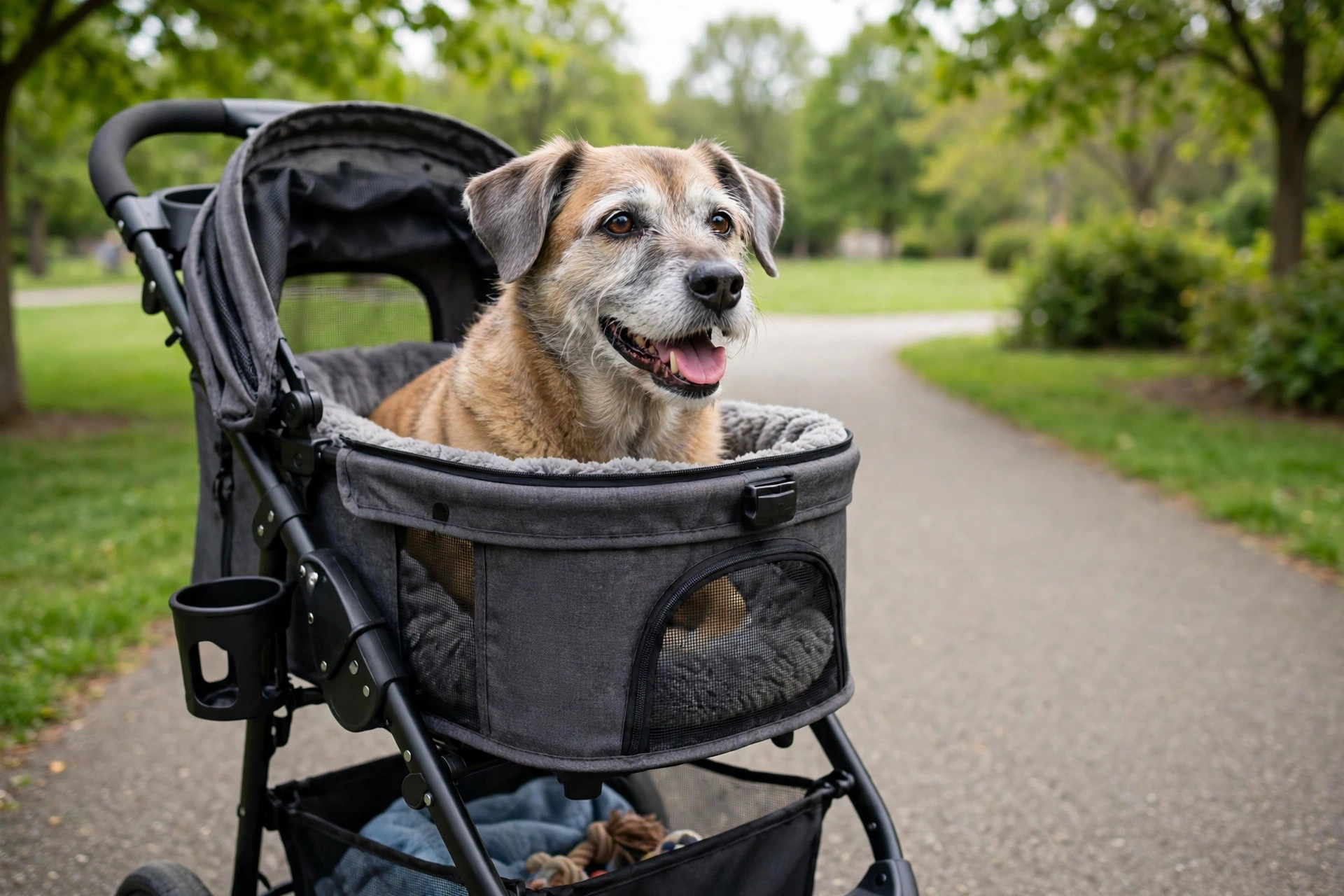
Five years ago, a dog in a stroller got you looks. Now searches for dog strollers are up about 178% year over year, running at roughly 60,500 searches a month — which means a lot of people have stopped worrying about the looks. The interesting thing about the boom is who’s driving it. It isn’t owners dressing up healthy puppies. It’s owners of senior dogs, dogs recovering from surgery, and flat-faced breeds who overheat — people solving a specific problem: the dog still wants to go, but the dog’s body has terms and conditions.
A stroller, used well, is a mobility tool. Used badly, it’s a way to accidentally retire a dog who still needs to move. Here’s how to tell the difference, the use cases most guides never mention, what actually matters when you buy one, and how to introduce it so your dog doesn’t treat it like a trap.
Key Takeaways
- A stroller extends a dog’s world when walking the whole way isn’t possible: post-surgery recovery, arthritis on long outings, and flat-faced dogs on warm days.
- Underrated uses: crowded markets and city streets, hot pavement, and multi-dog households where one dog’s pace would strand the other.
- Buy for fit and terrain: weight limit with headroom, ventilation and shade, wheel type for your surfaces, and a fold that fits your car trunk.
- Introduce the stroller in short indoor sessions with treats — parked first, moving second, outdoors third.
- The hard limit: a healthy young dog needs to walk, sniff, and exercise. A stroller is a support tool, not a substitute for the walk itself.
The Use Cases Most Guides Miss
Post-surgery and injury recovery
This is the case vets actually prescribe rest for — and rest is harder than it sounds. A dog on restricted exercise after knee surgery, a fracture, or a spinal scare still has to go outside, still wants to see the neighborhood, and goes quietly stir-crazy in a silent house. A stroller lets a recovering dog come along for the family’s walk, get the smells and the change of scene, and do it without putting weight through a healing leg. Always match the plan to your vet’s restrictions — some recoveries allow short leash walks, some don’t — but for mental stimulation during crate-rest weeks, a stroller ride is hard to beat.
Arthritis on long outings
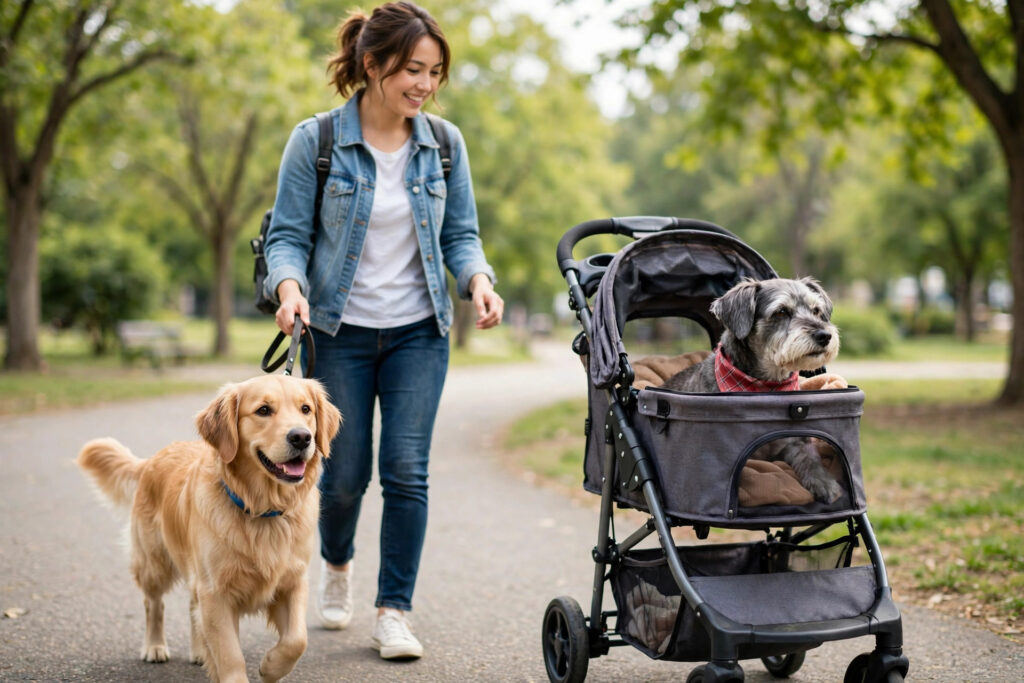
The classic senior-dog problem: the first fifteen minutes of the walk are wonderful, and then the dog is done — but you’re a mile from home, and so is the car. A stroller turns “walk until you’re tired, ride the rest” into a real option, which means longer outings stay on the calendar instead of shrinking to the end of the driveway. Many owners of arthritic dogs use a hybrid rhythm: dog walks the interesting parts, rides the boring stretches, walks again at the park. The dog gets exercise and autonomy; the owner gets to actually go somewhere.
Flat-faced dogs and warm weather
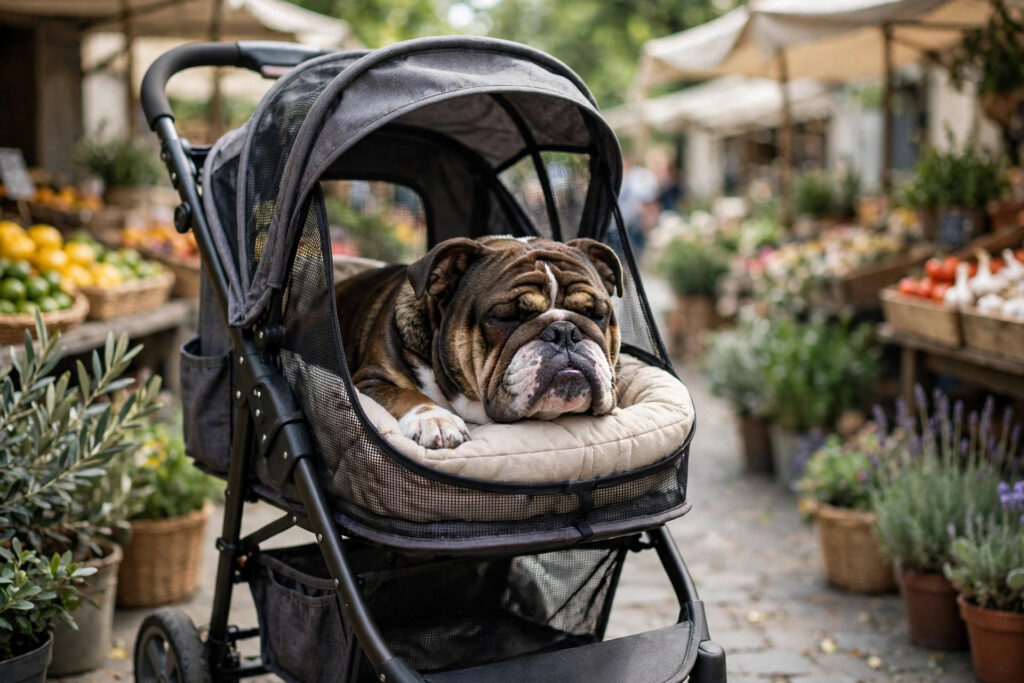
Bulldogs, pugs, Frenchies, and other flat-faced breeds struggle to cool themselves, and a summer outing that would be easy for a shepherd can become dangerous for them. A stroller with good ventilation and shade lets a flat-faced dog join the family at an outdoor market or a park day without walking the whole distance in the heat. It doesn’t make hot weather safe by itself — shade, water, and short outings still rule — but it removes the exercise load from the equation.
Crowded streets, markets, and events
A small dog at a farmers market is at ankle height in a crowd: stepped-on risk, dropped-food risk, and big-dog-greeting risk all at once. Riding at stroller height, the same dog is visible, contained, and calm. This is the use case that converts a lot of skeptics, because the alternative is leaving the dog home from every outing that involves a crowd.
Hot pavement days
Asphalt in summer sun can burn paw pads, and the dogs most at risk are the ones who have to cross big parking lots and city blocks to reach grass. A stroller is a bridge across the hot parts: ride the pavement, walk the park. Simple, and it saves the paw balm-versus-burns calculation entirely.
Multi-dog households with mixed abilities
One dog is nine and arthritic; the other is two and powered by springs. Without help, every walk is a compromise that’s wrong for both. A stroller lets the senior ride the stretches that are too much and walk the ones that aren’t, while the young dog gets the full route. Nobody gets left home, and nobody gets walked past their limit.
What to Look For When You Buy One
Skip the color options for a minute. These four things decide whether a stroller works for your dog:
- Weight limit — with headroom. Check the rated limit, then leave margin. A dog near the max weight rides low, stresses the frame, and has no room to shift position. The cabin should also fit your dog’s length lying down, not just his pounds — a long dog in a “correct weight” stroller can still be a sardine.
- Ventilation and shade. Mesh panels on multiple sides, not just the front, so air actually moves through. A canopy that shades without sealing the cabin shut. For flat-faced dogs and summer use, this is the feature that matters most.
- Wheels matched to your terrain. Small hard wheels are fine on smooth pavement and miserable everywhere else. Larger, air-filled or foam-filled wheels with some suspension handle park paths, cracked sidewalks, and gravel without rattling the passenger. If your routes include trails, look at jogger-style strollers built for it.
- Fold size and weight. Measure your trunk before you buy, and check the folded dimensions and the stroller’s own weight. A wonderful stroller that’s a wrestling match to load gets left in the garage, and a stroller in the garage helps no one.
Worth a quick check while you’re at it: a safety tether inside the cabin to clip to a harness, a brake that actually holds on a slope, and a cabin floor that’s firm rather than hammock-saggy — arthritic dogs brace against a stable floor.
One more practical tip: before you commit, think about where the stroller lives between outings. If it folds into a hallway closet or stands in the corner by the door, it will get used daily. If it has to be hauled from a basement or wrestled out of a packed garage, it will quietly become a sometimes thing — and “sometimes” equipment doesn’t help a dog whose bad days don’t announce themselves in advance. The best stroller is the one that’s ready in the thirty seconds between “he looks tired today” and leaving the house.
Introducing Your Dog to the Stroller
Dogs don’t object to strollers; they object to surprises. Introduce it like any new piece of equipment, in short sessions over a few days:
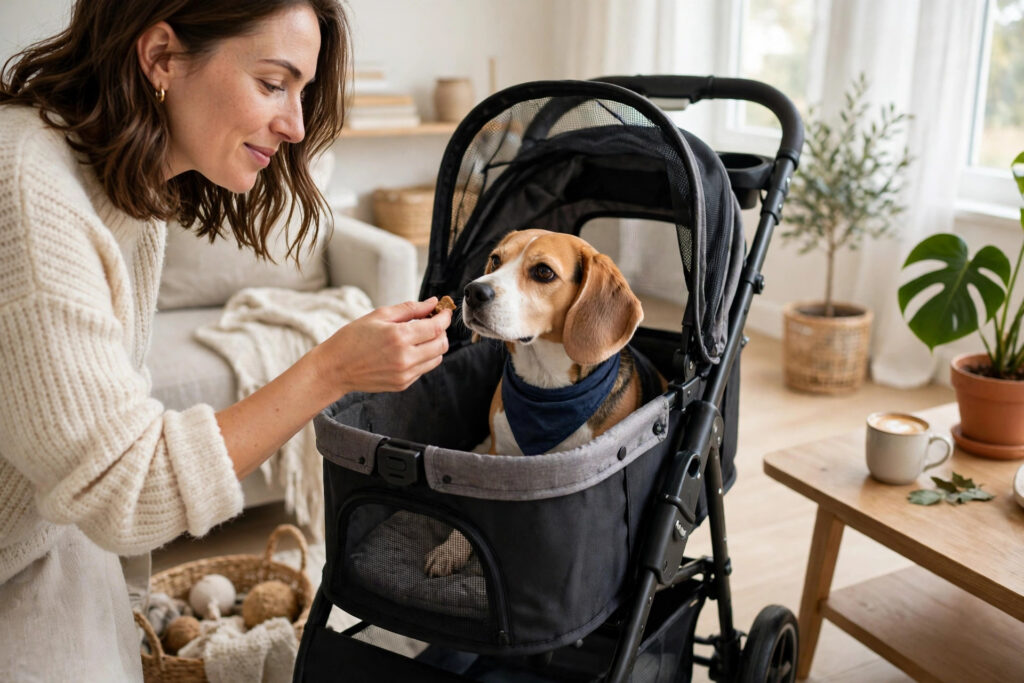
- Parked and boring. Set the stroller up in the living room, wheels locked. Let your dog sniff it, and feed a few treats inside the cabin. Leave it there so it becomes furniture.
- In and out, no moving. Encourage your dog in (lift small or mobility-limited dogs in rather than expecting a jump), treat, praise, lift out. Two minutes is plenty.
- Rolling indoors. Short, slow rolls across the room with treats arriving steadily. If your dog wants out, let him out — you’re building “this thing is fine,” not “this thing is inescapable.”
- First outdoor roll. A short trip on a familiar, quiet route. Senior and recovering dogs often settle fast once the smells start arriving; nervous dogs may need a few sessions to get there.
Never zip or latch a panicking dog in and push on regardless. A dog who learns the stroller means being trapped will fight it harder each time, and a dog with arthritis doesn’t need the stress on top of the soreness.
The Honest Limit: When Vets Say Walk Instead
Here’s the part the product pages leave out. For a healthy dog — especially a young one — walking is not a transportation problem to be solved. It’s the main event: exercise that maintains muscle and weight, sniffing that works the brain, and the daily structure the whole dog is built around. A healthy dog who rides everywhere loses fitness, gains weight, and misses the mental work that keeps behavior steady at home.
Vets and trainers tend to frame it as a simple rule: the stroller carries the dog through the parts he can’t do; the dog walks the parts he can. If your senior can happily walk ten minutes, he should walk ten minutes — then ride. If your recovering dog’s surgeon said leash walks only, the stroller is for transportation, not for extending the outing past the prescription. And if you catch yourself strollering a young, healthy dog because it’s easier than training loose-leash walking, that’s the honest moment to fix the walking instead.
The AVMA’s senior pet guidance emphasizes keeping older dogs active and engaged at the level their health allows — which is exactly the stroller’s best role: not replacing activity, but making more of the world reachable for a dog whose activity has limits. The ASPCA’s general dog care guidance makes the companion point for dogs of every age: daily exercise is a basic need, not an optional extra. Hold both ideas at once and you’ll use the stroller exactly right.
FAQ
Is using a dog stroller bad for my dog?
Not when it’s used as a support tool. For senior, injured, recovering, and flat-faced dogs, a stroller adds outings and stimulation they’d otherwise miss. It becomes a problem only when it replaces walking and exercise for a dog who is able and needs to move — healthy dogs should walk, not ride.
How do I know what size stroller my dog needs?
Start with the weight rating, then check the cabin dimensions against your dog lying down — length matters as much as pounds. Leave headroom under the weight limit so the frame isn’t strained and your dog can shift position. If your dog is between sizes, size up.
Can a stroller help a dog recovering from surgery?
Yes, within your vet’s restrictions. A stroller gives a dog on exercise restriction fresh air, smells, and a change of scene without weight-bearing activity. Confirm with your surgeon what’s allowed — some recoveries include short leash walks, others are strict rest — and lift the dog in and out rather than letting him jump.
Will my dog actually stay in it?
Most dogs settle once they learn the routine, especially when the introduction is gradual: parked sessions first, short rolls, treats throughout. Use the interior tether clipped to a harness, and never force a panicking dog to stay in. Senior dogs who associate the stroller with park trips usually load up happily.
Are strollers okay for puppies?
They can be handy for a young puppy who hasn’t finished vaccinations and shouldn’t walk in high-traffic dog areas, or for socialization outings where a small puppy would be overwhelmed at ground level. But puppies need ground time, play, and exercise as they grow — the stroller is for getting them safely to experiences, not for replacing puppyhood on foot.
The Right Way to Think About It
A dog stroller isn’t a statement about what kind of owner you are. It’s a piece of mobility equipment, in the same family as the ramp and the harness — judged by one question: does it give this dog more good life than he’d have without it? For the senior who can ride to the park and walk the good parts, the recovering dog watching the neighborhood go by, and the flat-faced dog shaded at the market, the answer is plainly yes. Just keep the rule taped to the handle: ride what’s too much, walk what isn’t.