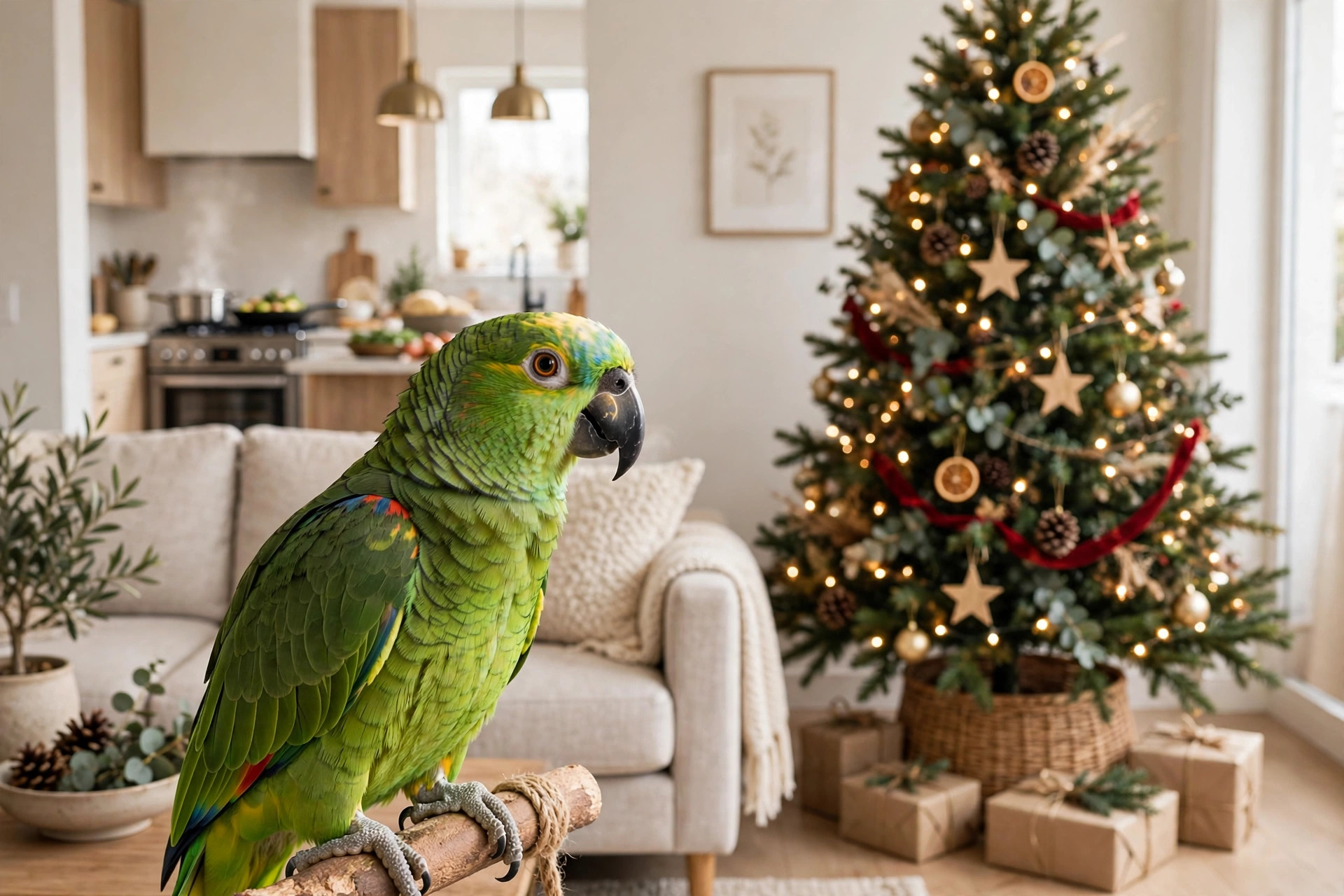
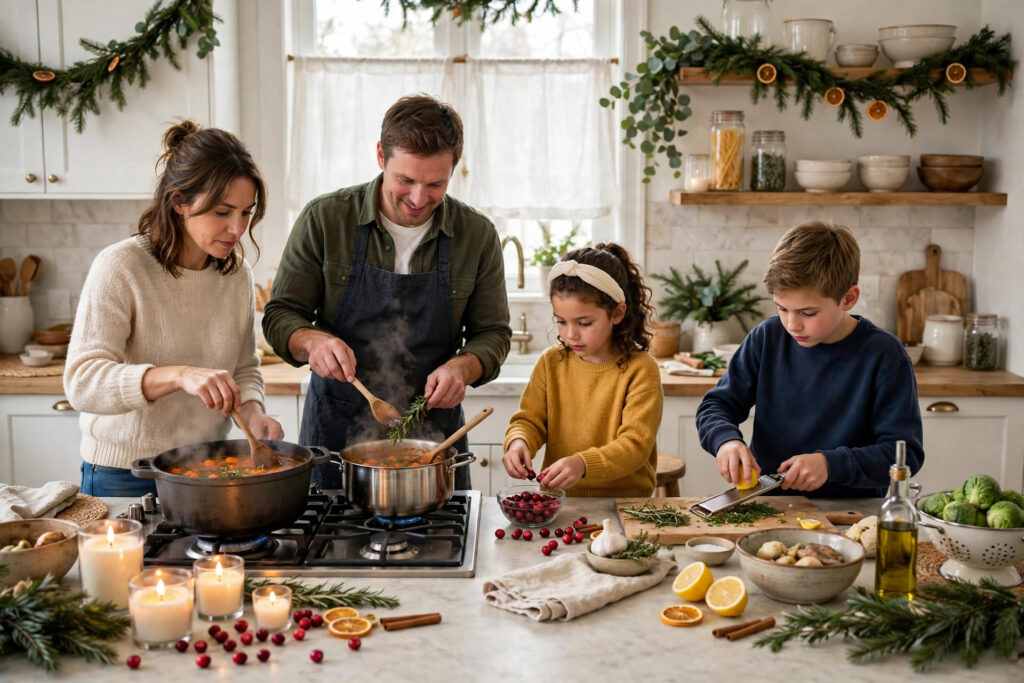
Thanksgiving gravy is simmering, somebody just lit a cinnamon candle, the oven is working overtime, and your parrot is happily shredding a toy two rooms away. It feels like a safe setup. It isn’t — not automatically. The holidays concentrate nearly every airborne hazard a pet bird faces into a few busy weeks: more cooking, more scented products, more smoke, more open doors, more chaos. Birds breathe differently from us. Their respiratory systems pull gases out of the air with an efficiency that keeps them airborne in the wild and makes them terribly vulnerable in a kitchen. Most holiday bird emergencies are not caused by careless owners. They’re caused by normal holiday routines nobody warned the owner about.
So don’t wait for December to get hectic. Walk through these nine hazards now, while the house is calm, fix the ones you can, and make a plan for the ones you can’t. Most of the fixes cost nothing. All of them are easier in November than in the middle of a dinner party.
Key Takeaways
- Overheated PTFE nonstick coating is the fastest killer on this list — its fumes can kill a bird in minutes, and they travel through the whole house.
- A self-cleaning oven cycle is a planned event: get your bird out of the house, or far away with strong ventilation, before you ever press that button.
- Scented candles, wax melts, diffusers, and aerosol sprays all load the air with particles and fragrances a bird’s lungs handle badly. Unscented and flameless is the safe swap.
- Do a kitchen and living-room audit before the cooking rush, not during it.
- If exposure happens: fresh air first, avian vet immediately. Don’t wait for symptoms — with fume exposure, symptoms may never come before collapse.
Hazard 1: PTFE Nonstick Pans — the One That Kills in Minutes
PTFE is the coating sold under names like Teflon that makes pans nonstick. Heated too high — an empty pan left preheating, a pot boiled dry, a broiler running hot — it breaks down and releases gases and particles that are colorless and odorless. You will not smell the warning. VCA Hospitals’ guide to PTFE poisoning in birds explains that birds can be poisoned even when they’re not in the same room as the cookware, because the fumes move through the home, and that sudden death may be the only sign. Smaller birds, budgies especially, are the most sensitive of all.
Read that again if your bird lives “nowhere near the kitchen.” Distance helps with splashes and smoke. It does not reliably protect against PTFE fumes in a house with shared air and a running HVAC system. The only reliable prevention VCA points to is avoiding PTFE products — or, at minimum, never letting them overheat, never leaving them unattended, and ventilating hard while they run. Holiday cooking, with four burners going and a cook who’s also hosting, is exactly how pans get forgotten on high heat.
Hazard 2: The Self-Cleaning Oven Cycle
A self-cleaning cycle burns residue off at extreme temperatures for hours — and oven interiors and drip pans can carry the same nonstick coatings, while the burning residue itself produces heavy fumes. For a bird, a self-cleaning cycle is closer to a chemical event than a cleaning chore. Treat it like one.
The rule is simple: schedule the cycle for a day your bird can be out of the house — at a trusted friend’s home, a boarder, or the vet clinic — or, at the very least, move the bird to the farthest room with windows open and the door sealed well before the cycle starts, and keep it there until the oven is cold and the house has aired out. Never run a self-cleaning cycle “really quick” while the bird naps in the next room. If a pre-holiday deep clean is on your list, this is the single most valuable item on it.
Hazard 3: The PTFE You Don’t Know You Own
Pans are the famous source. They’re not the only one. VCA’s guidance lists PTFE turning up in drip pans, waffle irons, clothing irons and ironing-board covers, heating elements, and heat lamps. Add the modern holiday kitchen: many air fryers use nonstick-coated baskets, and December is when the air fryer, the waffle maker, the panini press, and the countertop grill all come out at once. Some space heaters — the kind dragged out for a chilly guest room — have PTFE-coated elements too.
Before December, do a slow lap of your kitchen and utility spaces. Check the appliances that will get heavy holiday use. If a coating is flaking or scratched, retire the item. If you can’t confirm what a heating appliance is coated with, use it in a well-ventilated space away from the bird, or replace it with stainless steel, cast iron, or ceramic-coated alternatives. Bird households often end up going PTFE-free in the kitchen entirely, and most owners say they don’t miss it.

Hazard 4: Scented Candles and Wax Melts
A burning candle produces soot and fine particles, and a scented candle adds fragrance oils to the smoke. Wax melts skip the flame but still push fragrance into the air for hours. A bird’s air-sac system processes all of it far more thoroughly than your lungs do. Lafeber’s avian team, in their winter prep guide for pet birds, puts it plainly: a bird’s respiratory tract is not built for those scents, and the bird-safe choice is plain, unscented candles — or none at all.
The easy holiday swap: flameless LED candles. They give you the same warm flicker on the mantel with zero combustion and zero fragrance. If real candles are non-negotiable for a family tradition, burn unscented ones in a room the bird never enters, with ventilation, and never in the bird’s room.
Hazard 5: Diffusers, Plug-Ins, and Aerosol Sprays
Essential-oil diffusers mist concentrated oils into the air. Plug-in air fresheners emit fragrance continuously. Aerosol sprays — cooking spray near a hot pan, hair spray before the party, spray snow, furniture polish — put fine droplets exactly where lungs, human and avian, will collect them. None of these belong in a bird’s airspace, and “natural” on the label doesn’t change the physics of tiny oil droplets in a very efficient respiratory system.
For December, move diffusers and plug-ins out of any room the bird spends time in, and do all spraying — hair, cleaning, cooking — away from the cage with a window open. If a guest room needs freshening before visitors arrive, open windows and run a fan instead.
Hazard 6: Potpourri and Simmer Pots
Potpourri looks harmless sitting in a bowl. Dry potpourri is often treated with fragrance oils, and birds are champion investigators — a curious parrot can chew treated decorative material that was never meant to be food. Liquid potpourri and simmer pots add another layer: heated fragrance, all day, right at breathing height.
Keep decorative potpourri out of beak range entirely, skip the liquid kind, and if you love a stovetop simmer for the smell of the season, do it on a day the bird is in a closed, ventilated room elsewhere — or accept that in a bird home, the house can smell like actual food instead. It usually does anyway.
Hazard 7: Fireplace and Wood-Stove Smoke
A fireplace is the coziest thing in a December house and a real respiratory load: wood smoke carries fine particles deep into lungs, and a smoky backdraft when a door opens can fill a room fast. Birds shouldn’t share air with a smoking fireplace. Keep the bird’s cage out of the fireplace room on fire nights, make sure the flue is drawing well before you light anything, and never use the fireplace to dispose of wrapping paper, which flares, smokes, and can carry inks and coatings you don’t want in anyone’s air.
Hazard 8: The Christmas Tree Itself
Artificial flocking — the sprayed-on “snow” — is a problem twice over: the spray goes on as an aerosol, and the flocking itself can flake and be chewed. Skip flocked trees in bird homes, or keep the tree strictly in a bird-free room. Add the quieter hazards: tinsel and fine garlands that a chewing bird can swallow, low-hanging glass ornaments, electrical cords for lights, and — for real trees — the water reservoir, which can grow bacteria and collect whatever was sprayed on the tree before sale. The tree doesn’t have to be off-limits to the family. It does need to be off-limits to the bird: supervised out-of-cage time simply happens in a different room during December.

Hazard 9: Guests, Perfume, and Open Doors
The last hazard walks in wearing perfume. Holiday gatherings mean guests in scented products, a front door opening fifty times, kids who’d love to hold the bird, and a house running loud and late. Each piece matters. A heavily perfumed hug is a face-full of fragrance for a small bird. An open door during arrivals is an escape route for a startled, flighted bird — and December weather turns a lost bird emergency into a survival emergency fast. A parade of handling stresses a bird whose routine has already been upended.
Set the house rules before the party: the bird’s cage goes in a quiet room with the door closed or gated during big gatherings, guests admire with their eyes unless you say otherwise, and somebody is always on front-door duty when the bird is out. Most guests are delighted to cooperate once they know the reasons.
The Pre-December Kitchen Audit (20 Minutes)
Put it on the calendar like any other holiday prep. Walk the kitchen and living areas with fresh eyes:
- Cookware: identify every PTFE-coated pan, tray, and appliance. Decide now what the holiday cooking will actually use.
- Oven: if a self-cleaning cycle is coming, pick the date and the bird’s out-of-house plan today.
- Air: check the stove exhaust fan works and vents properly. You’ll lean on it all season.
- Scents: gather the candles, melts, diffusers, plug-ins, and sprays. Move them out of the bird’s rooms or retire them for the season.
- Heat: check any space heater or heat lamp for coatings and condition before its first cold night.
- Retreat: choose the quiet room the bird will use during parties, and set it up before you need it.
If Exposure Happens: Fresh Air First
If you suspect fume exposure — a pan burned dry, a cleaner sprayed nearby, the oven cycle started with the bird home — don’t wait and watch. VCA’s advice is to get the bird to fresh air immediately and call your veterinarian or an animal poison service (the ASPCA Animal Poison Control Center and the Pet Poison Helpline both run 24/7) for guidance. Signs of PTFE poisoning can include labored or rapid breathing, wheezing, agitation, weakness, and wobbling on the perch — but sudden death may be the only sign, which is why “wait and see” is the wrong instinct with fumes. Move first, call on the way, and let a vet decide what happens next.
Frequently Asked Questions
Can I keep using my nonstick pans if my bird lives in another room?
It’s a risk reduction, not a guarantee. VCA Hospitals notes birds can be poisoned by PTFE fumes even when they aren’t in the same room, since the gases travel and you can’t see or smell them. Many bird owners remove PTFE cookware from the kitchen entirely and switch to stainless steel, cast iron, or ceramic. If you keep any, never preheat it empty, never leave it unattended, and run the exhaust fan every time.
Is it ever safe to run the self-cleaning oven with a bird in the house?
Plan as if it isn’t. The cycle runs extremely hot for hours and produces heavy fumes. The safe routine is to board the bird or send it to a trusted home for the day, run the cycle, and air the house out completely before the bird returns. At minimum, the bird goes to the farthest, best-ventilated room with the door closed — but out of the house is the standard vets recommend.
Are flameless candles really the only candle option?
They’re the easiest safe option, and for the bird’s room they’re the right one. Plain unscented candles burned in a separate, ventilated room the bird doesn’t enter are the compromise many owners choose, following the Lafeber guidance to stick to unscented candles around birds. Scented candles and wax melts are the ones to bench for the season.
What about cooking sprays and cleaning sprays?
Keep all aerosols away from the bird. Aerosol droplets hang in the air and are exactly what a bird’s respiratory system collects so efficiently. Use pump sprays or wipes for cleaning, do it with the bird in another room and a window open, and let the room air out before the bird comes back.
My bird seems fine after a pan overheated. Can I skip the vet call?
No — make the call anyway. With PTFE exposure, VCA warns that sudden death may be the only sign, and birds who survive the first phase often need hospital care. Fresh air and an immediate call to your avian vet or a poison helpline cost you nothing and give your bird its best chance.
How do I keep my bird safe during a holiday party?
Move the cage to a quiet room before guests arrive, keep that door closed, and let the bird keep a normal bedtime. Brief guests: no feeding the bird from the table, no handling unless you offer, and watch the front door during arrivals. A calm bird in a boring room is having a better holiday than a stressed bird at the center of the party.
The Bottom Line
Holiday bird safety is mostly a November job: audit the kitchen, retire or sideline the PTFE, plan the oven cycle around the bird, swap scented for flameless, and set party rules before the doorbell rings. Do that, and December gets to be what it should be — loud in the dining room, calm in the bird’s room, and safe in every room. Keep your avian vet’s number on the fridge next to the poison-control numbers, and enjoy the season.