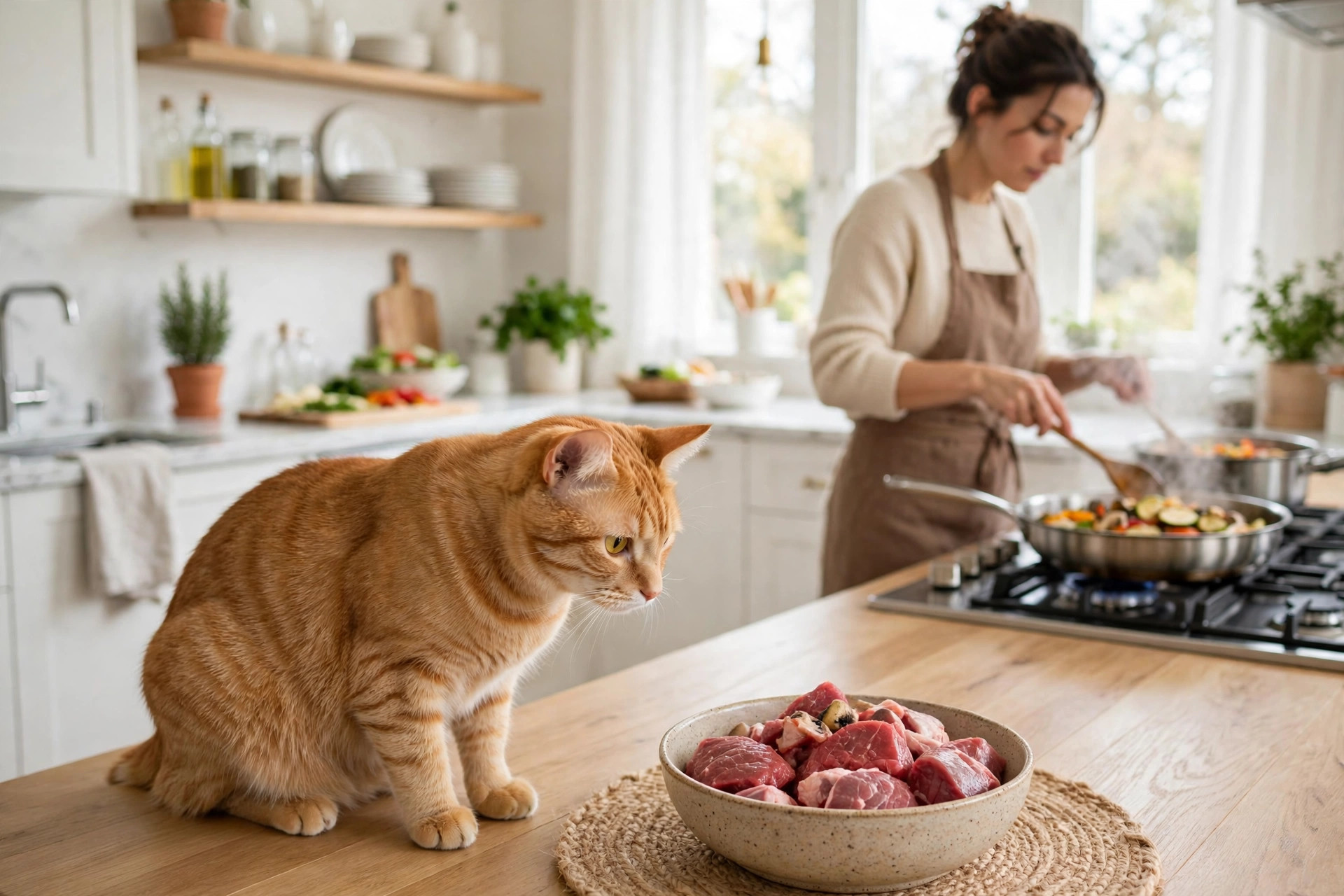
Raw cat food has passionate fans. The pitch sounds logical: cats are hunters, their wild cousins eat raw prey, so a bowl of raw meat must be closer to nature than anything cooked in a factory. The problem is that the three agencies Americans trust most on food and animal health — the FDA, the CDC, and the AVMA — have all looked at that logic and come back with the same answer: raw pet food carries real, documented risks, for your cat and for your family. And in the last couple of years, a new one has joined the list: H5N1 bird flu, which has proven deadly to cats that ate contaminated raw food or drank raw milk.
None of this means you fed your cat badly if raw is what’s in the freezer right now. It does mean the decision deserves the full picture, not just the marketing. Below is what each agency actually says, the misconceptions that keep tripping people up — including the idea that freeze-dried raw is somehow cooked — and a safe plan for switching your cat to a cooked diet if you decide to make the change.
Key Takeaways
- The agencies agree: The CDC advises against feeding pets raw pet food, the AVMA discourages raw animal-protein diets, and the FDA warns that H5N1 in raw food and raw milk can kill cats.
- Freeze-dried raw is still raw: Per CDC guidance, freeze-drying does not make a raw product safe — it counts as raw food.
- Freezing is not a kill step: Freezing does not reliably eliminate Salmonella or Listeria, and Listeria can even grow slowly in the fridge.
- The risk is not just your cat’s: Raw food handling spreads bacteria around your kitchen, which matters most for kids and anyone with a weakened immune system.
- Switch gradually, never by fasting: A cat that stops eating entirely risks hepatic lipidosis, a dangerous liver condition — transitions must keep the cat eating every day.
What the CDC Says About Raw Pet Food
The CDC’s position is the plainest of the three. Its guidance on raw pet food says not to feed pets raw pet food or unpasteurized (raw) milk, because raw meat and raw milk can carry germs such as Salmonella, Listeria, and E. coli — and, more recently, the H5N1 bird flu virus. The CDC’s raw pet food page spells out the concern in both directions: pets can get sick from contaminated food, and pets that eat contaminated food can shed germs in their saliva and stool, exposing the people who live with them.
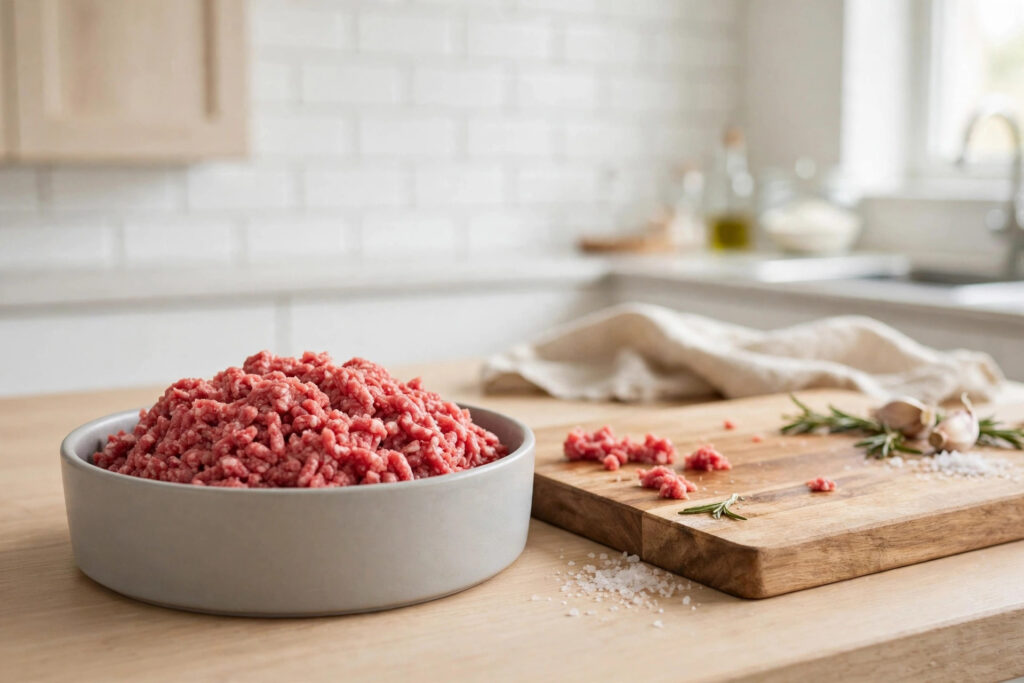
One clarification from the CDC catches a lot of owners off guard: freeze-dried raw food still counts as raw. Freeze-drying removes moisture; it does not cook the meat, and it is not a treatment that reliably kills bacteria or viruses. The same goes for dehydrated raw products and raw treats like uncooked bones and animal ears. If the product started raw and was never cooked or otherwise treated to kill pathogens, the CDC treats it as raw food — because, biologically, it is.
What the FDA Says — Including the Bird Flu Warning
The FDA regulates pet food, and its consumer guidance has warned for years that raw pet food is more likely than other pet foods to be contaminated with Salmonella and Listeria. Testing by the FDA’s Center for Veterinary Medicine has found those bacteria in raw pet food samples at rates that prompted repeated consumer advisories, and contaminated products have triggered recalls.
The newer warning is the one that changed the conversation. The FDA’s page on avian influenza H5N1 in cats states that cats can be infected with H5N1 through food — specifically raw or undercooked meat and unpasteurized milk from infected animals — and that the illness in cats is often severe or fatal. Cats infected with H5N1 frequently develop serious neurological signs, and many do not survive. This is not a theoretical risk assembled from lab studies; cats have died after eating raw pet food and drinking raw milk linked to the virus. If raw food was already a judgment call, H5N1 is the fact that pushed federal agencies to say the quiet part out loud: the risk is not worth it.
What the AVMA Says
The AVMA — the American Veterinary Medical Association, the professional body for U.S. veterinarians — has a formal policy discouraging the feeding of raw or undercooked animal-source protein to dogs and cats. The AVMA’s raw protein policy was written because the association judged the illness risk to pets and to people to outweigh the claimed benefits, which remain unproven in controlled studies. When your own vet raises an eyebrow at a raw diet, this policy is usually why: it’s the mainstream position of the profession, not one clinic’s opinion.
That doesn’t mean raw feeders are careless people. Many are meticulous. But meticulous handling reduces risk; it doesn’t remove it, because the contamination is inside the product itself, not just on your counter.
Three Myths That Keep Raw Feeding Feeling Safer Than It Is
“Freezing kills the germs”
Freezing slows bacteria down. It does not reliably kill Salmonella or Listeria, and both can survive frozen storage and wake right back up as the food thaws. Listeria is especially unbothered by cold — it can grow, slowly, at refrigerator temperatures, which is one reason it turns up in refrigerated ready-to-eat foods for people. A week in the freezer is not a safety step. It’s just storage.
“My cat’s stomach acid handles it — wild cats eat raw meat”
Cats do have acidic stomachs, and healthy cats sometimes eat contaminated food without obvious symptoms. Two problems follow. First, “sometimes” is doing a lot of work in that sentence — cats do get Salmonella and Listeria infections, and H5N1 has killed cats outright. Second, a cat can feel fine and still shed bacteria in its stool and saliva, which is how the risk quietly transfers to the humans scooping the litter box and getting licked on the hand. Wild cats, for the record, also live much shorter lives than indoor pets, partly because of what they eat and catch.
“Freeze-dried raw is basically cooked”
Covered above, but worth repeating because the packaging rarely says so: freeze-dried raw is raw. The CDC counts it as raw pet food. Removing water preserves the product; it doesn’t sterilize it.
The Human Side of the Bowl
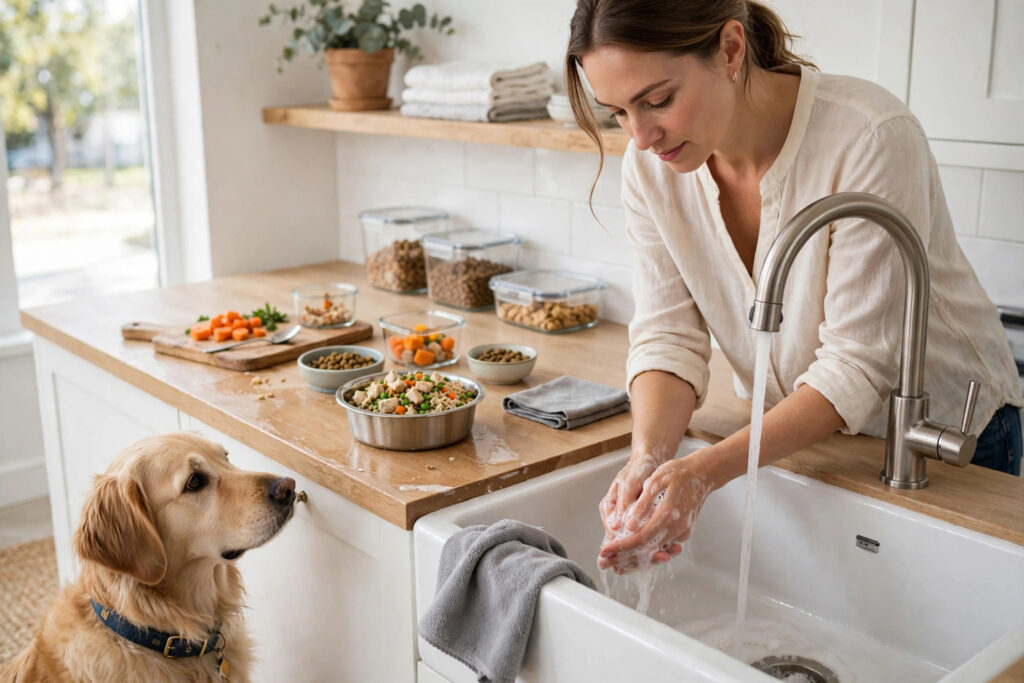
Every raw meal is a small food-handling event in your kitchen. Raw pet food touches scoops, bowls, counters, fridge shelves, and hands. Salmonella doesn’t care whether the meat was destined for a person or a cat — cross-contamination works the same either way, and a bowl sitting on the floor for hours is a bacterial incubator at ankle height, exactly where toddlers crawl.
The CDC flags the higher-risk households plainly: homes with young children, older adults, pregnant people, or anyone whose immune system is weakened by illness or medication should be especially cautious. If someone in your home fits that list, the agencies’ advice effectively makes the decision for you. Cats fed raw diets also shouldn’t visit hospitals or nursing homes as therapy animals, for the same shedding reason.
If you continue feeding raw despite the warnings, the standard harm-reduction steps are the ones the agencies publish: wash hands for 20 seconds after handling, wash bowls and utensils in hot soapy water after every meal, disinfect surfaces the food touched, store raw pet food sealed and separate from human food, don’t let your cat lick your face, and scoop the litter box daily with handwashing after. Know that these steps lower the risk. They don’t zero it out.
Indoor Cats Aren’t Automatically Out of the Raw-Exposure Picture
Feeding cooked food indoors removes the food-bowl risk, but keep an eye on the side doors. Cats with outdoor access can hunt birds and rodents, scavenge carcasses, or lap up raw milk on farms — all routes that bypass your careful shopping entirely. The ASPCA’s general pet care guidance and basic common sense point the same way: during bird flu activity in your area, keeping cats indoors or supervised outside closes the hunting route too. (Our companion article on bird flu and outdoor cats covers that local-action checklist in detail.)
How to Switch a Cat From Raw to Cooked Food — Safely
If the evidence has you ready to switch, the transition itself matters, because cats are famously suspicious of new food and because a hard stop can turn dangerous fast.
Never fast a cat into switching. This is the single most important rule. A cat that stops eating — especially an overweight cat — can develop hepatic lipidosis, a form of liver failure that sets in after even a few days without food. Starving a stubborn cat into accepting a new diet is not tough love; it’s a medical emergency in slow motion. If your cat refuses food entirely for more than 24 hours during a transition, call your vet.
Go gradual, over 7 to 10 days. Mix a small amount of the new cooked food into the raw food and shift the ratio a little each day — roughly a quarter new food for the first few days, half and half midweek, mostly new by the end. Cats who fixate on texture may accept the same protein in a new form more easily, so a cat raised on raw chicken often transitions best to a cooked chicken recipe.
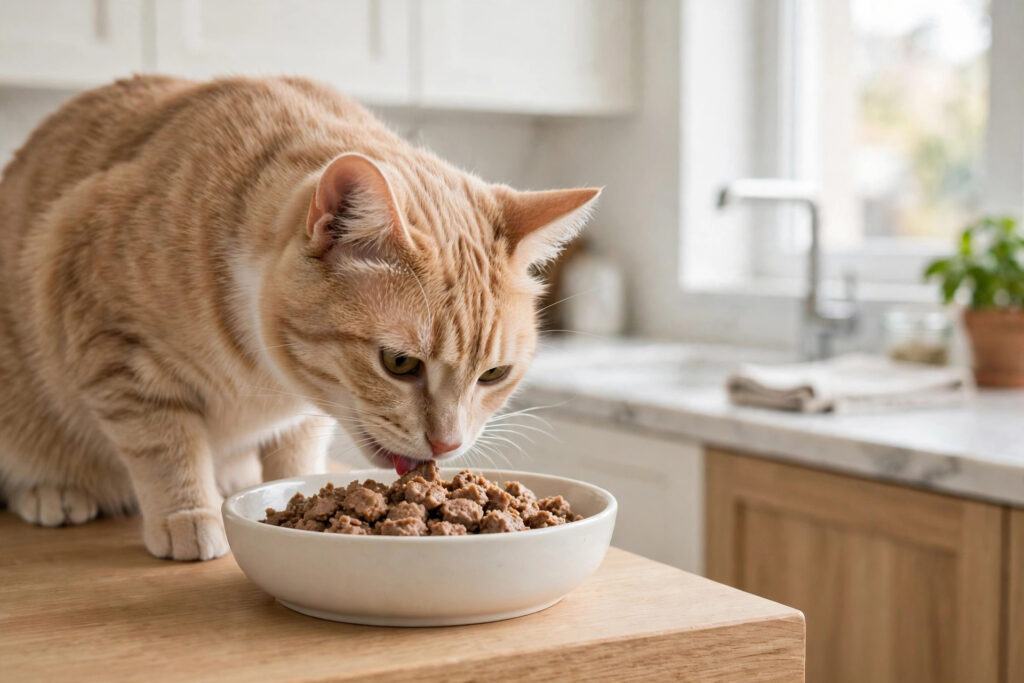
Make the cooked food worth eating. Warming wet food briefly to just above room temperature releases aroma and helps a lot. Serve fresh portions rather than leaving food out, keep mealtimes and locations consistent, and don’t offer a buffet of alternatives the moment the cat hesitates — that teaches holding out. A sprinkle of the old food on top, decreasing daily, can bridge picky cats.
Pick a complete cooked food. Look for a commercial cat food labeled as complete and balanced for your cat’s life stage (an AAFCO adequacy statement on the label). If you prefer home cooking, do it with a recipe formulated with a veterinarian or a board-certified veterinary nutritionist — plain cooked meat alone is nutritionally incomplete for cats, missing essentials like taurine that cooking doesn’t provide by itself. The Cornell Feline Health Center is a solid starting point for feline nutrition basics, and your vet can sanity-check any plan in one visit.
Frequently Asked Questions
Is freeze-dried raw cat food safe?
No — not by the standards the agencies use. The CDC counts freeze-dried raw products as raw pet food because freeze-drying doesn’t cook the meat or reliably kill Salmonella, Listeria, or viruses. Treat freeze-dried raw with the same caution as frozen raw.
Can indoor cats get bird flu?
Yes, if they’re exposed. The FDA has documented cats infected with H5N1 after eating contaminated raw pet food or drinking unpasteurized milk — no outdoor access required. Indoor cats that hunt, scavenge, or are fed raw products carry the risk; a strictly indoor cat fed cooked food and pasteurized products has a far smaller one.
Does freezing raw cat food kill Salmonella?
Not reliably. Freezing pauses bacterial growth rather than eliminating the bacteria, and Salmonella and Listeria can survive frozen storage and become active again as food thaws. Listeria can even grow slowly in the refrigerator.
My cat has eaten raw food for years and seems fine. Should I stop?
That’s a conversation worth having with your vet, with the agencies’ positions on the table: the CDC advises against raw pet food, the AVMA discourages raw-protein diets, and the FDA warns H5N1 in raw food and raw milk can be fatal to cats. A healthy-looking cat can still shed bacteria at home. If you switch, do it gradually over 7–10 days and never by withholding food.
Can I cook the raw cat food I already bought?
Cooking meat thoroughly kills the bacteria and viruses of concern, and some owners do cook down their remaining raw supply as a bridge food. Just know that commercial raw formulas are balanced to be fed raw and may include ground bone that shouldn’t be fed cooked — cooked bones can splinter. The cleaner path is a gradual switch to a complete cooked commercial food, using up or discarding the raw stock as you go.
Are raw treats like freeze-dried liver or raw bones safer?
The same logic applies. Single-ingredient freeze-dried treats are still raw products, and raw bones carry both bacterial risk and a chance of cracked teeth or intestinal injury. Cooked, commercially produced treats made for cats are the lower-risk way to keep treat time fun.
The Short Version
The FDA, CDC, and AVMA don’t agree on everything, but on raw cat food they’re unusually aligned: the documented risks — Salmonella, Listeria, and now H5N1 — outweigh benefits that have never been proven in controlled studies. Freeze-dried doesn’t change the math, and neither does freezing. If you switch your cat to a cooked diet, do it slowly, keep her eating every single day, and bring your vet into the loop. Your cat gets the nutrition she needs, and your kitchen stops moonlighting as a microbiology lab.