

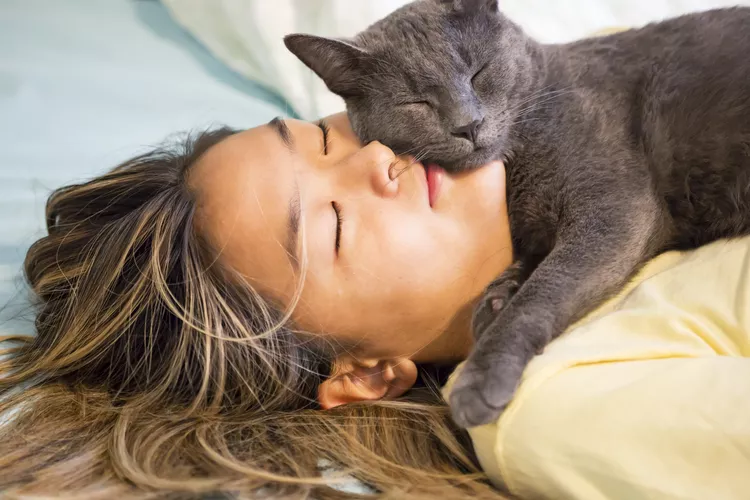
Sometimes cats prefer to nap on a private perch or tucked away in a hidden nook, but sooner or later, most of them end up sleeping on their owner’s lap, chest, or even head. Your cat may be doing this to feel closer to their favorite human, but the behavior is mostly rooted in biological instincts, such as kittens socializing with their mothers and siblings, or adult cats interacting with one another in the wild.
Here are the most common reasons your cat sleeps on you.
Why This Matters to Us
We are advocates of animal welfare, including pets and other domestic animals. The better we understand our cats, the better we can support and protect their wellbeing.
1. Marking Their Territory
Cats have scent glands all over their bodies that release pheromones. When a cat marks you with these pheromones, it is treating you as part of its in-group, a habit wild cats use to tell pack members from outsiders. When your cat sleeps on you, it leaves its scent on you so that you smell familiar and safe. Even cats who enjoy solitude may rub and head-butt their owners as part of the same scent-marking process.
2. Staying Warm
Many cat owners have watched their cat curl up in a sunny patch on the bed, or knock over plants and anything else in the way to claim the perfect window-napping spot. Warmth helps cats relax and fall asleep, and few places in the house are warmer than on top of a person. Warmth may also help cats start and maintain restorative sleep, which means seeking out warm spots can help keep them healthy.
3. Feeling Safe
Animals are most vulnerable to attack while sleeping, and cats are no exception. Cats who see their owners as a source of safety and security may enjoy sleeping on or near them, trusting you to protect them while they are unconscious. Even when a cat sleeps with its back to you, which can feel like rejection, it is actually another sign of trust.
This behavior can also be traced back to kittenhood. Young cats usually grow up in large litters, nursing from their mother and sleeping together in a group, sometimes stacked on top of one another. Particularly in homes without other cats, humans may step into a substitute role in this dynamic.
4. Bonding With You
In experiments aimed at stopping destructive scratching and urine-marking, scent-marking proved to be a powerful way to preserve the bond between cats and humans. When your cat sleeps on you and marks you with their scent, it creates a lasting olfactory reminder that you both belong to the same group. Being close to you also lets your cat hear and feel familiar, comforting sounds, like a beating heart or rhythmic breathing, which recall the safety of sleeping beside a mother cat and siblings.
Cats are most active at night and early in the day, but some will adjust their habits to match their owners’ so they can spend more time together. Cats really do care, even if they like to act standoffish!
5. Showing Affection
A recent study on cat-human bonding showed that cats aren’t the solitary creatures they are often portrayed to be. In the wild, cats live comfortably in matriarchal societies and show group-bonding behaviors such as mutual grooming, allorubbing (when two members of the same species rub against each other), and sleeping together. Sleeping with their owner is one way cats show affection and care.
Why Cats Sleep on Different Parts of Your Body
Cats have been known to sleep in a variety of spots on and around their owners, including the head and neck, chest, and lap.
Head
It has long been assumed that cats like to be near their owners’ heads because that’s where the most heat escapes, but the human head releases about the same amount of heat as the rest of the body. That said, the head moves less when people toss and turn, so cats may stay near the top of the bed for safety. Cats also use their gaze to communicate with owners and other cats, so they may like being close to your eyes.
Chest
Kittens spend much of their early development sleeping on or near other kittens, leading veterinarians to theorize that the sound of regular breathing and a nearby heartbeat comforts cats and helps them sleep more easily. You may also be a calm sleeper, which makes your chest a perfectly cozy spot for a nap.
Lap
Most cat owners know what their cat wants when it jumps into their lap to sleep: petting and attention, though there is no definitive research to confirm this. Laps are warm and easy for owners to reach. What cat lover hasn’t spent an inconvenient amount of time sitting still to let a peaceful cat keep resting?
Are There Reasons Not to Sleep With Your Cat?
Your preferences are personal, of course, but there are a few things to consider before letting your cat sleep with you:
- Sleep disruption: If you’re a light sleeper, a cat in your bed may disturb your rest and make it harder to reach deep, restorative sleep.
- Hygiene: Some cats track litter into the bed, which raises cleanliness concerns.
- Allergies and breathing: You don’t want to inhale cat fur, especially if you have respiratory issues.
- Children: It is unsafe to let a cat sleep with a child under the age of five, and a child of any age could startle a cat and get scratched.
Does your cat sleep on you? Tell us in the comments where your cat likes to nap!


Pingback: How to Get a Cat to Use a Cat Bed: 9 Tricks That Actually Work - Paw Chirp