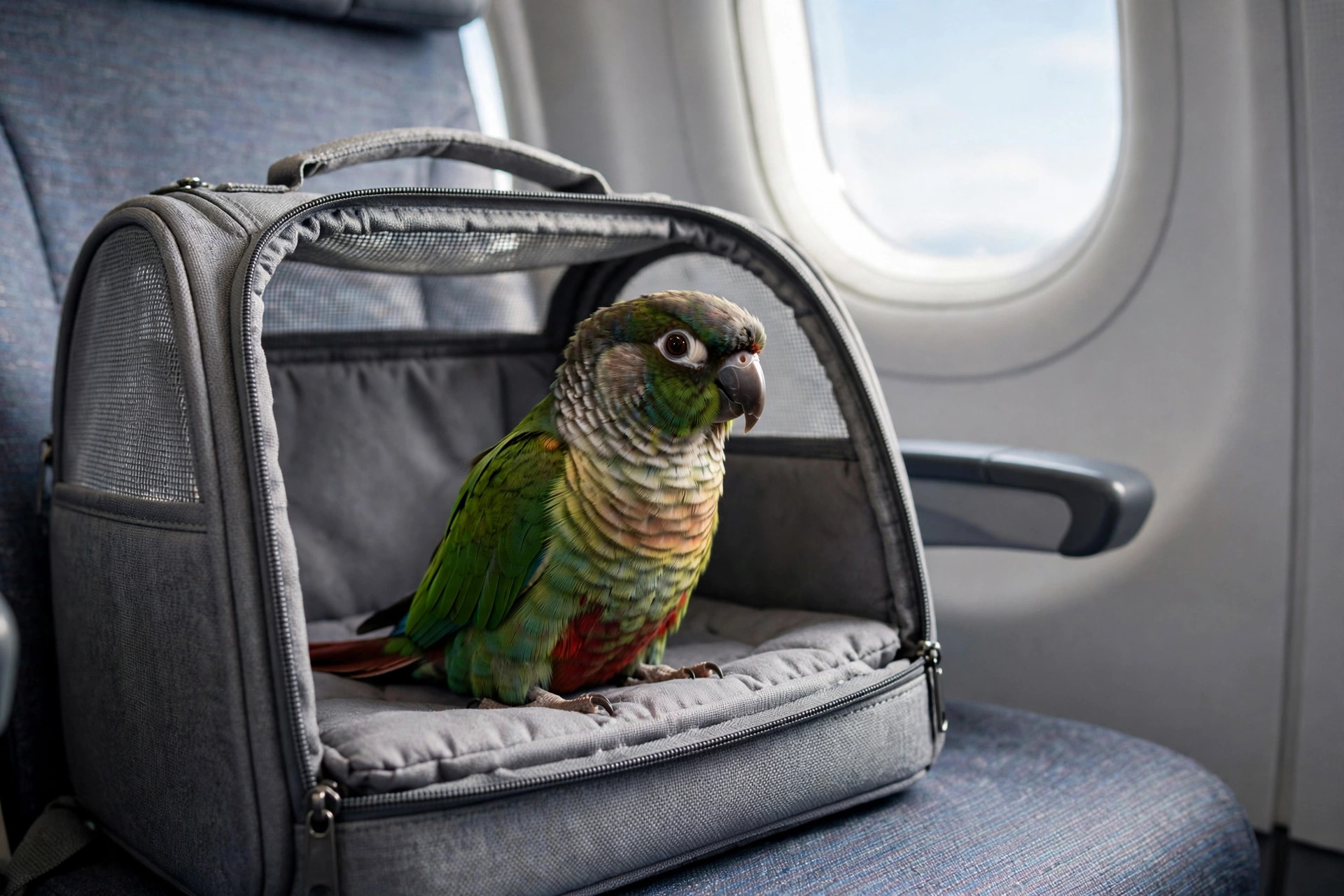
Every holiday travel guide on the internet assumes your pet has fur. Dogs get a section, cats get a section, and birds — animals that live in millions of American homes — get nothing, as if nobody has ever stood in a kitchen in December wondering whether the cockatiel can come along. He might be able to. Buried in the pet policies of a handful of US airlines is an exception most travelers never hear about: small household birds are allowed in the cabin on several carriers. The rules are specific, the booking process is old-fashioned, and winter adds its own hazards. Here’s the full picture.
Key Takeaways
- Birds are the exception, not the rule: As of late 2026, Delta, Frontier, and Spirit allow small household birds in the cabin on domestic routes, and Alaska lists small household birds on qualifying itineraries — most other carriers don’t.
- You book by phone: A bird’s spot usually can’t be reserved like a seat online; you call the airline, and per-flight pet capacity is limited, so call early.
- The carrier must fit under the seat in front of you, and the bird stays inside it for the whole flight.
- Rules vary by airline and route: Health-certificate requirements and route exclusions (Delta excludes Hawaii, for example) differ — confirm every detail when you book.
- Cold cars are the road-trip danger: Pre-warm the car, shield the cage from drafts, and never leave a bird in a cold parked car.
- Sometimes the best trip is no trip: For a stressed bird, an avian-savvy sitter at home often beats a noisy holiday house.
Which Airlines Actually Allow Birds
Let’s name names, because vague advice doesn’t help at booking time. As of late 2026, the US carriers whose published pet policies include small household birds are a short list.
Delta Air Lines accepts small dogs, cats, and household birds in the cabin on domestic flights. The bird must travel in a carrier that fits under the seat, and the policy carries route exclusions — Hawaii is the notable one, so a bird-inclusive policy on the mainland doesn’t mean your parrot can fly to Honolulu. Delta charges a per-way pet fee, collected at check-in.
Frontier Airlines is one of the most bird-friendly names in US aviation: its domestic pet policy includes dogs, cats, rabbits, guinea pigs, hamsters, and small household birds. The bird rides in the cabin in an approved carrier for a per-way pet fee.
Spirit Airlines also includes small household birds in its cabin pet policy on domestic routes, alongside small dogs and cats, again with a carrier that fits under the seat and a per-way pet fee.
Alaska Airlines lists small household birds among the pets accepted in the cabin on qualifying itineraries. Alaska’s policy is route- and aircraft-dependent in places, so treat it as a “yes, if” — the if gets settled on the phone.
And the honest flip side: several major carriers limit cabin pets to dogs and cats only, and birds are not accepted at all. Policies also change — airlines revise pet rules more often than you’d think — so treat this list as your starting point, not your boarding pass. The ASPCA’s travel tips make the same point for all pets: confirm the current policy directly with the airline before you count on it. Everything in this section should be re-verified when you book, which you’d have to do anyway, because of how bird reservations work.
How Booking a Bird Actually Works
Here’s the part that surprises people: on most of these carriers, you cannot add a bird the way you’d add a checked bag in the app. Pet capacity in the cabin is capped per flight — only a set number of animals ride on each plane — and bird spots are typically reserved by calling the airline after (or before) you book your own ticket. Call early. Holiday flights fill their pet quota the way they fill everything else.
On the call, expect to confirm the species and size of your bird, the carrier dimensions, and the route. Ask specifically about health certificates: requirements vary by airline and destination, and some routes want a certificate of veterinary inspection issued within a set window before travel. Ask, too, whether your exact aircraft and route qualify — a policy that allows birds generally can still exclude a specific route, and codeshare or regional flights sometimes play by different rules.
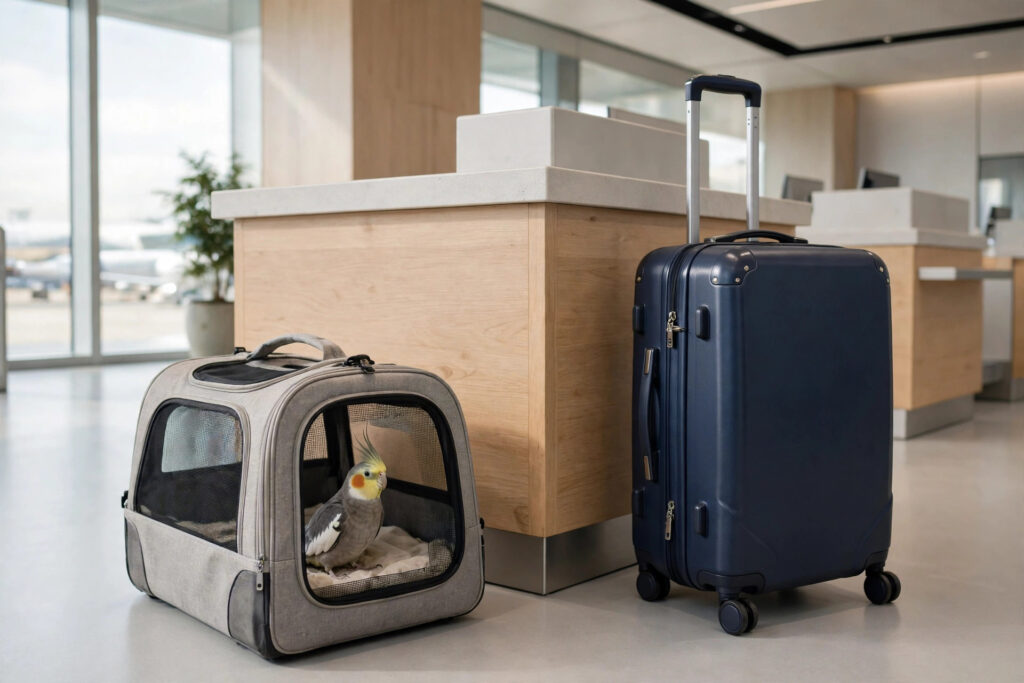
At the airport, plan extra time. You’ll check in at the counter rather than breezing through with a mobile boarding pass, pay the per-way pet fee there if you haven’t already, and go through security with the bird. Security screening usually means the carrier goes through the X-ray while you carry the bird through, or officers inspect the carrier privately — a harness-trained bird makes this calmer, and a bird that has practiced being in its carrier at home makes it calmer still. That practice matters more than any gear: a bird who has spent happy afternoons in the travel carrier, eating treats and watching the house, travels like a veteran. A bird meeting the carrier for the first time on travel day travels like a hostage.
Choosing and Prepping the Travel Carrier
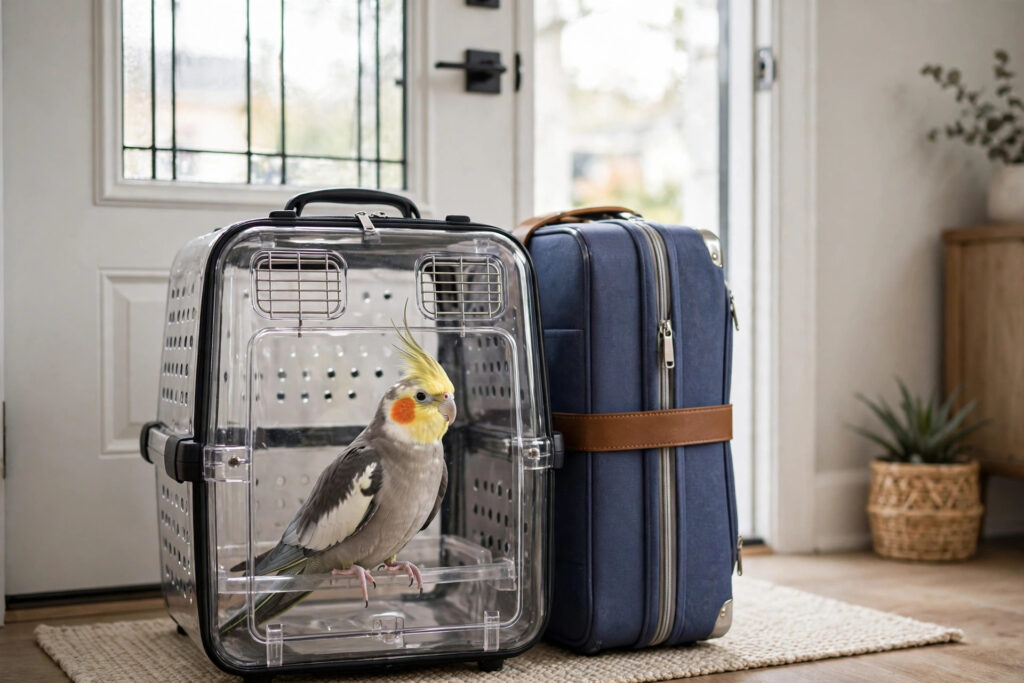
The carrier has one non-negotiable job: fit under the seat in front of you, within the airline’s published size limits for pet carriers. Soft-sided carriers are the usual pick because they flex slightly under the seat while keeping their shape. Inside, your bird needs a perch it can grip — a carrier without a perch turns every bump into a slide — plus a small cup arrangement for water on longer travel days, and a cover or the option to drape one. Many birds settle in semi-darkness; a light cover over the carrier cuts visual stress in a busy terminal.
Line the bottom with paper you can swap at a layover. Bring a small kit: paper towels, a spray bottle for misting if your bird likes it, a day’s worth of its normal food in a sealed container, and a familiar shreddable toy. Familiar is the theme. New food, new toys, and a new carrier all on the same day is three stresses stacked; keep everything but the scenery the same. Lafeber Pet Birds offers species-by-species care guidance from avian vets that’s worth browsing before any big change in a bird’s routine, travel included.
Cold-Weather Road Trips With a Bird
Driving instead? Winter road trips with a bird are very doable, and the rules are mostly about temperature and air. Pet birds are tropical and subtropical animals wearing a thin layer of feathers over a small body; they chill fast, and drafts are the enemy — a steady warm car is fine, a stream of cold air across the cage is not.
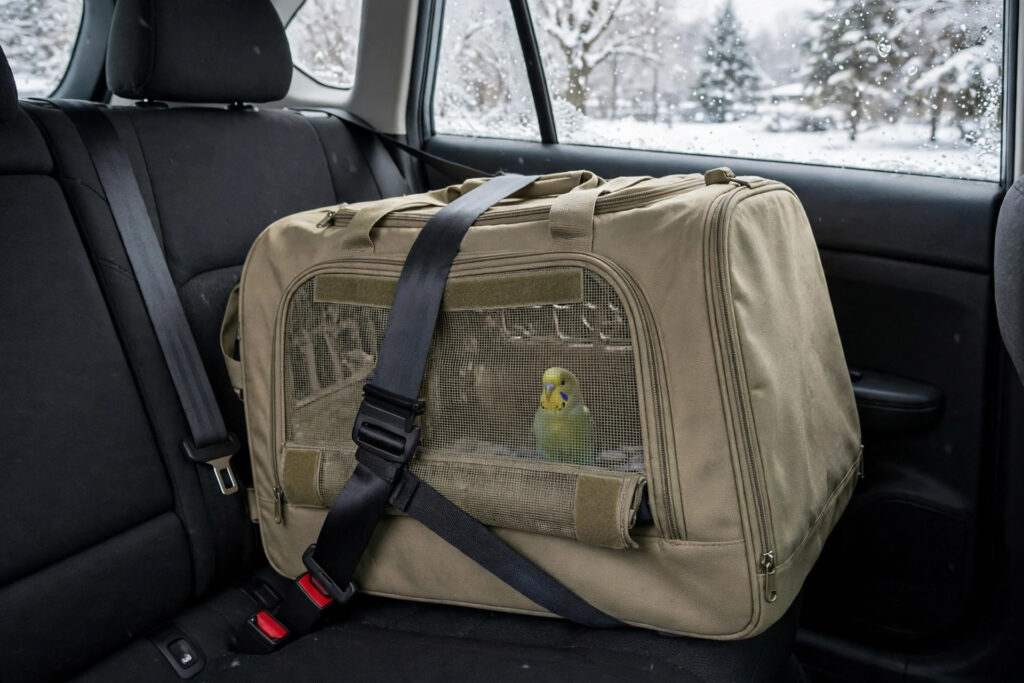
Pre-warm the car. Run the heat before the bird comes out of the house, and carry the covered carrier straight into a warm cabin. The trip from front door to car is the coldest thirty seconds of the journey; a cover over the carrier blocks wind on that walk too.
Position the cage away from vents and windows. Strap or wedge the carrier so it can’t slide or tip, keep it out of direct blasts from the heater vents, and drape the cover so air circulates but drafts don’t. A bird panting with wings held out is too hot; a bird fluffed into a ball and silent is too cold. Aim for the boring middle.
Never leave a bird in a cold parked car. A parked car’s temperature falls fast in winter, and a small bird has almost no reserves. If a stop means the bird can’t come inside, keep the stop to a true minimum with the car warm — or better, travel with a second adult so someone always stays with the bird. This is the road-trip rule with no exceptions.
Keep the ride quiet. Normal conversation is fine; a holiday playlist at full volume inches from the cage is not. Birds hear well and startle at sudden sounds. Talk radio at low volume, a calm car, and a covered carrier will get most birds through a drive asleep or quietly watching. Offer water at stops, keep the bird’s normal light schedule as much as the road allows, and if the drive is long, plan the overnight stop somewhere the bird can come inside with you — call ahead, since hotel pet policies that mention dogs may need a conversation about a caged bird.
The Honest Alternative: Leaving the Bird Home
Some birds travel beautifully. Some — the nervous rescue, the elderly bird, the one who screams at a new curtain — experience a trip as a week of low-grade terror in a loud house full of strangers, cooking fumes, scented candles, and a cousin’s toddler. For that bird, the kindest holiday plan is a good sitter at home, where the cage, the light schedule, and the silence stay exactly the same. Nonstick cookware fumes and scented products are genuine hazards to birds in unfamiliar houses, and holiday kitchens run both at full blast. Choosing the sitter isn’t the lesser option. For many birds it’s the better one, and our guide to bird boarding and sitters walks through how to pick one and what to leave behind.
Frequently Asked Questions
Can I take my bird on a plane in the US?
On some airlines, yes. As of late 2026, Delta, Frontier, and Spirit allow small household birds in the cabin on domestic routes, and Alaska lists them on qualifying itineraries. Most other carriers accept only dogs and cats. Policies change, so confirm with the airline when you book — and book the bird’s spot by phone, since cabin pet capacity is limited per flight.
Does my bird need a health certificate to fly?
It depends on the airline and the route. Some carriers and destinations require a certificate of veterinary inspection issued within a specific window before travel; others don’t for domestic cabin pets. Ask when you call to reserve the bird’s spot, and schedule the vet visit accordingly if one is needed.
Can my bird ride in the cargo hold instead?
Treat cargo as a last resort and, for most pet birds, a no. Temperature swings, noise, and darkness in the hold are rough on small birds, and many airlines restrict which animals they’ll carry below deck at all. If the cabin isn’t an option for your bird on your route, driving or a good sitter is usually the better plan.
What size carrier does my bird need for a flight?
It must fit under the seat in front of you within the airline’s published pet-carrier dimensions, with room for your bird to perch and turn around. Soft-sided carriers are the common choice. Confirm the exact size limits for your airline and aircraft when you book, since they vary.
How do I keep my bird calm during travel?
Practice. Let the bird spend relaxed time in the carrier at home for days before the trip, with treats and favorite toys inside. On travel day, keep the carrier covered, keep voices and music low, stick to the bird’s normal food, and preserve its sleep schedule as closely as you can.
Is it better to travel with my bird or leave it with a sitter?
It depends on the bird. Confident, well-socialized birds who are used to their carriers often travel fine, especially by car. Nervous, elderly, or medically fragile birds usually do better at home with an experienced sitter, away from holiday noise, fumes, and strangers. Your bird’s personality is the deciding factor — not the destination.
The Bottom Line
Flying with a pet bird is genuinely possible in the US — on a short list of airlines, by phone reservation, in an under-seat carrier, with rules you confirm at booking. Driving is simpler and often calmer, as long as you respect the cold: warm car, covered cage, no parked-car waits. And when the honest answer is that your bird would rather stay home, believe it. The best travel plan is the one your bird experiences as a good week, whether that’s in the cabin, in the back seat, or asleep in its own cage at its usual bedtime.