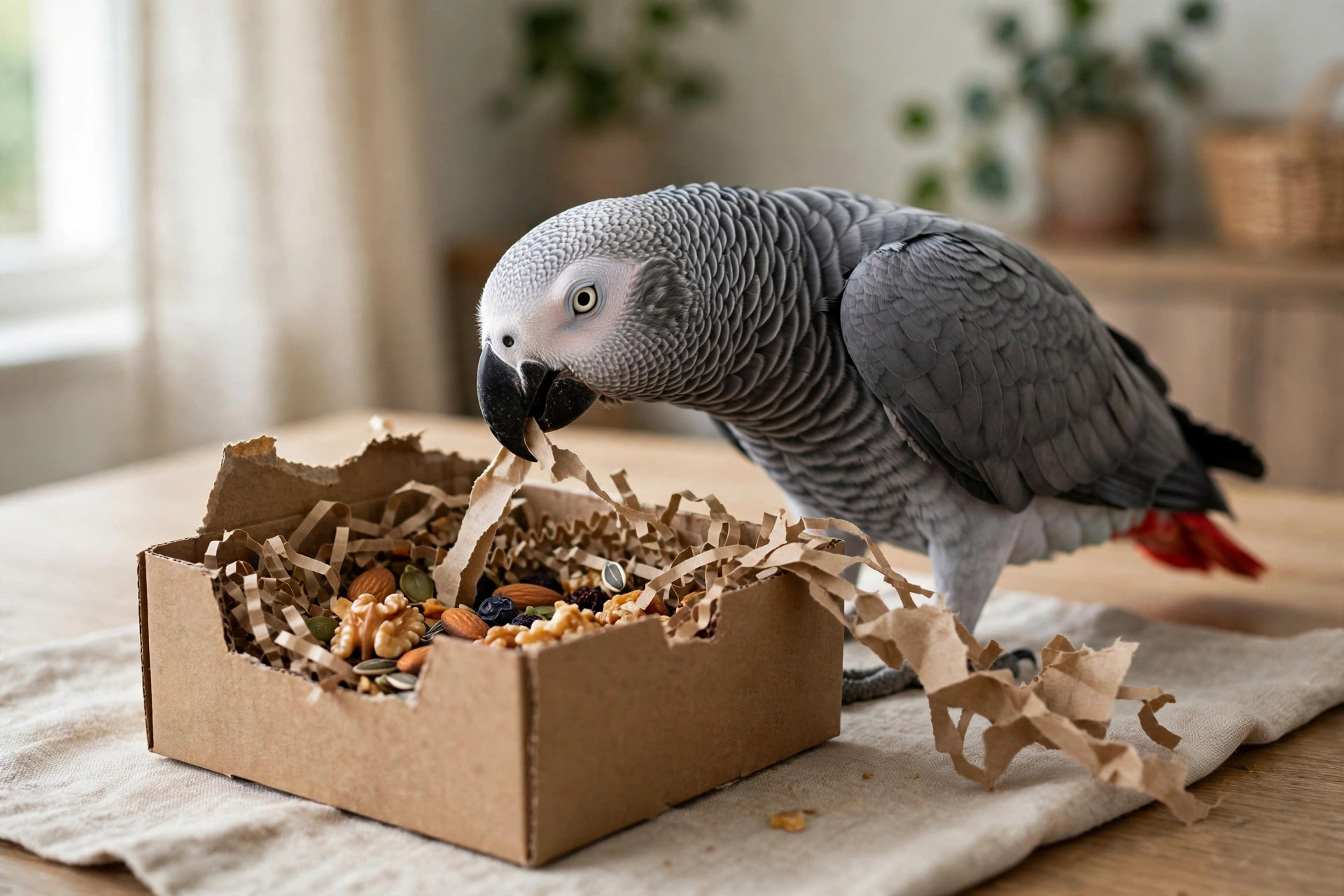
A wild parrot’s day is mostly a job. Flying to feeding trees, stripping bark, cracking, prying, sorting — hours of skilled work stand between a wild bird and its dinner. Your parrot’s day, in a quiet house in January, is a bowl. The food is already there. The weather outside the window is nobody’s business. The humans are at work, the light is gray, and the most interesting event scheduled is the mail. We call the result “cabin fever” in people. In parrots it looks like screaming at nothing, pacing the same perch route, and — in the birds who turn frustration inward — feathers on the cage floor that shouldn’t be there. The fix isn’t a bigger cage or a louder TV. It’s giving the bird its job back, one hidden treat at a time. These five DIY foraging toys do that with stuff you already have in a kitchen drawer.
Key Takeaways
- Boredom is a workload problem: Wild parrots spend hours working for food; a bowl-fed bird in a quiet winter house has nothing to do, and boredom feeds screaming and feather-plucking.
- Five DIYs, all household materials: Paper and cardboard puzzles, untreated pinecones, woven paper strips, a cardboard foraging box, and cup-and-treat stacks.
- Safety checks are non-negotiable: No printed ink, no tape or glue, no treated or painted wood, and no parts small enough to be a hazard for your bird’s size.
- Teach, don’t just hang: Start shy birds with food visible, then hide it deeper over days as skills grow.
- Rotate weekly so yesterday’s solved puzzle becomes next week’s fresh challenge.
- Know the limit: Foraging helps boredom, but plucking can be medical — a plucking bird needs an avian vet, not just more toys.
Why Winter Is the Hard Season
Winter squeezes a pet bird from every side. The house is quieter — no open windows, fewer visitors, less going on in the street to watch. Your schedule shifts, the light fades early, and out-of-cage time shrinks because the house is drafty and the bird can’t be out near a cold window. Meanwhile the bird’s instincts haven’t changed at all. Lafeber Pet Birds, the avian veterinary resource, consistently presents foraging as a daily behavioral need for parrots — not a weekend treat — because searching for and working at food is what a parrot’s brain is built to do for hours a day. A bowl removes the job. Foraging toys put it back on the schedule, and winter is when the schedule needs it most.
The Safety Rules (Read Before the Fun Part)
Every DIY below follows the same checks. Run any homemade toy through this list before it goes in the cage, and size everything to your bird — a part that’s fine for a macaw can be a hazard for a budgie.
- No printed ink. Use plain, unprinted paper and cardboard. Skip glossy flyers, printed newspaper sections with heavy color ink, and cardboard with printed coatings on the surface the bird will chew.
- No tape, no glue, no staples. Adhesives and metal fasteners don’t belong in a beak. Fold, tuck, weave, and wedge instead — paper engineering holds together better than you’d expect.
- No treated or painted wood. Pinecones and wood pieces must be untreated and unpainted. For pinecones, collect from an area you know hasn’t been sprayed, scrub, and bake them to clean and open them before use.
- No small parts for your bird’s size. Anything a beak can snap off and swallow is too small. Scale up for big beaks, and supervise the first session with any new DIY.
- Remove and inspect. Homemade toys are short-lived by design. Check them daily, and retire anything that develops sharp edges, tangling strands, or a soggy mess at the bottom.
The 5 DIY Foraging Toys
1. The paper twist: wrapped treats in plain paper
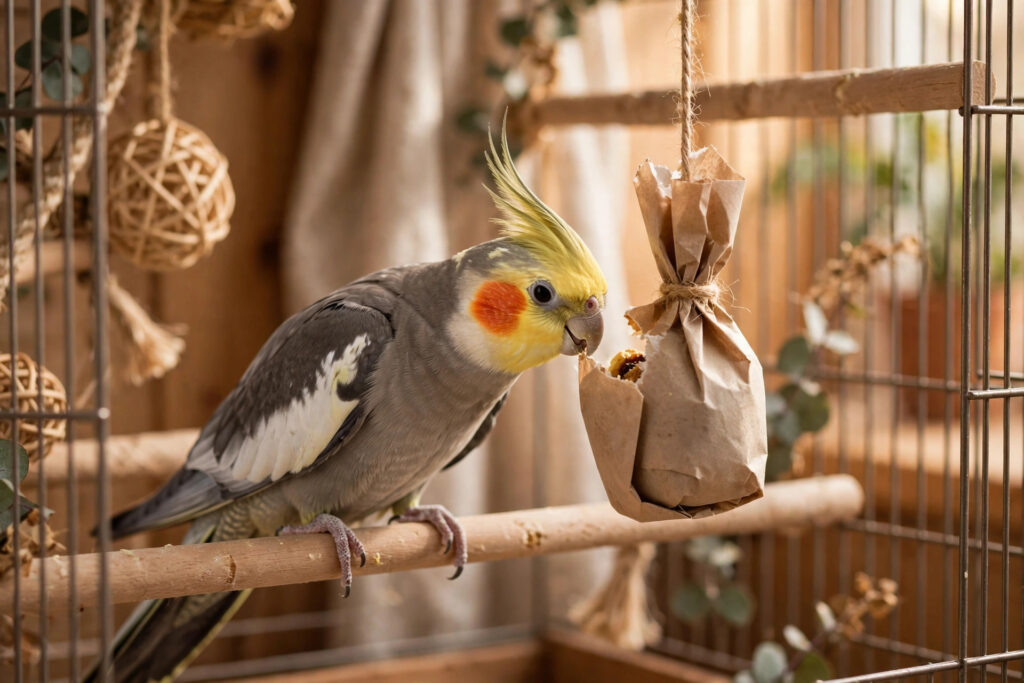
The gateway foraging toy, and the right first project for a bird who has never worked for food. Take a favorite treat — a nut piece for a big parrot, a bit of millet for a small one — and wrap it in a small square of plain unprinted paper, twisted closed like a candy wrapper. First sessions: leave the twist loose and the treat peeking out, and place a few on the cage floor or in the food cup. The bird learns paper equals prize. Over days, twist tighter, add a second layer, then tuck the parcels into perches, toy buckets, and the corners of the cage. A bird who started the week ignoring paper will end it hunting twists on sight. Cost: nothing. Difficulty curve: entirely yours to control.
2. The pinecone stuffer
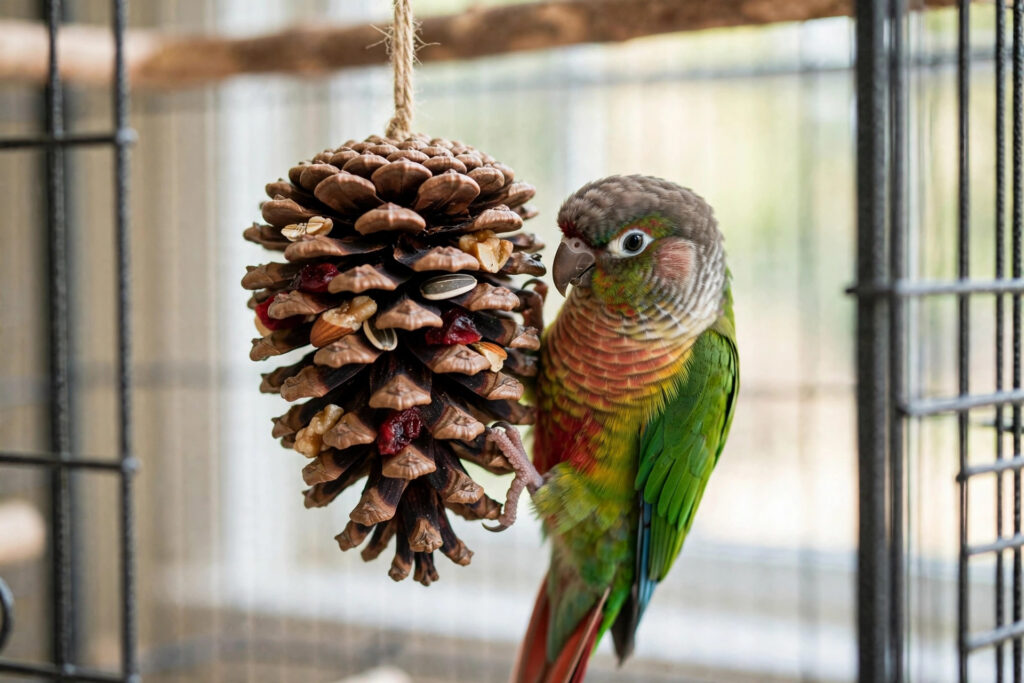
A cleaned, baked, untreated pinecone is a ready-made foraging puzzle — nature built the compartments. Wedge small treat pieces, bits of nut, or a smear of something tasty deep between the scales, and hang the cone or wedge it between bars. Birds have to work each scale, turning and prying, and the cone itself becomes a shredding project once the treats are gone. Big cones for big beaks; small cones for cockatiels and conures. This is the highest work-to-treat ratio on the list, and conures in particular will guard a loaded pinecone like it pays rent.
3. Woven paper strips through the bars
Cut plain paper into strips and weave them in and out through the cage bars in a loose lattice, or weave a small mat and clip it (with a bird-safe stainless clip) to the cage wall. Hide tiny treat bits in the weave’s folds as you go. The bird pulls strips free one at a time — each pull is a small win — and discovers the hidden pieces along the way. For birds who love destruction more than puzzles, skip the treats some days and let the weaving itself be the shredding wall. It’s also a gentle starter for shy birds, because the bird works from its own perch, on its own territory, at its own pace.
4. The cardboard foraging box
The winter centerpiece. Take a plain, unprinted cardboard box sized to your bird — shoebox for a cockatiel, something sturdier for a grey or macaw — and fill it with crumpled plain paper, paper twists from project one, clean cardboard pieces, and a scatter of treats and favorite dry food mixed through the layers. Set it on the cage floor or in a play area and let the bird excavate. This is the closest a living room gets to a wild bird working a forest floor: digging, tossing, sorting, finding. Expect a spectacular mess and a deeply satisfied bird. Replace the filling every day or two; the box itself survives until it doesn’t, and then you build another.
5. Cup-and-treat stacks
Stack plain paper cups (unprinted, unwaxed if you can find them) or small cardboard cups with a treat in one cup of the stack, nested so the bird must pull cups apart and tip them over to find the prize. Start with two cups and the treat in the top one. Graduate to a stack of four or five with the treat hidden in a random layer, and watch a smart parrot develop a system — because they do develop systems, and beating the system you built is the entire game. For small birds, use the tiniest cups and a single visible treat until the idea clicks.
Teaching a Shy Bird to Forage
Some birds take to foraging like they invented it. Others — rescues, older birds, lifelong bowl-feeders — stare at a wrapped treat the way you’d stare at a locked refrigerator. The teaching ladder is simple and it works: start embarrassingly easy. Put treats in plain sight on top of paper. Then under one loose layer. Then in a loose twist left open at one end. Then closed. Then hidden in a box the bird has already explored empty. Each step might take a day or a week; let the bird set the pace, and never let foraging toys become the bird’s only access to food while it’s learning — the regular bowl stays until the bird is a confident worker. Praise helps. So does letting the bird watch you “find” a treat in a twist yourself. Parrots are social learners; a puzzle the flock cares about is a puzzle worth solving. Our collection of DIY foraging toys for birds has more builds once these five are in rotation.
Rotation: The Week-Long System
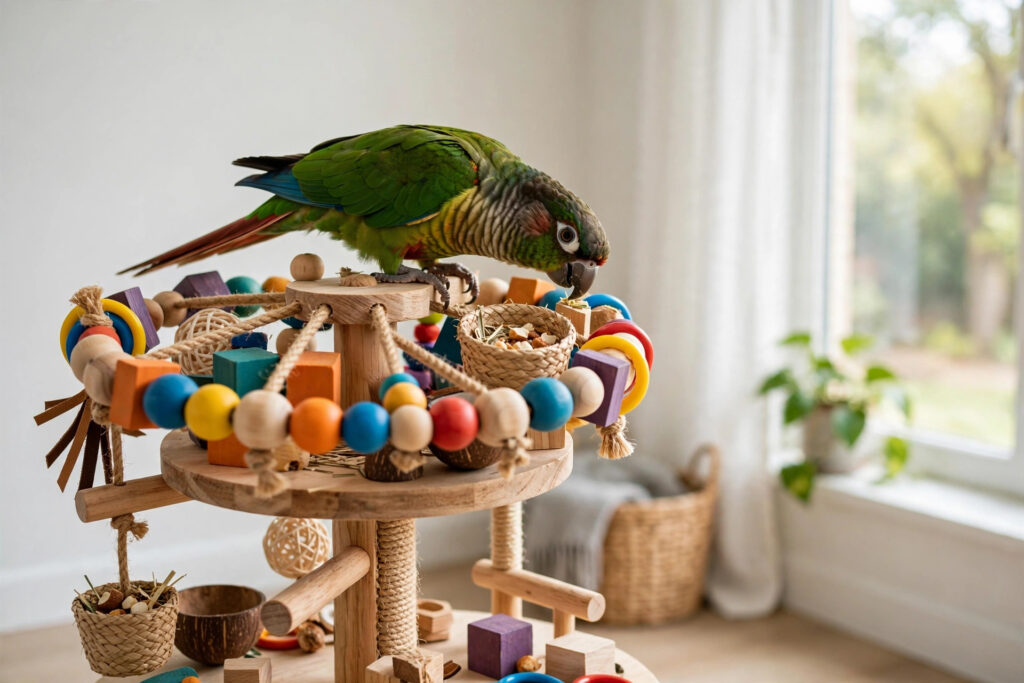
A solved puzzle is a boring puzzle. Keep five to seven foraging toys in circulation — the five above plus variations — and swap what’s in the cage every few days, so each toy returns as a half-forgotten challenge. Hide treats in different spots, change which cup holds the prize, refill the box with a new mix. Rotation costs nothing and it’s the difference between a bird who checks its toys each morning and a bird who walks past them. Pair the rotation with the rest of the winter basics — consistent sleep in a covered, dark cage, out-of-cage time in the warmest room, a perch near (not on) the household action — and you’ve rebuilt most of a wild bird’s working day inside a January apartment.
The Honest Limit: When It’s Not Boredom
Everything above assumes the problem is an underemployed bird, and often it is. But feather-plucking, screaming, and appetite changes can also be medical — skin and feather disease, nutritional problems, thyroid and liver issues, pain, and infections can all wear the same costume as boredom. The ASPCA’s pet care resources make the general point for all pets: behavior changes deserve a medical look, not just a behavioral one. So the rule is this: build the toys, run the rotation, give it honest effort — and if your bird is plucking, losing weight, or changing behavior in ways that persist, book an avian vet. Foraging is enrichment, not treatment. A bird can be bored and sick, and the toys will still be there after the vet visit.
Frequently Asked Questions
How long should my bird spend foraging each day?
Build toward foraging being a normal part of the day rather than a timed session. Start with short, easy wins — a few wrapped treats — and grow the share of daily food the bird earns through toys as skills develop. Many experienced keepers aim for birds to work for a meaningful portion of their food across the day, while keeping a base bowl available for birds still learning.
Are pinecones really safe for parrots?
Yes, with preparation: collect untreated pinecones from an unsprayed area, scrub them clean, and bake them before use to kill insects and open the scales. Skip any cone that’s painted, glittered, scented, or sold for crafts — those are decorations, not bird toys.
My bird ignores every foraging toy. What am I doing wrong?
Usually the first step was too hard. Go back down the ladder: treats visible on paper, then barely covered, with the regular food bowl untouched. Use the bird’s single most loved food as the prize, place toys where the bird already hangs out, and let the bird watch you handle and open one. Most “ignoring” is really “hasn’t connected paper to prize yet” — and that connection, once made, tends to stick.
Can foraging toys stop feather-plucking?
They can help when boredom is the driver, and they’re part of good care either way — but plucking has many possible medical causes, and toys are not a diagnosis. If your bird is plucking, enrich the environment and see an avian vet. The two tracks run together, not instead of each other.
How often should I replace DIY foraging toys?
Inspect daily and replace as they wear — paper toys may last a day of honest work, a pinecone several days, a foraging box’s filling a day or two. That’s the design: these are consumables made from free materials, and a destroyed toy means the system worked. Rotation keeps fresh challenges coming without new spending.
The Bottom Line
Your parrot doesn’t need winter to be exciting. It needs winter to have a job in it. Five builds from paper, cardboard, and pinecones — made safely, taught patiently, rotated weekly — hand that job back, and the screaming-at-nothing afternoons get shorter. Start with the paper twist tonight. By February, you’ll have a bird who checks every cup in the stack, just in case — and a much quieter house.