This guide contains affiliate links. As an Amazon Associate, PawChirp earns from qualifying purchases — at no extra cost to you. Read our full disclosure.
If your couch, your sweaters, and the inside of your car all wear a fine layer of cat, you’re not doing anything wrong — shedding is just what cats do. You can’t switch it off. What you can do is catch that loose hair on a brush a few times a week instead of picking it off your clothes forever. The catch: there is no single best cat brush for shedding. The right tool depends entirely on the coat: the slicker that glides through a Maine Coon’s double coat can feel like a rake on a Siamese, and the gentle rubber brush a Siamese adores won’t dent a Persian.
The Cornell Feline Health Center makes the basic case for regular brushing: it keeps a cat’s coat clean, shiny, and sleek, loose fur removed during grooming won’t wind up on the furniture, and your cat will ingest less hair. Cornell also notes that brushing is easier if your cat learns to accept it young — advice worth stealing even if your cat is past kittenhood, since short, calm sessions build tolerance.
So instead of crowning one winner, we organized this roundup by coat type: five tools covering the four brush designs for shedding — slickers, a rubber curry brush, a bristle brush, and a steel comb — with the best fit for short, long, and double coats called out for each.
Key Takeaways
- Match the tool to the coat: slickers do the heavy lifting on long and double coats, rubber and bristle brushes suit short hair and sensitive cats, and a steel comb checks whether the coat is clear.
- The Hertzko Self-Cleaning Slicker is the easiest brush to live with — one button press retracts the pins and the collected hair falls off.
- The KONG Cat ZoomGroom is the pick for cats who run from anything with metal pins: it’s a rubber massage brush that doesn’t look or feel like a brush.
- The Andis Steel Pet Comb carries the highest approximate owner rating in this roundup (≈4.7/5) and is the finishing tool groomers pair with every slicker.
- Short, frequent sessions beat marathon grooming — a few minutes several times a week removes more hair than one long battle your cat learns to dread.
Quick Picks: The 5 Best Cat Brushes for Shedding at a Glance
| Brush | Best For | Type | Owner Rating | |
|---|---|---|---|---|
| Hertzko Self-Cleaning Slicker Brush | Double coats and long hair; easiest cleanup | Self-cleaning slicker, retractable pins | ≈4.5/5 (Amazon) | Check Price on Amazon |
| Hartz Groomer’s Best Slicker Brush for Cats | Short hair and sensitive cats | Slicker with coated pin tips | ≈4.5/5 (Chewy) | Check Price on Amazon |
| KONG Cat ZoomGroom | Brush-averse cats and short hair | Rubber curry / massage brush | ≈4.5/5 (Chewy) | Check Price on Amazon |
| Safari Complete Cat Brush | Daily grooming, short to medium hair | Bristle brush / soft slicker combo | ≈4.2/5 (Chewy) | Check Price on Amazon |
| Andis Steel Pet Comb, 7.5-in | Long hair and double coats; finishing check | Stainless steel comb, coarse + fine teeth | ≈4.7/5 (Chewy) | Check Price on Amazon |
How We Chose
We compared the cat brushes that surface repeatedly in independent roundups, groomer recommendations, and owner reviews, then judged them on design, materials, and safety features rather than marketing claims — things like coated or rounded pin tips, retractable pins that protect the wires between uses, and coat-appropriate tooth spacing. Owner ratings are quoted as approximate figures from the retailer listings in our research. This guide is based on published specifications and owner feedback, not hands-on testing — more on our process on our how we choose products page.
Hertzko Self-Cleaning Slicker Brush: Best for Double Coats and Easy Cleanup
Who it’s for: Owners of long-haired and double-coated cats — Maine Coons, Ragdolls, Siberians — who brush often enough that cleaning the brush has become its own chore.
The Hertzko is built around one genuinely useful idea: press the button and the fine bent-wire pins retract into the head, so the collected hair falls off in one sheet. Anyone who has picked hair out of a standard slicker one tuft at a time will understand the appeal. The angled head follows the body’s contours, and the thick rubber handle has an anti-slip grip with a thumb rest. It comes in small and regular sizes; the regular suits most adult cats.
Those fine stainless-steel wires are why it works: they reach through the topcoat and lift loose undercoat instead of skimming the surface. Owners rate it around 4.5 out of 5. Use a light hand, though — the pins can feel sharp under pressure, especially on thin coats.
Pros
- One-button self-cleaning: pins retract and hair drops off, no picking
- Fine bent-wire pins reach loose undercoat on long and double coats
- Comfort-grip rubber handle with thumb rest; small and regular sizes
Cons
- The retraction button is the weak point in owner feedback — some find it unreliable, and some report having to keep it pressed while brushing
- Pins feel sharp under heavy pressure, so it’s not the gentlest choice for thin-coated or sensitive cats
Hartz Groomer’s Best Slicker Brush for Cats: Best Slicker for Short Hair and Sensitive Cats
Who it’s for: Short-haired cats, smaller cats, and any cat whose skin makes you nervous about bare wire pins.
This is the classic slicker, sized and softened for cats. The extra-fine bristles grab loose hair from the undercoat, and — the detail that matters — each pin tip carries a protective coating, so the coating, not bare wire, meets your cat’s skin. At about 6.5 inches long with roughly half-inch bristles, it’s compact enough to control on a small frame, and the ergonomic handle stays comfortable through a full session. Hartz says it was developed with professional groomers; owners rate it around 4.5 out of 5 across 1,800+ Chewy ratings.
The fine, closely spaced pins do real work on short coats that a bristle brush would just polish — and it’s a sensible first slicker if you’re graduating from a rubber brush.
Pros
- Coated pin tips — the safety feature that makes it gentler than uncoated wire slickers
- Cat-sized head and fine bristles suit short coats and small cats
- Ergonomic handle; strong owner ratings for the price class
Cons
- No self-cleaning mechanism, and hair can be stubborn to pull out of the fine pins
- Some reviewers find the bristles too stiff for their cats
- Small head makes slow work of a large, dense double coat — long-haired cats are better served by the Hertzko and Andis
KONG Cat ZoomGroom: Best for Cats Who Hate Being Brushed
Who it’s for: Short-haired cats, kittens, seniors, and — especially — cats who vanish the moment a wire brush appears.
The ZoomGroom doesn’t look like a brush, and to your cat it doesn’t feel like one either. It’s a single piece of flexible rubber, shaped like a cat, with firm 3/4-inch rubber fingers. You hold it in your palm — there’s no handle — and stroke. The rubber fingers attract and lift loose flyaway hair while delivering something closer to a massage than a grooming session — which is why cats who dodge pins often lean into it. It works wet or dry — doubling as a shampoo brush at bath time — and it’s made in the USA. Owners rate it around 4.5 out of 5.
If your cat’s problem is the brush rather than the brushing, start here — and pair it with the low-pressure approach in our guide to why your cat hates being brushed. Many owners use it as the gateway tool, then add a slicker once grooming is no longer a wrestling match.
Pros
- Rubber fingers massage while they lift loose hair — the most widely accepted design for brush-averse cats
- One-piece rubber construction: nothing to break, easy to rinse clean
- Works wet or dry, including as a bath-time shampoo brush
Cons
- Loosens hair better than it traps it — loose fur needs collecting afterward rather than staying on the brush
- No detangling ability; it can’t do anything for long or matted coats
Safari Complete Cat Brush: Best Gentle Brush for Daily Grooming
Who it’s for: Short- to medium-haired cats, sensitive cats, and owners who want a mild daily driver rather than a heavy-duty deshedding tool.
The Safari Complete is the gentlest full brush here because there’s no exposed metal in it at all. It’s a combination design — part soft slicker, part bristle brush — with nylon bristles and soft, cone-shaped fingers on a plastic handle, about 6.5 inches long. Instead of raking out undercoat, it lifts hair and surface dirt while distributing natural oils, leaving short coats smoother after a few passes.
That makes it a good first brush for a cat new to grooming, and a good maintenance brush between deeper slicker sessions. Owners rate it around 4.2 out of 5 — the lowest here, and the reviews explain why: it’s a light-duty tool, and it behaves like one.
Pros
- No metal pins at all — the safest-feeling option for sensitive cats and thin coats
- Smooths and shines short coats by spreading natural oils while it lifts loose hair
- Gentle enough for daily use and for introducing grooming to a new cat
Cons
- The small head fills up after a couple of passes, and hair is fiddly to extract from between the short bristles
- Reviewers question its effectiveness on denser or longer coats — it finishes a coat more than it clears one
Andis Steel Pet Comb, 7.5-in: Best Finishing Comb for Long Hair
Who it’s for: Long-haired and double-coated cats, and any owner who wants to know — not guess — whether the coat is clear after brushing.
Every slicker above has the same blind spot: it can skim across the top of a thick coat while loose undercoat and small tangles sit untouched near the skin. The Andis comb is the honest test. It’s a flat, 7.5-inch stainless steel comb in the greyhound style, with coarse teeth on one half and fine teeth on the other, each tooth about 1.5 inches long with a rounded tip. Run the coarse end through first, then the fine end: if it glides, the coat is clear; if it snags, you’ve found the spot that needs work.
That two-step check is why groomers pair a comb with every slicker, and why this simple tool holds the highest approximate owner rating here, around 4.7 out of 5. For the full technique, see our walkthrough on how to brush a long-haired cat.
Pros
- Coarse and fine teeth in one comb — works through the coat, then verifies it’s clear
- Long, rounded-tip stainless teeth reach the base of long and double coats without scratching
- Highest owner rating in this roundup (≈4.7/5); nothing mechanical to fail
Cons
- The flat, handle-free steel spine can be awkward to hold and fatiguing during long sessions on a long-haired cat
- It will pull if forced through a formed mat — mats must be teased apart with fingers first, never combed through
Buying Guide: How to Choose a Cat Brush for Shedding
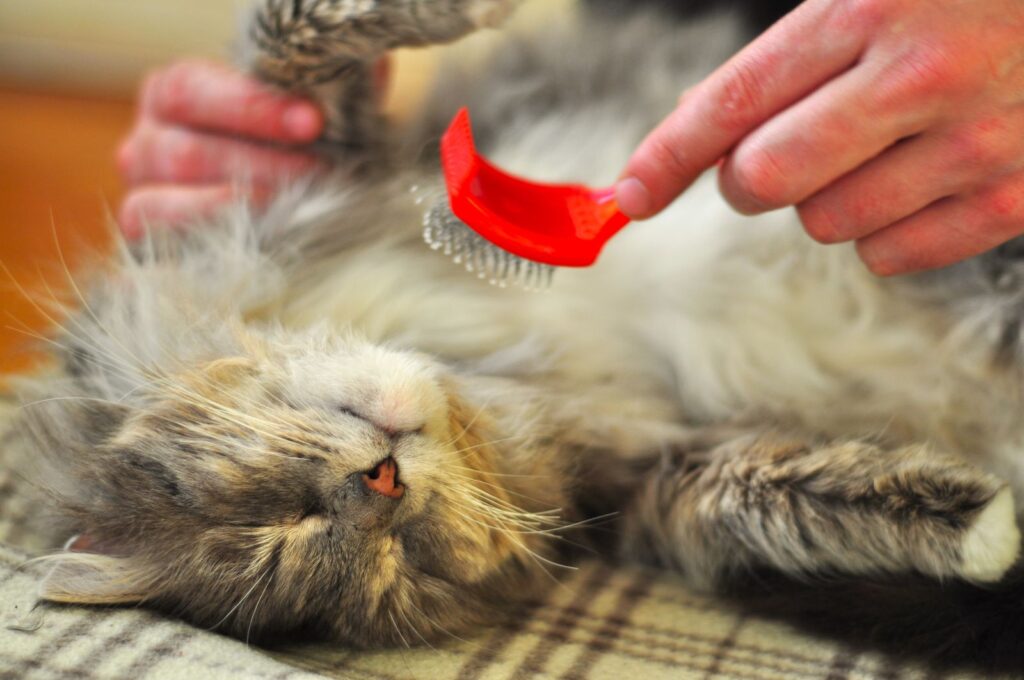
Slicker brushes are the deshedding workhorses. Their fine, angled wire pins reach through the topcoat and pull out loose undercoat, where most shed hair lives — making them the right default for long hair and double coats. Look for coated or rounded tips if your cat’s skin is sensitive, and a self-cleaning design if you’ll be brushing several times a week.
Rubber curry brushes like the ZoomGroom trade power for acceptance. They lift surface hair and flyaways, feel like petting, and suit short coats and cats who won’t tolerate pins. What they can’t do is detangle or reach an undercoat.
Bristle brushes are finishers. They remove surface hair, smooth the coat, and spread natural oils — ideal for daily upkeep on short to medium coats, but not a solution for heavy shedding or tangles.
Steel combs are the verification step. A comb with coarse and fine teeth tells you whether brushing cleared the coat down to the skin, and it’s the safest first tool for checking mat-prone spots: behind the ears, under the legs, along the belly.
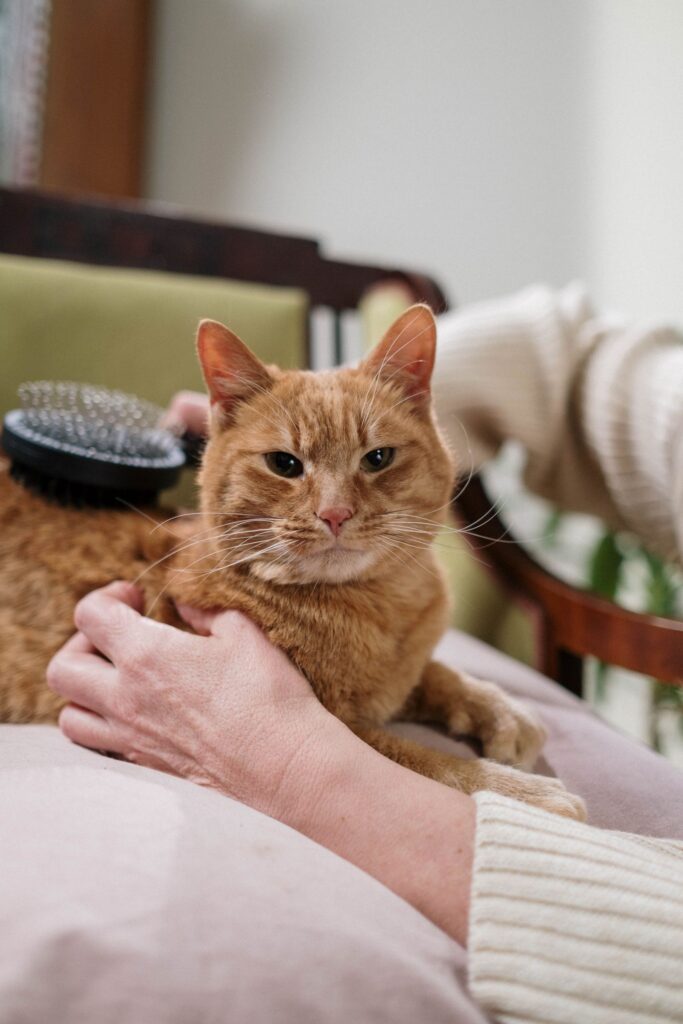
Match the tool to the coat. Short hair: a rubber brush or coated-tip slicker, once or twice a week. Long hair: a slicker plus a steel comb, several times a week to daily for full coats. Double coat: a self-cleaning slicker for volume, finished with the comb’s fine end. And whatever you buy, keep sessions short: five to ten minutes, with the direction of growth, light pressure, stopping while your cat is still relaxed. Never yank a tool through a mat — tease mats apart gently with your fingers, and leave a tight, skin-close mat to a groomer rather than reaching for scissors.
Frequently Asked Questions
How often should I brush my cat to reduce shedding?
For most short-haired cats, once or twice a week keeps loose hair under control. Long-haired and double-coated cats do better with several short sessions a week, and daily brushing during heavy spring and fall sheds. Consistency matters more than session length — five calm minutes twice a week removes more hair than one long session your cat learns to avoid.
What is the best brush for a long-haired cat?
A two-tool setup: a slicker brush (the Hertzko above) to lift undercoat, followed by a steel comb (the Andis) to confirm the coat is clear to the skin. A slicker alone can skim the surface of a thick coat and miss the tangles forming underneath, where mats start.
Do slicker brushes hurt cats?
They can if you press hard or rake the same spot repeatedly — the fine wire pins are stiff. Used with light pressure and strokes in the direction of growth, most cats tolerate them well. If your cat’s skin is thin or sensitive, choose coated tips (like the Hartz) or start with a rubber brush and work up.
Can I use a dog brush on my cat?
Sometimes — the Hertzko here is sold for both dogs and cats, and a steel comb like the Andis is a general grooming tool. What matters is size and pin spacing: dog brushes are often larger, with longer, stiffer pins for thicker skin and heavier coats. On a cat, choose the smaller size and finer pins, and skip dog dematting tools.
How do I get a cat who hates brushing to tolerate it?
Start with the least brush-like tool — a rubber curry brush — keep sessions to a minute or two at a calm time of day, and stop before your cat gets annoyed. Let her sniff the tool, pair strokes with treats, and build up over days. Our guide to why cats hate being brushed walks through the full desensitization approach.
Conclusion
The best cat brush for shedding is the one matched to your cat’s coat — and the one your cat will sit still for. For long and double coats, pair the Hertzko Self-Cleaning Slicker with the Andis Steel Comb and you’ve covered both removal and verification. For short hair, the Hartz coated-tip slicker does real work gently, while the Safari Complete handles daily upkeep. And if your cat treats every brush like a threat, the KONG ZoomGroom is where to rebuild trust. Keep sessions short and boring, and the hair ends up in the trash instead of on everything you own.