The first real cold snap of the year always produces the same moment: leash in hand, dog at the door doing the full-body wiggle, and you staring at the weather app wondering whether this walk is a good idea or a bad one. Your dog’s enthusiasm is not data. Plenty of dogs will happily trot out into weather that’s genuinely risky for them, and plenty of owners cut walks short on days that were perfectly fine.
What you need is a chart, not a vibe. Below is a clear temperature guide built on the risk scale used in current ASPCA-based winter care guidance (adapted from the Tufts Animal Condition and Care scale), broken down by size, coat, and age — plus the wind-and-wet-weather adjustment most people forget, the points where coats and booties actually earn their keep, and the winter hazard that has nothing to do with temperature at all.
Key Takeaways
- Below 45°F: potentially unsafe territory begins for many dogs — small, lean, short-coated, young, old, or unwell dogs need caution and shorter outings.
- Below 30°F: dangerous for most dogs; keep walks short and purposeful.
- Life-threatening zone: below 25°F for small dogs, and below 15°F for medium and large dogs — bathroom breaks only.
- Wind and wet move the line: a wet or windy 35°F day can hit your dog like a much colder one. Judge the weather your dog feels, not the number on the app.
- Antifreeze is the hidden killer: sweet-tasting and dangerous in tiny amounts — about a teaspoon can be lethal to a cat, a tablespoon to a dog.
The Temperature Chart
The scale below reflects the risk bands used in ASPCA-based winter guides, which draw on the Tufts TACC (Animal Condition and Care) scoring system. Think of the bands as weather risk for an average healthy adult dog; the adjustments that follow shift individual dogs colder or hardier.
| Temperature | Risk Level | What It Means for Your Walk |
|---|---|---|
| 45°F and above | Generally safe | Normal walks for most dogs. Still watch small, elderly, and short-coated dogs on long outings. |
| 32–45°F | Potentially unsafe for vulnerable dogs | Fine for hardy, double-coated dogs. Small, lean, short-coated, puppy, and senior dogs: shorter walks, consider a coat. |
| 20–32°F | Dangerous for many dogs | Short walks only for small and vulnerable dogs. Medium and large dogs do better but shouldn’t linger outdoors. |
| Below 25°F | Life-threatening for small dogs | Small dogs: out for a bathroom break and straight back in. |
| Below 15°F | Life-threatening for medium and large dogs too | No walks. Bathroom breaks only, for any dog, and keep them brief. |
Two dogs, same thermometer reading, different answers. A 90-pound husky-type with a double coat experiences 25°F as a pleasant afternoon. A 9-pound Italian Greyhound — all legs, no insulation, minimal body fat — experiences it as an emergency in progress. Size matters because small dogs lose heat faster relative to their mass. Coat matters because a dense double coat is a parka the dog was born wearing, while a single short coat is a t-shirt. Age and health matter because puppies can’t regulate temperature well and seniors often have thin coats, low muscle mass, arthritis that stiffens in the cold, and conditions that make cold stress harder to handle. The ASPCA’s cold weather safety guidance puts it simply: if it’s too cold for you to stand outside comfortably, it’s worth questioning for your pet too — and your dog may have far less protection than you do.
The Adjustment That Changes Everything: Wind and Wet
The chart assumes a dry, still day. Real winter rarely cooperates. Wind strips the warm air layer a coat (yours or your dog’s) traps against the body, and a wet coat loses most of its insulating value — a rain-soaked or snow-melted dog gets cold dramatically faster than a dry one at the same temperature. Practical rule: when it’s windy, treat the day as one band colder on the chart. When your dog is wet — from rain, sleet, or rolling in slush — treat it as colder still, and end the walk when the shivering starts, not when your route is finished.
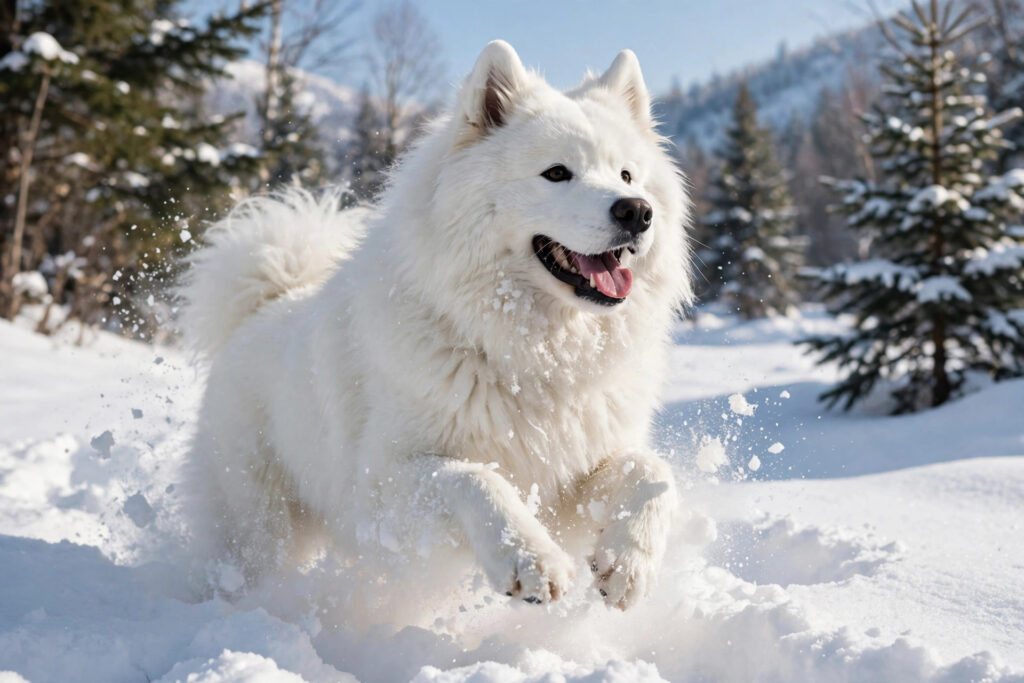
Shivering is information, not drama. So are lifted paws, slowing down, whining, seeking to turn for home, and a hunched posture with the tail tucked. Any of those means the walk is over regardless of what the thermometer said at the door. Dogs who love snow will sometimes push through discomfort to keep playing; part of your job is being the one who calls it.
When Coats and Booties Actually Help
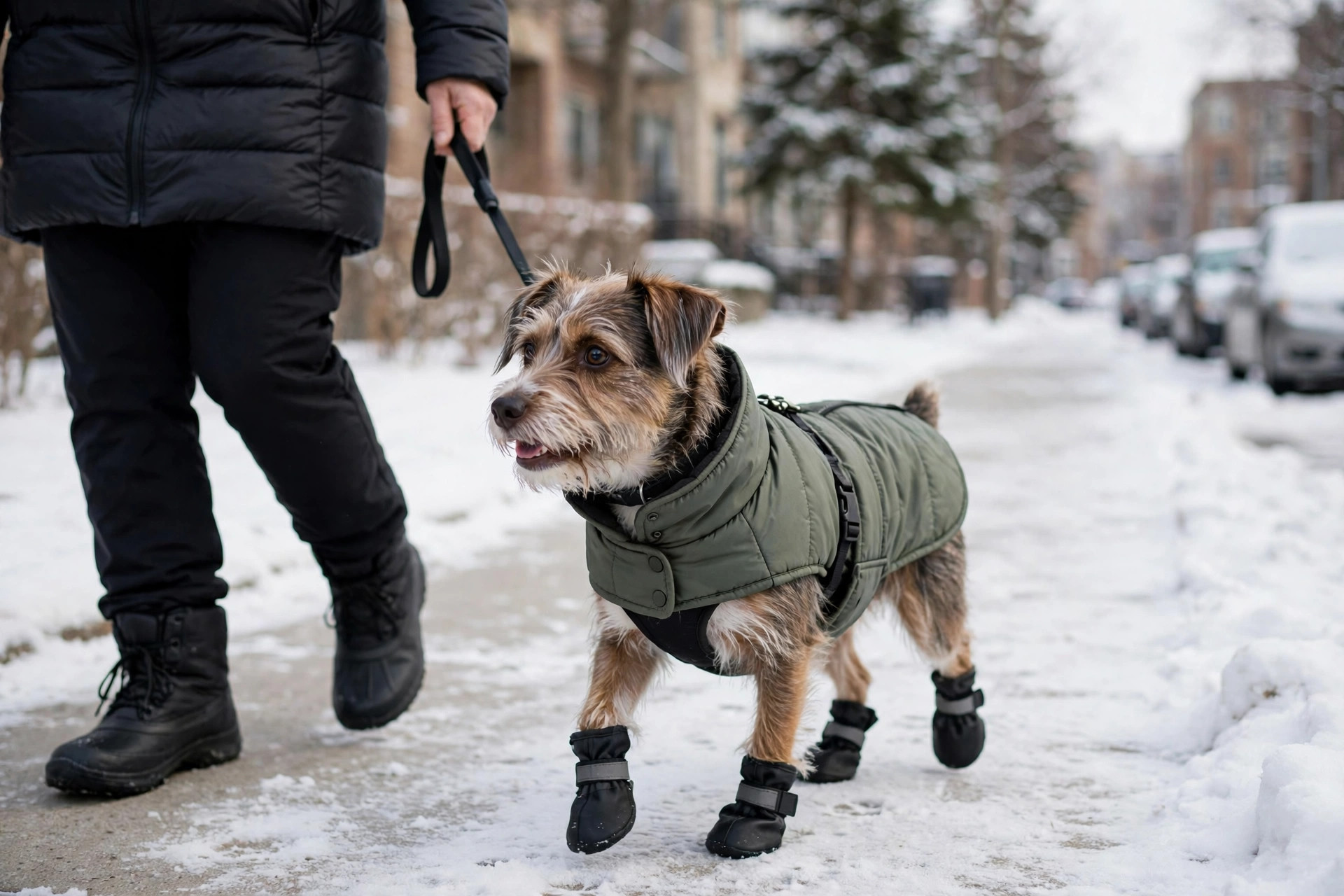
Dog clothing has a reputation problem — half the internet thinks it’s fashion, the other half thinks it’s fussy. For the right dog at the right temperature, it’s equipment. Here’s how the thresholds break down:
- 32–45°F: A coat earns its place on small, short-coated, lean, senior, and puppy walkers. Hardy double-coated breeds don’t need one here and may overheat in one during active play.
- 20–32°F: Coats for most dogs on anything longer than a quick outing. This is also where booties start to matter — not just for cold, but for what’s on the ground (see below).
- Below 20°F: Coat plus paw protection for any dog that must be out, and “must be out” should mean minutes, not a route. If your dog refuses booties, shorten the outing instead of arguing.
Fit matters more than features: a coat should cover the chest and belly (where heat escapes and slush splashes), stay clear of the legs’ movement, and not slide around. For booties, expect a comedy phase — most dogs high-step like they’re walking on the moon for the first few sessions. Practice indoors with treats before you need them on a 22°F morning. Dogs who truly won’t tolerate booties can still walk, but check and wipe their paws thoroughly afterward, and favor un-salted routes where you can.
Paws vs. Winter Streets: Salt, Ice, and the Wipe-Down Rule
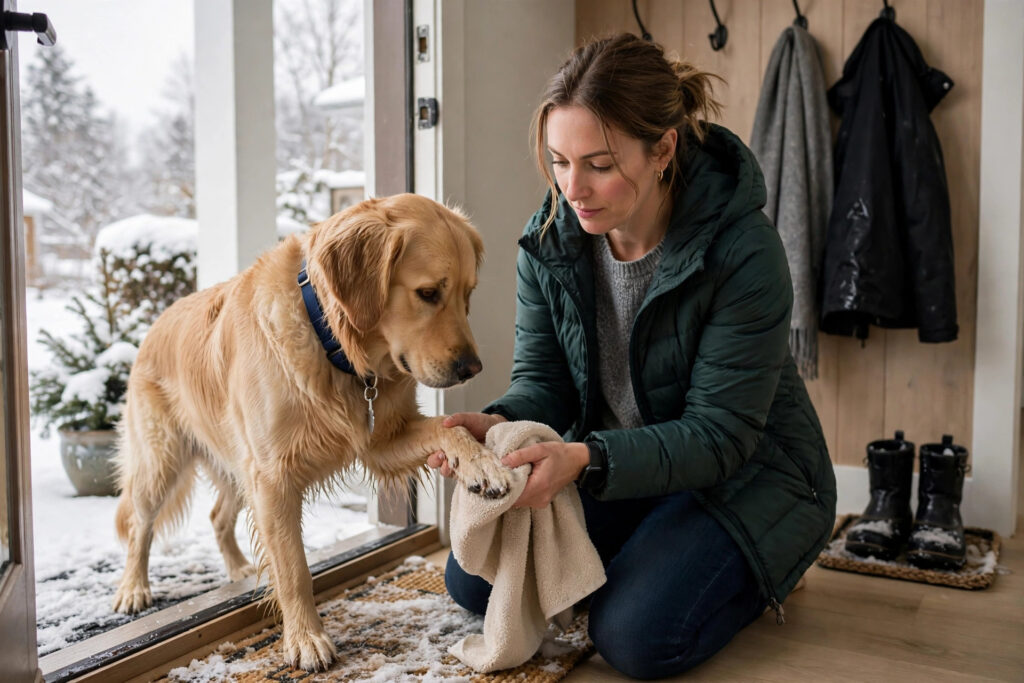
Cold isn’t the only thing winter puts under your dog’s feet. Sidewalk salt and chemical de-icers irritate and can crack paw pads, and dogs lick their paws after walks — ingesting whatever the street seasoned them with. Ice balls pack painfully between the toes of long-haired dogs, and sharp ice edges cut pads like glass.
The routine that handles all of it takes ninety seconds: when you come in from any walk on treated streets, wipe your dog’s paws, legs, and belly with a damp towel. That removes salt and de-icer before the licking starts, melts out ice balls, and gives you a daily look at the pads for cracks or cuts. Indoors, dry air does its own damage — if your dog’s pads are getting rough and cracked despite wiping, ask your vet about a pet-safe paw balm. And trim the fur between the toes on long-coated dogs; shorter fur collects far less ice.
The Winter Hazard That Isn’t About Temperature: Antifreeze
Every winter guide should shout this part, so here it is plainly. Antifreeze — ethylene glycol — tastes sweet, which means dogs and cats will lap it up willingly from garage floors, driveways, and puddles near parked cars. It is dangerous in amounts that sound made up: roughly a teaspoon can be lethal to a cat, and about a tablespoon can kill a dog. It damages the kidneys fast, and treatment is a race measured in hours.
So: clean up spills immediately and completely, store containers sealed and out of reach, and treat any unexplained puddle under a car as contaminated — steer your dog around it on walks, and be extra careful in parking lots and along curbs where cars drip. If you suspect your pet licked antifreeze, this is a drop-everything emergency vet call, not a wait-and-see. Minutes genuinely matter with this one. The ASPCA Animal Poison Control line is worth saving in your phone before you ever need it.
Restructuring the Walk on the Coldest Days
“Dangerous” weather doesn’t mean your dog gets nothing — it means the exercise moves and changes shape. On days when the chart says short outings only:
- Walk at midday. The warmest hours are your friend; the pre-dawn and after-dark slots are the coldest of the day.
- Short loops near home beat one long route. Two or three ten-minute loops let you bail the moment your dog shows cold signs, and keep you close to the door.
- Move play indoors. Hallway fetch, tug, puzzle feeders, a snuffle mat, and training games burn real energy. Ten minutes of learning a new trick tires many dogs out more than a mile of walking — mental work counts.
- Never leave a dog in a cold car while you run errands “for just a minute.” A parked car in winter becomes a refrigerator; the ASPCA’s rule for summer heat applies in reverse.
Signs Your Dog Is Too Cold
Know the escalation ladder. Early signs: shivering, anxious behavior, slowing down, lifting paws off the ground, seeking warmth or the way home. Those mean “go inside now.” More serious signs of hypothermia include intense shivering that then stops, lethargy, weakness, and clumsiness — a dog at that point needs warming and a vet call. Frostbite targets ears, tail tips, and paws, and can look like pale, gray, or cold skin that becomes red and painful as it warms. If you suspect either, warm your dog gradually with blankets and room-temperature shelter — not hot water or heating pads, which can damage cold tissue — and get veterinary guidance right away.
Frequently Asked Questions
Is 40°F too cold for a dog walk?
For a healthy, medium or large dog with a decent coat, 40°F is fine for a normal walk. For a small, short-coated, lean, very young, very old, or unwell dog, 40°F sits in the “potentially unsafe” band — shorten the walk, add a coat, and watch for shivering or lifted paws. Wind and wet weather push 40°F colder than it reads.
How long can a dog stay out in 20°F weather?
At 20°F you’re in the dangerous band for many dogs. Small and vulnerable dogs should be out only a few minutes — a bathroom break, not a walk. Larger, double-coated dogs tolerate it better but still shouldn’t linger; keep outings short and purposeful, and head in at the first cold signs regardless of the clock.
Do dogs really need booties, or is that overkill?
Booties do three real jobs: they protect pads from extreme cold, from salt and chemical de-icers, and from sharp ice. Below about 20°F, or on heavily salted routes at any winter temperature, they’re practical equipment, not a costume. If your dog won’t wear them, compensate with shorter walks, cleaner routes, and a thorough paw wipe-down at the door.
Which dogs are most vulnerable to cold?
Small dogs, lean and short-coated breeds (think greyhounds, Chihuahuas, short-haired terriers), puppies, seniors, and dogs with health conditions or low body fat. At the other end, northern and double-coated breeds handle cold that would send a Chihuahua into danger — which is why any honest chart has to be read through your own dog’s size, coat, and age.
Can my dog get sick just from a cold walk?
A single chilly walk won’t give a healthy dog an illness, but cold stress is real: prolonged exposure can lead to hypothermia and frostbite, and cold, dry air aggravates some respiratory conditions. The bigger winter risks on most walks are actually the ground-level ones — salt on paws and antifreeze in puddles. Keep walks matched to the chart, wipe paws after, and steer around anything that dripped from a car.
The Bottom Line
Read the weather the way your dog experiences it: cautious below 45°F for the small, the lean, the young, and the old; dangerous below 30°F for most; bathroom breaks only below 25°F for small dogs and below 15°F for the big ones — and always one band colder when wind or wet joins in. Add a coat in the 30s and 40s for the dogs who need it, paw protection as it drops through the 20s, wipe paws after salted streets, and treat antifreeze like the emergency it is. Your dog will vote for the long walk every time. Your job is to check the chart before you second that motion.